Understanding Khanmigo: The AI-Powered Tutor from Khan Academy
Learn about Khanmigo, Khan Academy's AI tutor, utilizing GPT-4 for personalized, safe education in K-12.
Introduction to Khanmigo and Educational AI Tools
Khanmigo represents Khan Academy’s innovative entry into AI-powered education, built on OpenAI’s GPT-4 technology specifically for K-12 students and teachers. Launched as a paid pilot program in March 2023, Khanmigo exemplifies how education AI tools like it can provide personalized learning experiences, adapting to each student’s pace and needs. Traditional classroom settings often lack the capacity for one-on-one attention, but AI tutors like Khanmigo fill this gap by offering immediate feedback and guidance whenever students need help.
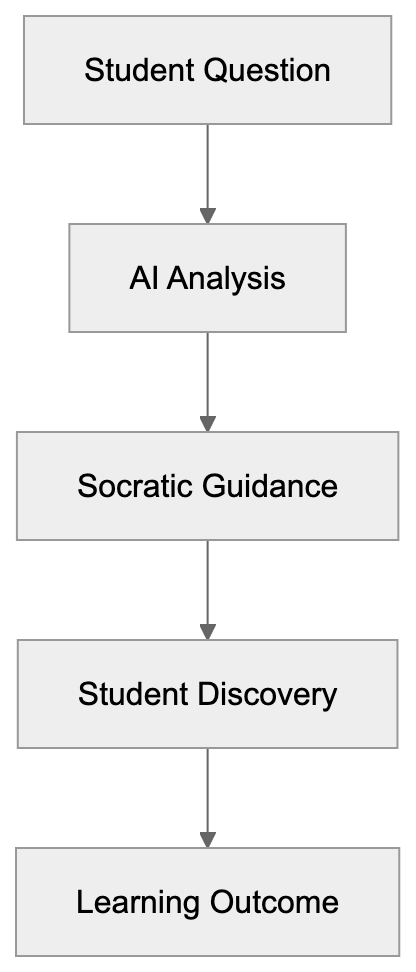
Khanmigo utilizes the Socratic method AI approach, which means it doesn’t just give answers but guides students through questions to help them discover solutions independently. Key features include homework help, writing coaching, test preparation assistance, and teacher tools for lesson planning. For parents and educators concerned about AI in education, rest assured that Khanmigo includes safety features and monitoring capabilities specifically designed for younger users.
Khanmigo’s Educational AI Approach:
What is Khanmigo
Khanmigo is an AI-powered tutoring assistant created by Khan Academy, running on GPT-4, OpenAI’s large language model. At an annual cost of $44 for individual users, it integrates seamlessly within Khan Academy’s existing learning platform. Unlike general chatbots, Khanmigo is designed explicitly for educational purposes. It refuses to simply provide answers to homework problems, instead guiding students with questions that foster independent thought.
This approach mimics how a human tutor would engage a student. The AI supports subjects across math, science, humanities, and other areas covered in K-12 education. Additional features include writing assistance, where students receive feedback on essays and creative writing. Younger students benefit from the engaging option to chat with historical figures or literary characters. The tool integrates directly with Khan Academy’s video lessons and practice exercises. Teachers have access to a dashboard showing what students discussed with the AI, highlighting areas where additional help may be needed.
Why Khanmigo Exists and Its Purpose
The education sector has a persistent issue: not every student receives the individual attention they need to succeed, a challenge addressed by Khan Academy’s AI initiatives. Larger class sizes mean teachers can’t spend hours with each student, and traditional tutoring services are often expensive, costing $40 to $100 per hour. Many families simply cannot afford these private tutors. Seizing an opportunity with the availability of GPT-4 technology in early 2023, Khan Academy aimed to create an affordable, always-available tutor for students.
Khanmigo offers democratized access to personalized education support at an annual cost of just $44, cheaper than a single hour with a human tutor. It also assists teachers, alleviating time spent on lesson planning and creating educational materials. Khanmigo can generate lesson plans, discussion prompts, and even help teachers explain complex concepts innovatively. The broader aim is to test if AI can be safely and effectively integrated into K-12 education, with Khan Academy positioning it as a learning opportunity for the education sector. They share findings of what works and what doesn’t as they further develop the platform.
Khanmigo Core Purpose:

How Users and Organizations Use Khanmigo
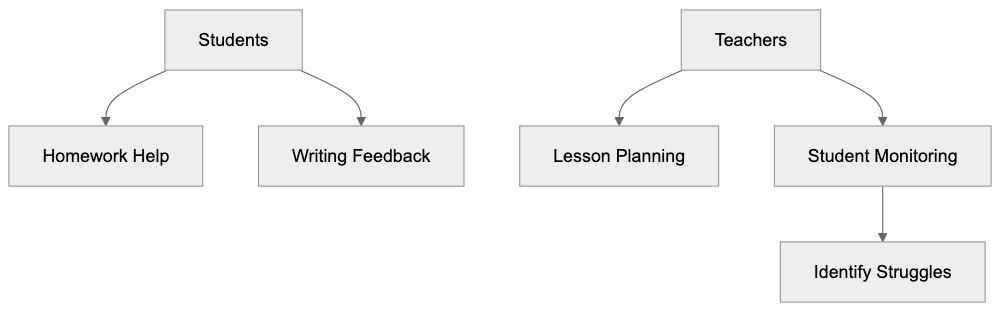
Students use Khanmigo primarily for homework help and test preparation. When faced with challenging math problems, they can ask the AI for guidance, which breaks the problem into smaller steps and poses guiding questions. For writing assignments, students submit drafts and receive feedback on structure, grammar, and argument strength. The AI doesn’t rewrite essays but highlights areas for improvement. The debate feature allows students to practice argumentation skills against the AI.
Teachers utilize Khanmigo for diverse purposes, such as generating lesson plans for specific topics and grade levels. The AI suggests discussion questions, creates rubrics, and even assists in writing progress reports. The teacher monitoring dashboard reveals where students struggle; common queries on a single topic can signal the need to reteach that concept. School districts like Newark Public Schools and Hobart High School in Indiana pilot Khanmigo, providing access as part of the regular curriculum. As of late 2023, over 800 schools and districts were testing Khanmigo, collecting data to refine AI responses. Parents can also monitor their children’s AI interactions to ensure appropriate use.
Safety Features and Educational Approach
Khanmigo incorporates several safety mechanisms not typically found in general AI chatbots. All student conversations are monitored for inappropriate content, with teachers and parents able to review chat histories anytime. Khanmigo refuses direct answers to homework requests, instead employing the Socratic method AI to promote critical thinking. The AI does not engage outside educational topics and flags inappropriate content, sending automatic alerts to teachers.
For younger students, the interface is simplified, and the AI language adjusted for age-appropriateness. Content filters are stringent, tailored to educational settings, and developed with input from child safety experts and educators. The platform complies with student privacy laws, like COPPA and FERPA, ensuring student data isn’t used to train the GPT-4 model according to agreements with OpenAI. These privacy measures address major concerns regarding AI education tools.
Student and Teacher Workflow:
Khanmigo Compared to Alternative AI Education Tools
Several AI tutoring platforms have emerged alongside Khanmigo, each with a distinct approach to AI in education. Here’s how Khanmigo compares to other options available for students and teachers.
| Tool | Base Technology | Cost | Key Features | Target Audience |
|---|---|---|---|---|
| Khanmigo | GPT-4 | $44/year | Socratic method, teacher tools, safety monitoring | K-12 students and teachers |
| Tutor.AI | GPT-3.5/4 | Free tier, $10/month premium | Subject-specific tutoring, instant answers | High school and college |
| Quizlet Q-Chat | GPT-4 | Included in Quizlet Plus ($35.99/year) | Study help based on flashcard sets | High school and college |
| Duolingo Max | GPT-4 | $29.99/month | Language learning with AI explanations | Language learners of all ages |
| Brainly Tutor | Proprietary AI | $24/month | Homework help with step-by-step solutions | Middle and high school |
| Photomath | Proprietary AI | Free basic, $9.99/month premium | Math problem solving via photo | K-12 math students |
Khanmigo distinguishes itself with its strict refusal to provide direct answers—a feature most competitors don’t emulate. Its annual pricing model makes Khanmigo an affordable option for year-round use, though platforms like Photomath offer free tiers. Integrated with Khan Academy’s existing curriculum, Khanmigo is advantageous for students already using the platform. Duolingo Max costs more monthly but focuses exclusively on language learning with specialized features. Quizlet Q-Chat requires a subscription to Quizlet for access to AI tutoring at no additional charge. For teachers, Khanmigo offers more comprehensive tools compared to alternatives, which focus primarily on student-facing features.
Technical Details and Platform Integration
Khanmigo operates as a chatbot interface within the Khan Academy website and mobile app, requiring no separate software or accounts. Using OpenAI’s GPT-4 API, Khan Academy implements custom prompts and filters to align responses with educational best practices. The AI references Khan Academy’s extensive library of over 10,000 videos and 100,000 practice problems, recommending relevant content during interactions.
The platform supports text-based chat and voice input on mobile devices, with response times averaging 2-3 seconds. Teacher dashboards update in real-time, displaying metrics like time spent with the AI and topics discussed. Khan Academy relies on AWS infrastructure to manage computational demands. While capacity issues arose during peak hours at launch, server resources have since increased. Khanmigo is accessible from any device with a web browser or the Khan Academy iOS and Android apps.
Limitations and Ongoing Development
Khanmigo has known limitations openly acknowledged by Khan Academy. The AI can sometimes offer incorrect information, particularly on very advanced topics or recent events due to the GPT-4 model’s knowledge cut-off. Its Socratic method AI approach may frustrate students seeking quick answers, intentionally creating friction for users accustomed to traditional chatbots.
The system occasionally struggles with complex multi-step math problems. Users can report inaccurate responses through a feedback system, reviewed by developers to refine AI prompts. Currently, language support is focused on English, limiting accessibility for non-English speaking students. The $44 annual fee, though cheaper than traditional tutoring, remains a barrier. Khan Academy partners with school districts to provide subsidized or free access in underserved communities and explores grant funding to broaden availability. Future plans include better integration with schools’ learning management systems and enhanced progress tracking.
Data Privacy and Usage Policies
Khan Academy assures that student interactions with Khanmigo are not used to train OpenAI’s base GPT-4 model, due to a specific agreement between the two organizations. However, Khan Academy does analyze conversation data internally to enhance Khanmigo’s educational effectiveness, identifying common misconceptions and refining responses. Parents and students can request conversation deletion through Khan Academy’s privacy settings.
The platform complies with FERPA, governing U.S. educational records, and requires proper consent under COPPA for users under 13. Teachers can view student conversations but cannot share or export data outside the platform. Khan Academy may use anonymized data for research, removing individual identifiers from shared datasets. The organization ensures not to sell student data or use it for advertising, addressing privacy concerns from AI educational tool implementation. Those uncomfortable with data collection can opt out of using Khanmigo, although this limits access to its personalized tutoring.
Conclusion
Khanmigo represents a significant experiment in safely and effectively integrating AI into K-12 education. Built on GPT-4 technology, it offers students an affordable alternative to traditional tutoring at $44 annually. Its emphasis on the Socratic method sets it apart from other AI chatbots by refusing to provide simple answers, instead guiding students through questions to develop problem-solving skills. Teachers benefit from lesson planning tools and monitoring dashboards that identify students needing extra help.
Safety features, including conversation monitoring and content filters, address concerns about AI with younger students. Compared to alternatives like Quizlet Q-Chat and Duolingo Max, Khanmigo provides competitive pricing and robust integration with a complete K-12 curriculum. Limitations include occasional accuracy issues, English-only support, and the learning curve associated with an AI that refrains from giving direct answers. Khan Academy continues to develop the platform, incorporating feedback from hundreds of schools piloting the program. For families and educators seeking supplemental learning support, Khanmigo offers a middle ground between expensive human tutors and unrestricted AI chatbots.
Frequently Asked Questions
What subjects does Khanmigo assist with?
Khanmigo supports a wide range of subjects covered in K-12 education, including math, science, and humanities. It also offers writing assistance and engages users with historical figures and literary characters for a more interactive learning experience.
How does Khanmigo ensure my child's safety while using the platform?
Khanmigo incorporates multiple safety features such as monitoring conversations for inappropriate content and allowing teachers and parents to review chat histories. The platform has strict content filters and is tailored for age-appropriate interactions, ensuring a safe learning environment for younger users.
Can teachers use Khanmigo for lesson planning?
Yes, teachers can utilize Khanmigo to generate lesson plans, discussion prompts, and rubrics. The teacher dashboard provides insights into student interactions, helping educators identify areas where additional support may be needed.
Is Khanmigo suitable for all K-12 students?
Khanmigo is designed explicitly for K-12 students, making it suitable for learners from elementary through high school. However, the AI's effectiveness varies based on individual student needs and learning styles, and it may require some time for users to adapt to its Socratic method approach.
How is Khanmigo priced compared to traditional tutoring?
Khanmigo costs $44 annually, which is significantly cheaper than traditional tutoring services that can range from $40 to $100 per hour. This pricing structure provides families with affordable access to personalized educational support.
What should I do if I encounter inaccuracies in Khanmigo's responses?
If you encounter inaccuracies, users can report the response through a feedback system. This enables developers to review the feedback and refine the AI's prompts to improve accuracy and effectiveness in the future.
Can Khanmigo be used on mobile devices?
Yes, Khanmigo is accessible via the Khan Academy mobile app, allowing users to benefit from AI tutoring on various devices. The platform supports both text-based and voice input, enhancing the user experience on mobile platforms.
Track Your AI Visibility
See how AI chatbots like ChatGPT, Claude, and Perplexity discover and recommend your brand.