Exploring Perplexity: AI Chatbot with Real-Time Search
Discover Perplexity's capabilities including real-time search, inline citations, and Pro features, compared to ChatGPT for research tasks.
Introduction
Perplexity is an AI chatbot that combines conversational abilities with real-time web search. Unlike traditional chatbots, it pulls current information from the internet during your queries. Launched in 2022, it gained traction among professionals and researchers who need verified, current answers. The standout feature is inline citations for every claim, allowing immediate source verification. It offers both free and Pro versions, with the Pro tier providing access to advanced AI models.
What is Perplexity AI
How Perplexity Works:
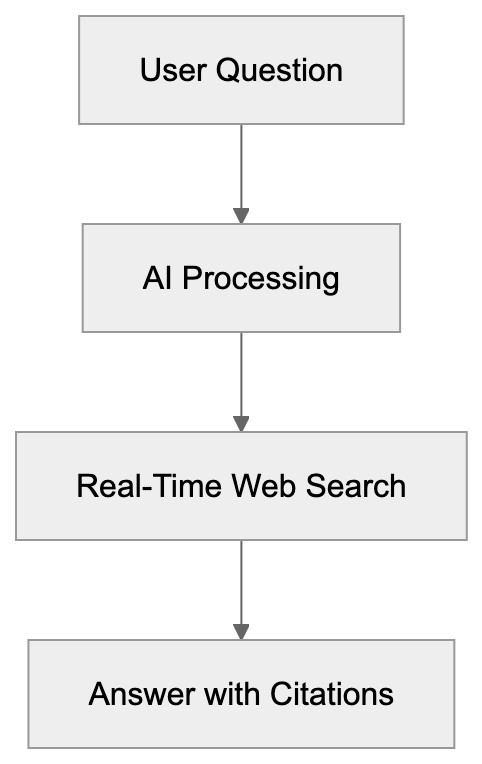
Perplexity AI functions as a conversational search engine, which leverages AI language models combined with live web searches. When you ask a question, it searches the internet in real time, synthesizing the information into a coherent answer. Each statement in the response includes numbered citations linking directly to source websites. This is unlike standard chatbots, which rely on training data from a fixed date. The interface is user-friendly: just type your question and receive a detailed answer with accompanying sources. Follow-up questions are supported, allowing deeper dives into topics without restarting. Perplexity uses multiple AI models, ranging from the default to advanced models like GPT-4 and Claude, depending on your subscription level. Conversations are organized into threads that you can revisit later, making this a practical AI research tool for web developers and SEO experts needing to track research sessions and verify information sources.
Why Perplexity Exists and Its Purpose
Perplexity’s primary purpose is to solve the information freshness problem that plagues many AI chatbots. Traditional language models have outdated training data and can’t handle questions about recent events. Perplexity bridges this gap by conducting real-time searches to formulate answers. It’s indispensable for tasks requiring current information, like market research and news analysis. The citation feature addresses AI hallucination concerns, allowing users to verify response accuracy. Small business owners researching competitors or marketing professionals tracking industry trends benefit from having sources to review. The tool facilitates faster and more reliable research by combining chatbots’ natural language interfaces with the accuracy required for professional work.
How Users and Businesses Use Perplexity
Perplexity vs Traditional Chatbots:
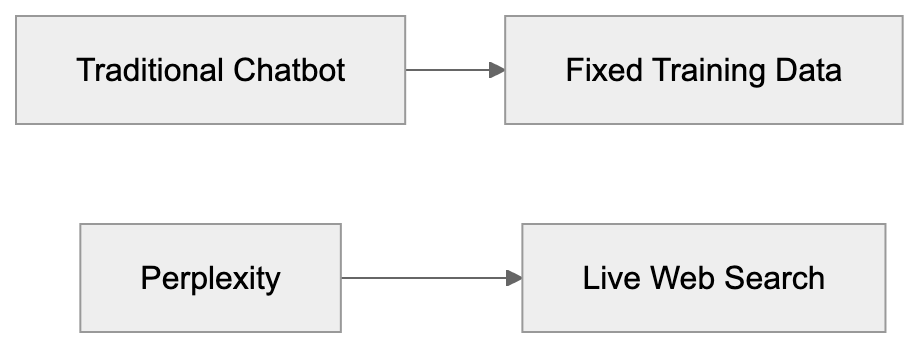
Researchers use Perplexity to gather topic-specific information without sifting through numerous search results, as the AI automatically reads and synthesizes multiple sources, saving time. Content marketers find current statistics and trends readily available for articles, complete with citations. Software developers turn to the platform for updates on APIs, libraries, or troubleshooting solutions not covered by older training data. SEO experts leverage the real-time search feature to explore current ranking factors, algorithm updates, and competitor strategies. Small business owners can research market conditions and pricing strategies efficiently. With the follow-up question feature, users can explore topics in more detail. Perplexity Pro users access advanced models for tackling complex queries and enjoy higher usage limits. The Focus feature narrows searches to specific sources like academic papers or YouTube videos. Companies benefit from competitive intelligence by gathering data on rival products swiftly. The feature to share conversation threads enhances collaboration by letting team members review the same research path and sources.
Perplexity Features and Confirmed Facts
Perplexity operates on a freemium model with free and paid tiers. The free version offers access to basic AI models with limited daily queries. Perplexity Pro costs $20 per month and includes GPT-4, Claude, and other advanced models. The latest Claude versions include Claude 3.5 Sonnet, Claude 4, and Claude Opus 4.5. Pro users enjoy over 300 searches per day compared to the limited access of the free tier. Having raised $73.6 million in funding by early 2024, the platform claims millions of monthly users, although exact numbers may vary. Answers feature inline citations numbered throughout, linking directly to source webpages. The Focus feature allows searches in specific domains like academic databases or social media. The mobile app mirrors desktop functionality, enabling research on the go. Perplexity supports multiple languages, with English yielding the most comprehensive results. Image generation is possible on Pro plans through integration with AI image models. Users can create collections to organize research topics and share them with others. An API is available for developers wanting to integrate Perplexity’s search capabilities into their applications. Response times range from 3 to 10 seconds, depending on query complexity and server load.
Chatbot Comparison: Perplexity vs. Alternatives
Comparing the Perplexity chatbot to other AI assistants reveals several key differences. ChatGPT excels at conversation and content generation but lacks real-time search unless using ChatGPT Plus. Google Bard integrates with Google Search but lacks clear citation features. Bing Chat combines GPT-4 with Bing search, offering citations akin to Perplexity. You.com features AI chat with web search and a unique multi-source interface, while Phind specializes in developer queries with code-focused searches and responses.
| Feature | Perplexity | ChatGPT | Bing Chat | You.com | Phind |
|---|---|---|---|---|---|
| Real-time search | Yes | Limited (Plus only) | Yes | Yes | Yes |
| Inline citations | Yes | No | Yes | Partial | Yes |
| Free tier | Yes | Yes | Yes | Yes | Yes |
| Pro pricing | $20/month | $20/month | Free | $15/month | Free |
| Advanced models | GPT-4, Claude | GPT-4 | GPT-4 | GPT-4 | Custom |
| Mobile app | Yes | Yes | Yes | Yes | Limited |
| API access | Yes | Yes | No | No | No |
| Focus modes | Yes | No | No | Yes | Developer-focused |
For research tasks, Perplexity and Phind excel in prioritizing citation and source transparency. ChatGPT generates creative content but requires fact-checking for current information. Bing Chat integrates well with Microsoft services but limits conversation length. You.com provides a unique side-by-side interface but can feel cluttered. Phind targets developers with code examples and technical documentation searches. Marketing professionals and SEO experts often prefer Perplexity due to its citation feature, simplifying claim sourcing. The right choice depends on whether you prioritize creative writing, factual research, mobile access, or API integration.
Perplexity Pro vs. Free Version
The free version of Perplexity offers a basic AI model and caps daily queries, generally restricting to 5-10 searches in quick succession. Free users access the standard Perplexity model, suitable for general queries. The Pro version, at $20 monthly, removes restrictions and unlocks GPT-4, Claude 3.5 Sonnet, and Claude Opus 4.5 models. Pro subscribers enjoy over 300 searches daily, ample for intensive research, and gain image generation capabilities through AI model integration. File uploading for analyzing documents and images is exclusive to the Pro tier. Pro users access Copilot mode, which asks clarifying questions before searching to enhance answer quality. Developers can utilize Pro API access to build custom applications on Perplexity’s infrastructure. Priority support and faster response times accompany the paid subscription. Casual users asking occasional questions find the free tier sufficient, while content marketers, researchers, and developers performing extensive research benefit from upgrading.
Privacy and Data Usage
Perplexity collects conversation data to enhance its services and train AI models. The privacy policy indicates user queries and exchanges may be used for product development. An opt-out mechanism isn’t clear in the main settings. Conversations are stored in account history and can be deleted manually. Using third-party AI models like GPT-4 and Claude entails data passage under their terms, raising privacy concerns for sensitive research. The platform doesn’t offer an enterprise tier with improved privacy as of now, though this might change. Logged-out users can utilize Perplexity, but their queries are processed and potentially stored. Mobile apps request typical permissions for functionality but avoid excessive device data collection. SEO experts and marketing professionals should be cautious about entering confidential client strategies. There is no end-to-end encryption for conversations; they’re stored on Perplexity’s servers. While no major data breaches have been publicized as of 2024, any cloud service poses risks. For maximum privacy, avoid inputting personal information, trade secrets, or sensitive business data into AI chatbots, including Perplexity.
Feature Comparison Overview:

Practical Tips for Using Perplexity Effectively
Start with specific questions rather than broad topics to receive focused answers with relevant sources. Use the Focus feature to narrow searches to academic papers for scholarly sources or Reddit for community opinions. Verify citations by clicking through to confirm AI interpretations; hallucinations can still occur. Follow up for specific aspects instead of starting new conversations, maintaining context and obtaining more targeted information. Save conversation threads to Collections for organizing research by project or topic. On Pro plans, experiment with different AI models: GPT-4 for complex reasoning, Claude for subtle analysis. Use Copilot mode for ambiguous questions where clarifying details would improve the answer. Rephrase questions if the first answer misses the mark; AI responses vary based on wording. Compare Perplexity results with traditional search engines occasionally to catch potential gaps or biases. For developers, integrate APIs into custom workflows and applications. Set up mobile access for quick research while away from your desk. Remember, real-time search might include unverified information for breaking news, so cross-reference crucial facts before using them professionally. Share features make collaboration easier, enabling team members to review and contribute to research projects.
Summary
Perplexity combines conversational AI with real-time web search and inline citations. It’s particularly useful for research tasks where you need current information and source verification. The free tier works for casual use, while Pro unlocks advanced models and higher limits. Privacy considerations apply as with any AI service: user data is collected and conversations are processed through third-party model providers. Compared to ChatGPT, Perplexity focuses more on factual research with sources rather than creative content generation.
Frequently Asked Questions
What types of questions can I ask Perplexity?
You can ask Perplexity a wide range of questions, from general knowledge to specific queries about market trends, APIs, and more. The bot excels at providing current, sourced information on contemporary topics and research.
Is there a mobile app for Perplexity?
Yes, Perplexity offers a mobile app that mirrors the functionality of the desktop version. It enables users to conduct research on the go, making it easier to access information wherever you are.
How does the citation system work?
Perplexity provides inline citations for every claim made in its responses. Each statement includes numbered citations that link directly to the source websites, allowing you to verify the information easily.
Can I save my research within Perplexity?
Absolutely! Perplexity allows you to save conversation threads to Collections, helping you organize research by specific projects or topics. This feature enhances efficiency for ongoing research tasks.
What's included in the Pro version of Perplexity?
The Pro version, priced at $20 per month, includes access to advanced AI models like GPT-4 and Claude, increased search limits (over 300 searches daily), image generation capabilities, and priority support. These features are ideal for intensive research needs.
How does Perplexity ensure the information is current?
Perplexity sets itself apart by performing real-time web searches every time you ask a question. This approach allows it to provide the most up-to-date information, unlike traditional chatbots relying on static training data.
What precautions should I take regarding privacy when using Perplexity?
While using Perplexity, be cautious about entering sensitive information, as conversations are stored on their servers and can be used for product development. Avoid sharing confidential client data or trade secrets to maintain privacy.
Track Your AI Visibility
See how AI chatbots like ChatGPT, Claude, and Perplexity discover and recommend your brand.