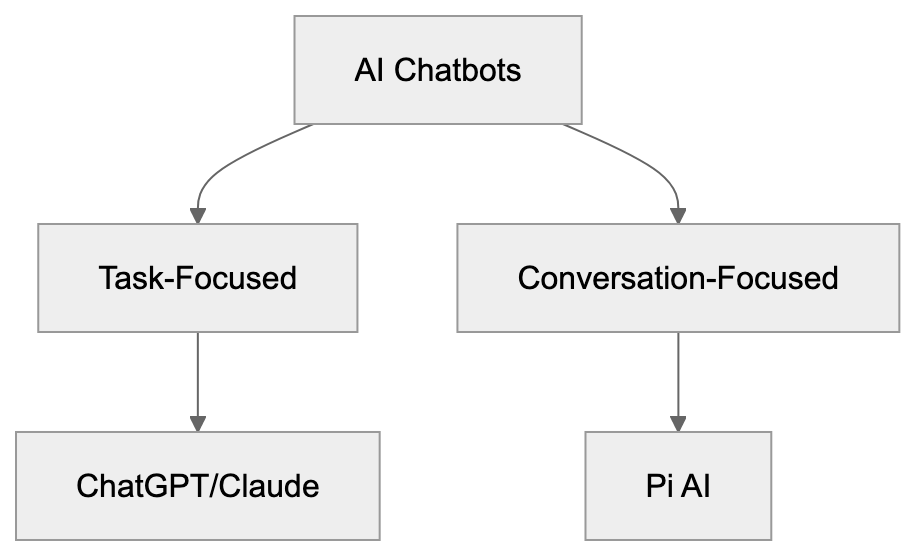
Pi AI: Inflection's Empathetic Personal Chatbot Explained
Learn about Pi AI from Inflection AI. An emotional chatbot focusing on empathy and conversation rather than productivity tasks.
Table of Contents
- What Is Pi AI and Why It Matters
- Understanding Inflection AI and Their Vision
- How Pi AI Works and Main Features
- Who Uses Pi AI and Common Use Cases
- Pi AI vs Other Chatbots: Key Differences
- Privacy and Data Usage Considerations
- Technical Details and Model Information
- Limitations and What Pi Cannot Do
- Getting Started with Pi AI
- The Future of Emotional AI and Pi’s Role
- End: Is Pi AI Right for You
- What Is Pi AI and Why It Matters
- Understanding Inflection AI and Their Vision
- How Pi AI Works and Main Features
- Who Uses Pi AI and Common Use Cases
- Pi AI vs Other Chatbots: Key Differences
- Privacy and Data Usage Considerations
- Technical Details and Model Information
- Limitations and What Pi Cannot Do
- Getting Started with Pi AI
- The Future of Emotional AI and Pi’s Role
- End: Is Pi AI Right for You
What Is Pi AI and Why It Matters
Pi AI is a personal AI chatbot created by Inflection AI. Launched in May 2022, it stands apart from ChatGPT or Claude, which focus on productivity and task completion. Pi places its emphasis on being an empathetic chatbot, designed for conversation and emotional support, acting as an AI companion. This makes it quite different from other tools that assist in writing code or summarizing documents. Pi stands for Personal Intelligence and facilitates interaction through text and voice exchanges, accessible via web browsers and mobile apps.
The main allure of Pi AI is its natural, conversational interface that doesn’t require specific tasks or prompts. Small business owners might use it for brainstorming ideas conversationally, while marketing professionals could discuss campaign concepts. However, Pi AI leans more towards personal rather than business productivity uses. Its voice interaction feature uniquely sets it apart from other text-only chatbots.
Understanding Inflection AI and Their Vision
Pi AI’s Unique Positioning:
Inflection AI was founded in June 2022 by Mustafa Suleyman, Reid Hoffman, and Karén Simonyan. Suleyman co-founded DeepMind, which Google acquired, and Hoffman is recognized as LinkedIn’s co-founder. Inflection AI raised significant funding, reportedly $1.3 billion in June 2023, with a valuation of $4 billion.
Their vision deviates from other AI companies; instead of focusing on enterprise solutions or productivity tools, they created AI that understands emotional context. The goal was to make AI feel more human, less transactional. Their large language model, Inflection-2.5, powers Pi, and was crafted specifically for empathetic responses. In March 2024, Microsoft acquired most of Inflection AI’s team, including Suleyman, to lead a new consumer AI division. This acquisition altered the company’s trajectory, yet Pi continues to operate as a standalone empathetic chatbot.
How Pi AI Works and Main Features
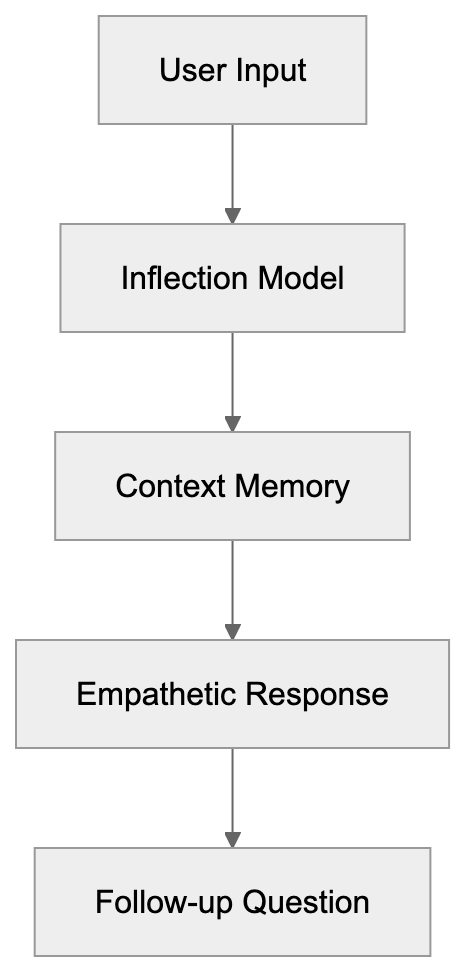
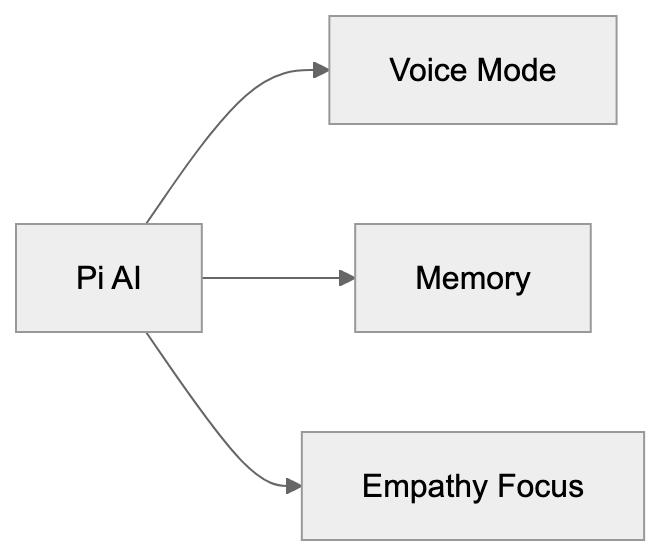
Pi AI functions through simple conversations. No complex prompts or instructions are needed—just start talking as you would with a friend. The Pi chatbot retains memory of previous interactions, providing context continuity across sessions. This memory helps it maintain awareness of your interests and discussions.
Voice mode is a standout feature, offering natural, non-robotic voice interactions with multiple options to suit personal preferences. The web interface is minimalist, with no complicated menus or settings. Pi’s mobile apps are available for iOS and Android devices. It asks follow-up questions to sustain conversation, showing curiosity about your thoughts and feelings. Unlike ChatGPT, Pi delivers shorter, more conversational responses. It won’t write code or create detailed business plans but stays focused on dialogue and emotional engagement.
Who Uses Pi AI and Common Use Cases
Pi targets users seeking conversational AI over task-based tools, serving as a sounding board for ideas without judgment. Some use it akin to a diary to discuss feelings, attracted by its emotional AI capabilities. Students might talk through academic challenges or career decisions, whereas marketing professionals could brainstorm themes in a relaxed manner, switching to ChatGPT or Claude for content creation.
Small business owners might discuss challenges to organize thoughts, while developers don’t typically use Pi for coding since it’s not optimized for that. Pi’s audience is broader than other AI tools, appealing to anyone desiring conversation, not just tech professionals. Its voice interaction capability makes it accessible while multitasking. Some users appreciate having an AI companion that offers empathetic responses without striving for productivity, valuing its personal use cases over professional applications.
How Pi AI Processes Conversations:
Pi AI vs Other Chatbots: Key Differences
Pi AI differs fundamentally from mainstream chatbots. While ChatGPT excels at providing information and task completion, Pi focuses on conversational AI quality. Claude is known for longer context windows and detailed analysis, while Pi prefers keeping exchanges brief and personal.
Here’s a comparative overview:
| Feature | Pi AI | ChatGPT | Claude | Google Gemini | Character AI |
|---|---|---|---|---|---|
| Primary Focus | Conversation & empathy | Productivity & tasks | Analysis & safety | Search & combining | Roleplay & characters |
| Voice Interaction | Strong emphasis | Available in app | Not available | Limited | Not available |
| Coding Ability | Limited | Strong | Strong | Strong | Weak |
| Emotional Tone | Very empathetic | Neutral/helpful | Professional | Informative | Character-dependent |
| Memory | Cross-session | Within chat | Within chat | Limited | Strong |
| Free Access | Yes | Limited free tier | Limited free tier | Yes | Yes |
| Business Use | Low | High | High | High | Low |
ChatGPT and Claude are better suited for work tasks like writing, coding, or research, whereas Pi is preferable for idea discussions or emotional support. Character AI shares Pi’s focus on conversation but involves fictional characters. Google Gemini integrates with Google services, unlike the standalone Pi, which focuses on being an AI companion.
Privacy and Data Usage Considerations
Pi AI Feature Comparison Overview:
Pi AI, like most AI services, collects conversation data, aiding continuous improvement of its AI model. Data is collected even without an account, though creating one enables Pi to remember your conversations across devices, requiring some personal information, like email.
Voice exchanges are also processed and stored, enhancing speech recognition and synthesis systems. Inflection AI claims not to sell personal data to third parties but uses it internally for model advancement. Currently, there’s no opt-out from data collection, so privacy concerns are valid. The Microsoft acquisition in 2024 raised questions about data handling, potentially affecting long-term policies.
For sensitive conversations, remember nothing is entirely private, as the company can access conversation logs. Marketing professionals and developers should practice caution when discussing confidential strategies or code snippets. Given Pi’s personal and emotional nature, privacy is crucial, particularly as users might share more personal details than with task-focused chatbots.
Technical Details and Model Information
Pi operates on Inflection AI’s exclusive model, Inflection-2.5, launched in March 2024, designed for conversational ability and emotional AI intelligence. Comparable with GPT-4 on certain benchmarks, it reportedly utilized thousands of GPUs for its training process.
The model prioritizes shorter, natural interactions over long-form generation, with proprietary voice synthesis technology that offers natural-sounding speech. Response times match those of ChatGPT, with strong context handling but relatively weaker factual accuracy compared to Claude or GPT-4. For technical users, API access is limited relative to OpenAI or Anthropic, with minimal emphasis on developer tools or business integration.
Limitations and What Pi Cannot Do
Pi AI has evident limitations compared to productivity-focused chatbots. It doesn’t write long articles, generate code, or integrate with tools and services for web searches or real-time information access. It’s unsuitable for analyzing documents or images and falls short on mathematical calculations, limiting current event discussions.
Pi won’t replace productivity software or specialized AI tools, nor is it designed for SEO analysis or business strategy. Developers and web developers won’t find it useful for programming or debugging tasks. Its emotional focus sometimes leads to indirect answers, which can frustrate users seeking specific facts.
The voice feature requires a stable internet connection, and some users report Pi being overly agreeable, lacking challenge to assumptions.
Getting Started with Pi AI
Initiating with Pi is straightforward. Visit the Pi AI website at pi.ai in your browser to start chatting, with no account creation required. For mobile interaction, download the Pi app from the iOS App Store or Google Play for access to the same features as the web version.
Creating an account is optional but recommended for conversation memory, requiring just an email and password. Upon logging in, conversations sync across devices. Access previous chats from the interface to continue discussions. Click the voice icon to use voice mode, allowing microphone permissions as prompted.
There are no subscription tiers or fees, with all features free to use. Start with simple inquiries or greet Pi to initiate a conversation. Unlike ChatGPT, Pi accommodates casual talk well, engaging with follow-up questions. Discuss personal hobbies, seek advice on decisions, or dive into casual chat, enhancing the experience with confident emotional engagement.
The Future of Emotional AI and Pi’s Role
Emotional AI like Pi AI represents a growing niche in artificial intelligence. More companies see the value in AI that recognizes and responds to human emotions, diverging from task-focused tools. Pi emerged as a pioneer among mainstream empathetic chatbot models, highlighting user demand for diverse AI interaction.
Its success indicates an expanding market for conversational AI, exemplified by Character AI’s growth, prioritizing dialogue over tasks. Mental health applications are potential future directions for such AI companions, though ethical concerns persist around potential AI replacement of human connection. The Microsoft acquisition of Inflection AI’s team brings uncertainty about Pi’s future development—whether it remains independent or integrates into Microsoft.
Pi’s technology might influence other companies’ chatbot designs, increasing emotional intelligence focus across AI tools. Businesses could see improvements in customer service through chatbots that recognize frustration or confusion. Marketing professionals could test message resonance using emotional AI, although striking a balance between empathy and effectiveness remains challenging.
End: Is Pi AI Right for You
Pi AI carves out its own niche in the AI landscape, not attempting to replicate ChatGPT’s productivity features. Its focus on empathy and conversation makes it a distinct AI companion.
Pi offers emotional support and brainstorming, with smooth voice interaction. However, for professionals needing work output, Pi holds less utility than ChatGPT or Claude. Developers, SEO specialists, and content marketers require different tools for coding or content generation needs.
Privacy considerations remain paramount, given the personal nature of conversations, with collected data used for model training. Despite uncertainty following Microsoft’s acquisition, Pi operates as a free conversational AI. For those interested in emotional AI or an empathetic chatbot companion, Pi merits exploration. There’s no cost to trying it—just visit the website and commence chatting while knowing it doesn’t support productivity tasks typically expected from other AI tools.
Frequently Asked Questions
What makes Pi AI different from traditional chatbots?
Pi AI distinguishes itself by focusing on empathetic and conversational interactions, rather than productivity or task completion. This design fosters a more personal and supportive experience, making it suitable for discussions about feelings and ideas.
Can I use Pi AI for professional purposes?
While Pi AI can be used for brainstorming and casual conversations relevant to professional contexts, it is primarily tailored for personal use. Professionals seeking complex outputs like code generation or detailed analysis should consider more productivity-focused AI tools.
Is my data safe with Pi AI?
Pi AI collects conversation data to improve its AI, and while they claim not to sell personal information, it is advisable to exercise caution. Sensitive discussions should be approached with care since the data may be processed and stored.
How do I get started with Pi AI?
Starting with Pi AI is straightforward; visit pi.ai in any browser or download the mobile app from the iOS App Store or Google Play. You don't need to create an account to begin, but doing so allows the retention of conversation history across devices.
What types of users benefit from Pi AI?
Pi AI appeals to a wide range of users, including students needing emotional support, small business owners seeking conversational creativity, and individuals looking for a non-judgmental space to discuss personal thoughts. Its inclusive design makes it a viable option for anyone wanting a dialogue-focused AI companion.
Does Pi AI have voice interaction features?
Yes, Pi AI includes a voice interaction feature that allows users to engage in natural conversations using spoken language. This feature contributes to the chatbot’s empathetic and conversational approach, enhancing the overall user experience.
What future developments can we expect for Pi AI?
As the demand for emotional AI grows, Pi AI may evolve to incorporate more features enhancing its empathetic capabilities. Potential developments could involve its integration into more consumer products or additional functionalities that support conversations around mental health and emotional well-being.