Guide to Poe: Quora's Multi-Model AI Chat Platform
Explore Poe by Quora. Discover its multi-model chat capabilities including ChatGPT, Claude, Llama, and custom bots, pricing, and comparison insights.
Introduction
Poe is an AI chat platform owned and operated by Quora, designed to provide seamless access to multiple AI models under one roof. With Poe, users can interact with various AI models, including ChatGPT, Claude, Llama, and others, without the need to juggle between different websites or apps. Poe also empowers users to create custom chatbots using existing AI models as a foundation. Launched in February 2023, Poe quickly attracted millions of users seeking streamlined ChatGPT access and the ability to compare outputs across different AI systems, such as Claude AI and more. Whether small business owners, developers, or content marketers, Poe’s primary draw is its ability to amalgamate multiple AI models under a single login, eliminating the complexities of managing separate accounts.
What is Poe and How Does It Work?
Poe AI does not stand for any specific acronym, but its core functionality is the aggregation of multiple AI language models into a unified interface. Upon opening Quora Poe, users are presented with a list of available AI models for selection. Notably, the platform provides access to OpenAI models, including GPT-4 and GPT-3.5, Anthropic’s Claude models, Meta’s Llama 3.1 and Llama 3.2, and Google’s Gemini models.
Poe Platform Architecture:
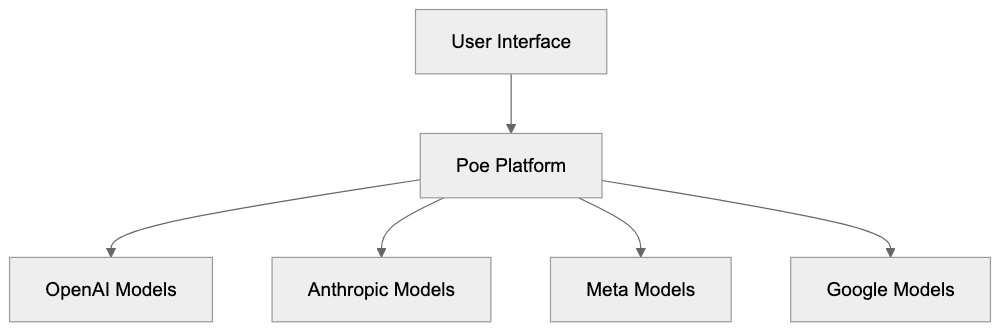
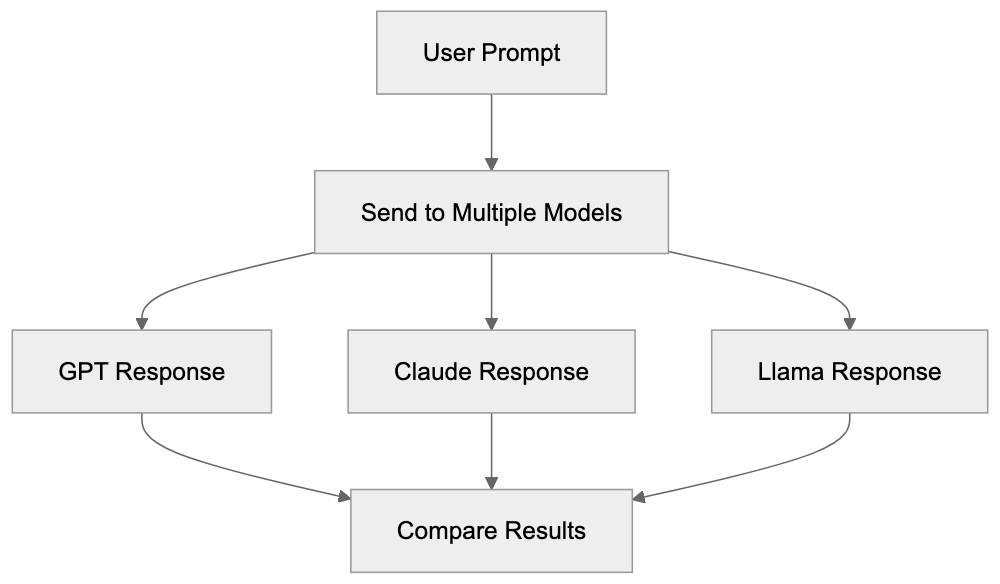
The user experience mimics typical chat applications. Users input prompts and receive responses from chosen AI models. Conversations can extend through follow-up questions, with each thread saved for later reference. One of Poe’s standout features is the ability to run identical prompts across various models, facilitating side-by-side AI model comparison—a valuable tool for developers and content creators.
Poe further enhances user creativity by offering a bot creation platform. Users can design custom AI bots by infusing existing models with unique instructions or prompts, and these bots can be shared within the Poe community. Popular entities in the bot marketplace include those for tasks like code review, creative writing, and data analysis.
Why Poe Exists and Its Purpose
Poe was born to address the issue of fragmented AI model access, which required users to navigate different platforms, each with separate accounts, billing, and interfaces. For instance, using ChatGPT required a visit to OpenAI, while attempting to harness Claude AI necessitated a separate journey to Anthropic.
Poe resolves this fragmentation by centralizing multiple AI systems access through one account. A single subscription can unlock premium features across various models. Quora identified an opportunity in becoming the intermediary between users and AI model providers, leveraging its experience with running a question-and-answer platform into AI chat functionalities.
The platform caters to several needs:
- It simplifies the trial of different AI models for casual users.
- It facilitates AI model performance comparisons for developers and researchers.
- It fosters a marketplace for custom AI chatbots through its bot creation feature.
- It generates revenue for Quora through Poe pricing subscriptions while remunerating AI providers for API access.
Poe Bot Creation Process:

Strategically, Poe positions Quora within the AI services market, adding value via aggregation and user-friendly design, ensuring the company remains relevant as AI chat platforms evolve.
How Users and Businesses Use Poe
Software developers utilize Poe to examine code generation capabilities across diverse models. By posing identical coding questions to GPT-4, Claude, and Llama, they determine which model delivers superior results, guiding their API integration choices.
Content marketers leverage the platform to produce various marketing copy versions, contrasting Claude’s formal tone responses with ChatGPT’s casual tone alternatives. This comparative approach aids in selecting optimal outputs or blending elements from distinct responses. Some marketers employ custom bots for tasks like crafting SEO meta descriptions or social media posts.
For small business owners, Poe serves as a research tool for customer service automation. They evaluate how different models tackle typical customer inquiries, assessing response quality before choosing a specific AI provider. The free tier allows for experimentation without financial risks.
Web developers engage Poe to generate HTML, CSS, and JavaScript snippets and compare output quality among models, sometimes crafting custom bots focused on specific coding standards or framework preferences.
SEO experts turn to Poe AI for keyword variation research and content ideation, feeding seed topics into the platform to observe how different models expand the ideas. Multi-model chat access provides diverse perspectives, enhancing content strategy development.
Poe Pricing Model and Features
Poe offers both free and paid tiers to accommodate different user needs. The free tier allows limited access to AI models, permitting a certain number of daily messages to premium models like GPT-4 and Claude 3.5 Sonnet. Basic models, such as GPT-3.5 and Claude Instant, often provide higher or unlimited message allowances on the free tier.
For those requiring more robust access, the Poe Subscription is available at $19.99 per month or $199 per year, with regional pricing variations. Subscribers enjoy significantly expanded message limits, priority access during peak times, and exclusive premium model availability.
Key features include:
- Access to multiple model versions like GPT-4, GPT-4o mini, Claude 3.5 Sonnet, Claude 3 Haiku, and Llama 2.
- Bot creation functionalities for all users, with enhanced capabilities for subscribers, enabling custom bots to utilize premium models.
- Synchronization of conversation history across devices, along with search features to revisit past dialogues and organize them into folders or categories.
- Support for file uploads for compatible models capable of processing images or documents, contingent on model capabilities.
- API access for bot creators seeking to integrate their Poe bots into external applications, broadening development opportunities on the Poe platform.
Comparing Poe to Alternative Platforms
In the landscape of AI chat platforms, several alternatives vie for attention. Here’s a comparison:
| Platform | Models Available | Free Tier | Paid Tier Price | Bot Creation | Key Difference |
|---|---|---|---|---|---|
| Poe | GPT-4o, Claude 3.5 Sonnet, Llama 3.1, Gemini | Limited messages | $19.99/month | Yes | Multi-model aggregation focus |
| ChatGPT Plus | GPT-4o, GPT-4o mini, o1 | GPT-4o mini unlimited | $20/month | GPTs | OpenAI models only |
| Claude Pro | Claude 3.5 Sonnet, Claude 3.5 Haiku, Opus 4 | 5x free tier | $20/month | Projects | Anthropic models only |
| Hugging Chat | Open-source models | Unlimited | Free | No | Open source focus |
| Perplexity Pro | Sonar Large, Llama 3.1 405B, Claude 3.5 Sonnet | Limited | $20/month | No | Search-focused answers |
ChatGPT Plus focuses deep within OpenAI’s ecosystem but limits model diversity, driving the need for separate subscriptions for other models such as Claude AI or Llama. Poe bridges this gap by bundling offerings from multiple providers.
While Claude Pro emphasizes Anthropic’s robust AI models, its single-provider scope limits broader comparison capabilities. Meanwhile, Hugging Chat champions open-source models, which, while free, often lack the sophistication of proprietary systems.
Multi-Model Comparison Workflow:
Perplexity Pro integrates search and AI answers, but its focus diverges towards source citation rather than direct chat utility. In contrast, Poe prioritizes direct interactions and content generation.
Poe’s primary advantage is its consolidation of multiple premium models into one subscription, augmented by a bot creation feature allowing customization—an attribute less prevalent among competitors. However, its role as a middleman adds an additional layer between users and direct AI provider interactions, making alternatives like ChatGPT Plus or Claude Pro potentially more integrative with specific ecosystems.
For users routinely utilizing multiple AI models, Poe’s convenience may outweigh the need for individual subscriptions.
Data Privacy and Usage Policies
User conversations on Poe are routed through Quora’s systems en route to AI model providers. Consequently, Quora potentially has access to chat content. Per its privacy policy, Quora collects usage data to enhance service quality.
Prompt entries and AI responses may be logged by both Quora and the AI providers. These entities hold distinct terms of service regarding data handling.
Poe’s functionality allows users to erase conversation histories from their accounts, though this action does not guarantee elimination from provider logs or backend systems. For sensitive data handling, users should recognize that multiple entities might access their information.
Though some AI providers utilize conversation data for model training, Poe settings may contain options to circumscribe this—availability varies. It is advisable to review privacy settings after account creation for data-sharing or AI training opt-out preferences.
Users considering Poe for business applications involving confidential information must evaluate if the platform’s aggregation model aligns with their security criteria. Direct API access to AI providers often offers more stringent data protection agreements.
Poe adheres to standard terms of service, stipulating a minimum user age of 13 in most areas. The platform prohibits content that is illegal, harassing, or attempts to manipulate AI models toward producing harmful outputs, with violations potentially resulting in account suspension.
Technical Considerations for Developers
Developers contemplating Poe must grasp its technical framework as an API aggregator. Poe manages connections to an array of AI providers, directing user requests to relevant backends. Response times are generally akin to direct API utilization but may be marginally increased due to this extra routing.
For applications prioritizing minimal latency, direct API access could outperform Poe. Nonetheless, Poe offers a creator API facilitating bot creation for custom functionality integration with Poe’s platform, enabling developers to deploy personalized logic, database queries, or additional API requests before or after AI model engagements.
Rate limits are active at several levels, encompassing message frequency constraints. During peak periods, even paid subscribers may experience delays with premium models.
Poe permits markdown formatting in responses, which includes code blocks, tables, and basic formatting. This capability renders it valuable for technical documentation and coding support.
Mobile applications are available for iOS and Android, maintaining parity with web features, enhancing AI interaction accessibility on the move.
Bot creation API documentation is accessible via Poe’s developer portal, featuring Python examples and other languages. Community forums supply further support for bot developers.
Use Cases and Practical Applications
Marketing professionals turn to Poe for generating campaign ideas through multiple AI lenses. For instance, GPT-4 might offer a data-driven technique, whereas Claude provides creative narrative insights. Blending insights from various models can yield comprehensive strategies.
Educators and students employ the platform to grasp diverse AI reasoning methodologies. By posing identical questions to multiple models, students observe divergent information processing, building AI literacy and critical evaluation of automated answers.
Writers exploit Poe for brainstorming and tackling creative blocks. Different models exhibit unique writing styles; Claude may deliver nuanced narrative elements, while GPT-4 might excel in structured outlines, corresponding to writers’ immediate objectives.
Data analysts leverage the platform to generate SQL queries and data visualization codes, assessing which models furnish effective queries or superior chart layouts. Some create custom bots adhering to specific database schemas.
Customer support teams trial-chat responses before comprehensive automation implementation. Testing multiple models for edge cases and difficult customer interactions expeditiously occurs on a single platform.
Translation and localization experts rely on multiple models for translation accuracy checks, as different AI systems interpret idioms or cultural contexts uniquely. Comparing outputs aids in detecting potential issues before finalizing translations.
SEO experts employ the platform to generate meta descriptions, title tags, and content outlines, experimenting to discover which model produces optimal keyword combinations while ensuring natural language flow. Custom bots can be tailored to adhere to specific SEO guidelines and character limits.
Limitations and Considerations
Poe’s reliance on upstream AI providers means that service disruptions (e.g., OpenAI outages) affect model availability on Poe too. The platform’s intermediary position introduces potential points of failure.
Model availability may fluctuate based on partnerships and provider updates. A currently relied-upon model might become unavailable in the future, making it crucial to confirm model lists prior to adapting workflows.
Customization options remain limited compared to direct API access, as temperature, token limits, and other technical parameters are not exposed through Poe. This restricts it to general purposes rather than fine-tuned applications.
High-volume use cases face cost-effectiveness scrutiny, as the monthly subscription may falter for heavy users at risk of exceeding message limits, incurring throttling. Direct API access with pay-per-token pricing could present a more economical alternative.
Poe does not feature all the advanced functionalities of its underlying models, such as function calling, embeddings, or fine-tuning. Developers necessitating these features should consider direct provider API access.
The quality of available bots varies significantly. The bot marketplace hosts user-created options with minimal quality control, prompting necessary testing before community bots can be relied upon.
Internet accessibility and real-time data capabilities differ by model. While some models access current web data, others are limited by training cutoff dates. Poe may not clearly indicate which models possess internet access.
End
Poe by Quora provides convenient multi-model AI access through a single platform, appealing to users who desire streamlined comparison capabilities without the complexities of managing individual subscriptions or interfaces. Software developers, content marketers, small business proprietors, and AI enthusiasts benefit from Poe’s comparative angle. The platform features models like GPT-4, Claude 3, Llama 2, among others, with premium access priced around $20 monthly alongside a free tier. The bot creation facet enriches customization options beyond ordinary chat interfaces.
Relative to alternatives like ChatGPT Plus or Claude Pro, Poe offers broader access but less intimate integration with specific providers. Given that data passes through Quora’s infrastructure, potential privacy considerations arise. Particularly suitable for experimentation, comparison, and moderate utilization, Poe serves as an effective AI aggregating platform. High-volume patrons or those necessitating advanced API capabilities must weigh direct provider options.
Frequently Asked Questions
What AI models can I access on Poe?
Poe provides access to several AI models, including OpenAI's GPT-4 and GPT-3.5, Anthropic's Claude models, Meta's Llama, and Google's Gemini models. This diversity allows users to explore various strengths and capabilities of different AI technologies within a single platform.
How does Poe's pricing structure work?
Poe offers both a free tier with limited access and a paid subscription at $19.99 per month or $199 annually. The paid tier significantly increases message limits, provides priority access during peak times, and ensures access to premium models like GPT-4.
Can I create custom chatbots on Poe?
Yes, Poe allows users to create custom chatbots using its bot creation platform. Users can build bots based on existing AI models, customize their instructions, and share them within the Poe community.
What are some practical applications of Poe for businesses?
Businesses can utilize Poe for various tasks, such as automating customer service queries, generating marketing content, and comparing AI performance for code generation. It serves as a cost-effective testing ground that allows firms to experiment with different models without significant financial commitment.
How does Poe handle user data and privacy?
Poe conversations are routed through Quora, which means user data may be accessed and collected by Quora and the AI providers. Users have the option to delete their conversation history, but this may not guarantee complete data removal from provider logs. It's advisable to review privacy settings after account creation.
What should I consider regarding limitations of Poe?
Users should be aware that Poe's reliance on various AI providers means service disruptions can affect availability. Additionally, customization options and advanced functionalities may be limited compared to direct API access, which could be a factor for developers needing higher control.
What makes Poe different from other AI platforms?
Poe distinguishes itself by aggregating multiple AI models into one unified platform, eliminating the need for separate accounts or subscriptions. This multi-model access facilitates easy comparison and experimentation, offering users a more versatile tool than many single-provider platforms.
Track Your AI Visibility
See how AI chatbots like ChatGPT, Claude, and Perplexity discover and recommend your brand.