Mastering Salesforce Einstein: AI Innovations for CRM Success
Explore Salesforce Einstein's AI-driven tools for CRM automation, featuring Einstein GPT, Bots, and AI-powered solutions for sales and service.
Introduction to Salesforce Einstein
Salesforce Einstein is the CRM AI layer that seamlessly integrates machine learning, natural language processing, and predictive analytics into Salesforce workflows. This integration means sales teams can forecast deals with greater accuracy, customer service representatives can resolve tickets more swiftly, and marketers can craft personalized campaigns effortlessly using Salesforce AI.
CRM systems generate vast amounts of data daily. Often, this data remains dormant without CRM automation through AI, like Salesforce’s, which transforms raw data into actionable insights. By automating repetitive tasks, predicting customer behavior, and facilitating smarter decisions, Einstein allows businesses to focus more on activities that drive revenue.
Understanding Salesforce Einstein
Salesforce Einstein Architecture:
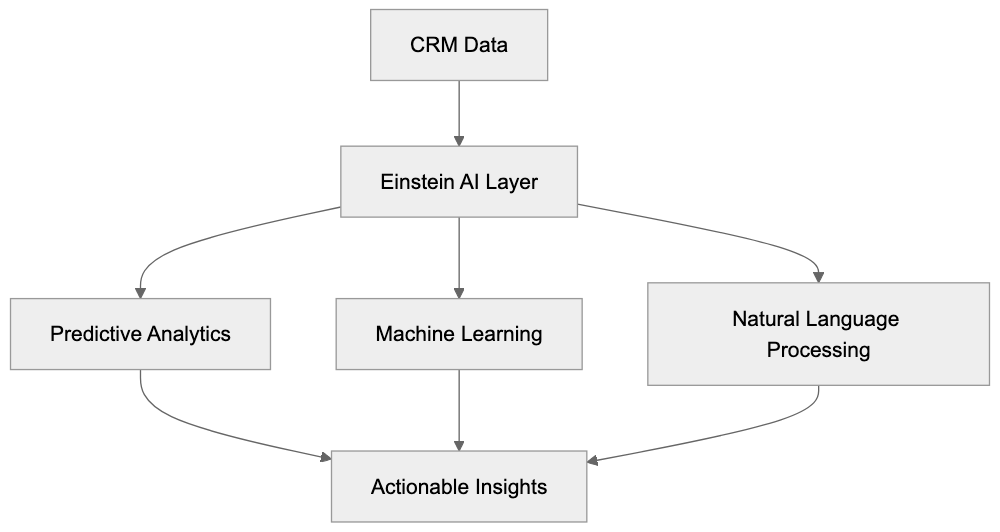
Salesforce Einstein is not a standalone product but a collection of AI features embedded across the Salesforce ecosystem. Functioning as the intelligence layer atop CRM data, it harnesses historical data to make insightful predictions. For instance, it can score leads based on conversion likelihood, recommend actions for sales reps, and generate email responses for customer service teams—all within the familiar Salesforce interface.
Einstein AI spans Sales Cloud, Service Cloud, Marketing Cloud, and other Salesforce products, each tailored for specific purposes. Sales teams receive forecasting and opportunity ideas, service teams benefit from Einstein Bots and case classification, while marketers enjoy enhanced audience segmentation. As the AI learns from specific data, prediction accuracy improves over time.
Einstein GPT and Generative AI Features
Introduced in 2023, Einstein GPT represents Salesforce’s response to the surge in generative AI. By merging Salesforce’s proprietary AI models with large language models from partners like OpenAI, users can produce content directly within CRM workflows.
A primary use case is auto-generating emails, where sales reps can have Einstein GPT draft personalized messages based on a customer’s history and current deal stage. Customer service agents are offered response suggestions drawn from knowledge base articles and past resolutions.
Einstein Bot Conversation Flow:

Additionally, Einstein GPT facilitates code generation for Salesforce developers. Users can describe needs in plain language, and Apex code or flow automation is generated, expediting customization processes significantly. Features are accessible via Einstein 1 Studio, where admins design custom AI experiences sans extensive coding.
Worth noting is the combination of external LLM providers for some features, which entails sending data outside Salesforce’s infrastructure. Reviewing data governance policies before activation is pivotal.
Einstein Bots for Automated Customer Service
Einstein Bots operate as conversational AI agents managing customer service dialogues across websites, mobile apps, and messaging platforms like WhatsApp and SMS. They can answer frequent questions, direct customers to the appropriate department, or handle transactions like password resets or order tracking.
These bots, set up using a visual bot builder within Salesforce, require no coding skills for basic conversational flow creation. By leveraging Einstein’s natural language processing, they interpret customer intents and provide responses from a knowledge base or execute actions. Failing this, they seamlessly pass the conversation to a human agent while retaining full context.
Integrated directly with Service Cloud cases, Einstein Bots reduce ticket volume for simplistic inquiries. Whether handling banking balance checks or e-commerce order statuses, these bots operate 24/7, handling multiple conversations simultaneously beyond human capability.
Sales Cloud AI Features
Sales Cloud Einstein aids sales teams in closing deals via lead scoring, opportunity ideas, and forecasting.
- Lead Scoring: Assigns numerical scores to leads based on conversion probability, identifying patterns from historical data like industry fields or email engagement.
- Opportunity Ideas: Offers real-time recommendations for ongoing deals, suggesting actions or discounts for stalled deals and highlighting at-risk deals.
- Einstein Forecasting: Utilizes historical and pipeline data to predict future revenue, factoring in seasonality and performance.
Sales Cloud Einstein Features:

- Einstein Activity Record: Automates email and calendar event logging, maintaining CRM accuracy while analyzing email sentiment for engagement insights.
Service Cloud AI Capabilities
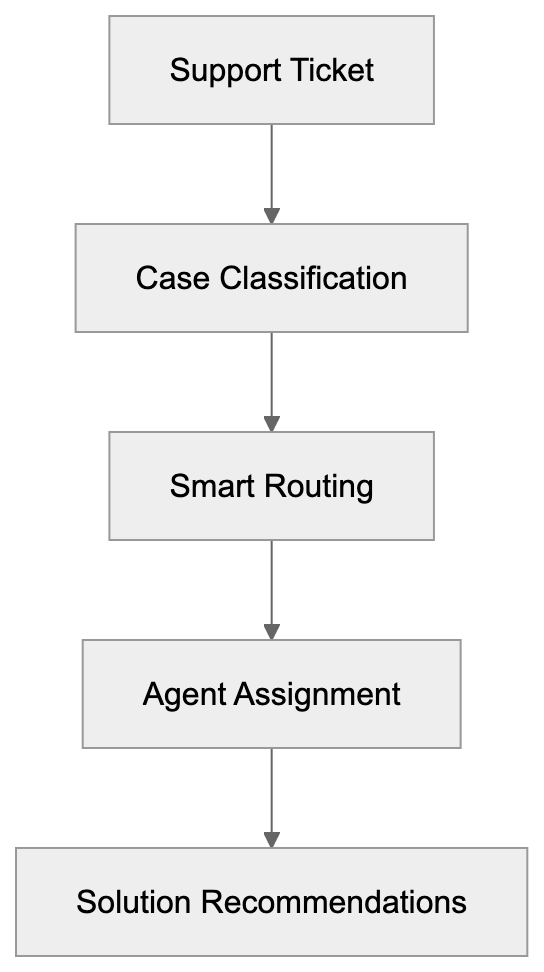
Service Cloud Einstein enhances support team efficiency and customer satisfaction through case classification, case routing, and recommended solutions.
- Case Classification: Automatically categorizes support tickets, aligning them to the appropriate team instantly.
- Case Routing: Assigns cases to the most qualified agents based on expertise and workload.
- Recommended Solutions: Suggests relevant knowledge base articles for agents, ensuring consistency and swift resolution.
- Field Service Improvement: Optimizes technician scheduling and routing, factoring skills, location, and logistical elements.
Marketing Cloud AI Tools
Service Cloud AI Workflow:
Marketing Cloud Einstein introduces AI into email marketing, advertising, and customer journeys, emphasizing personalization and optimization.
- Send Time Improvement: Predicts the optimal email open times for each subscriber.
- Engagement Scoring: Identifies highly engaged subscribers for prioritized marketing.
- Content Selection: Personalizes emails by selecting the best content variation for each recipient.
- Ad Budget Recommendation: Analyzes campaign performance to suggest budget reallocations.
- Einstein Copilot: Aids in generating campaign briefs and audience descriptions via generative AI.
Pricing and Licensing Structure
Salesforce Einstein pricing is feature-based, depending on user numbers and requirements. Basic Einstein capabilities often accompany Sales Cloud and Service Cloud subscriptions. Advanced features necessitate additional licensing, such as Einstein GPT, and are priced per user per month.
- Einstein GPT: Available as added licenses.
- Einstein Bots: Require conversational credits for scale beyond basic inclusion in Service Cloud Enterprise.
Consultation with Salesforce sales is advised to obtain precise pricing, which is contingent on existing licenses, user count, and desired features.
Comparison with Alternative CRM AI Solutions
Salesforce Einstein competes with several CRM AI platforms, each offering unique advantages.
- HubSpot AI: Excels in marketing automation with integrated features beginning at $800/month.
- Microsoft 365 AI: Known for customer insights, starting at $65/user/month.
- Zoho Zia: Budget-friendly AI solutions within Zoho CRM Enterprise tier at $40/user/month.
- Pipedrive AI Sales Assistant: Simple sales AI at $34/user/month for Pipedrive Advanced and higher users.
Salesforce Einstein’s strengths lie in depth and customization, offering more predictive models and collaborative points than competitors yet at an increased complexity and cost.
Data Privacy and Training Considerations
Salesforce Einstein trains on your CRM data, ensuring predictions are tailored to your business context. However, Einstein GPT’s generative AI features may involve third-party LLM providers, raising privacy concerns.
Salesforce’s Einstein Trust Layer ensures sensitive information is shielded. Admins have controls to limit Einstein’s data access, disable conflicting features, and configure preferences according to data governance requirements.
For instance, conversation data from Einstein Bots is stored within Salesforce unless external platforms are integrated, necessitating awareness of additional data retention policies.
Implementation and Getting Started
Activating Einstein features involves structured setup:
- Data Cleanup: Ensure CRM data quality through rigorous cleanup.
- Feature Selection: Prioritize high-impact features for activation.
- Einstein GPT Enabling: Involve Salesforce for setup, adhering to added terms of service.
- Einstein Bots Construction: Utilize the visual builder for conversational flows.
- Training: Equip teams with knowledge on Einstein predictions and implications.
Many organizations partner with Salesforce consultants for initial setups. Post-launch, performance monitoring through Einstein analytics aids in refining feature activation and adjustments.
Conclusion
Salesforce Einstein serves as a comprehensive AI layer for CRM automation and intelligence, spanning sales forecasting, service automation, and marketing personalization. For Salesforce users, Einstein complements existing setups through data-driven decision-making, albeit at a higher complexity and cost compared to alternatives. Einstein GPT positions Salesforce competitively within the generative AI landscape, necessitating careful consideration of data privacy when adopting these capabilities.
Frequently Asked Questions
What types of businesses benefit most from using Salesforce Einstein?
Salesforce Einstein is beneficial for businesses that rely heavily on data-driven processes, such as sales, marketing, and customer service. Companies looking to improve lead scoring, personalize customer experiences, or automate routine tasks will find significant value in its features.
How does Salesforce Einstein ensure data privacy?
Salesforce implements a robust Trust Layer to protect sensitive information when using Einstein. Admins have the ability to control data access for Einstein features, helping to ensure compliance with data governance policies and limiting exposure to external third parties.
Can I customize the AI features to suit my company's specific needs?
Yes, Salesforce Einstein is designed to be customizable. Users can utilize the Einstein 1 Studio to create tailored AI experiences without needing extensive coding skills, allowing for adaptations that fit unique business processes.
What are some typical use cases for Einstein Bots in customer service?
Einstein Bots can handle various customer interactions, such as answering FAQs, directing inquiries to the appropriate departments, and managing simple transactions like password resets or order status checks. This helps reduce ticket volume for support teams by addressing common issues autonomously.
How does the pricing structure work for Salesforce Einstein?
The pricing for Salesforce Einstein is dependent on the features utilized and the number of users. Basic functionalities are often included with Sales and Service Cloud subscriptions, while advanced features, including Einstein GPT, require additional licensing.
What steps should I take before implementing Salesforce Einstein?
Before implementing Salesforce Einstein, it’s essential to conduct a thorough data cleanup to ensure data quality. Additionally, prioritize the key features you wish to activate, and consider seeking assistance from Salesforce consultants for the initial setup to maximize your implementation's effectiveness.
Is Salesforce Einstein suitable for small businesses?
While Salesforce Einstein offers powerful capabilities suited for large enterprises, small businesses can also benefit from its automation and predictive features. The key is to assess whether the costs align with the potential value it can bring to their operations and customer engagement.
Track Your AI Visibility
See how AI chatbots like ChatGPT, Claude, and Perplexity discover and recommend your brand.