Tabnine AI Code Assistant: Privacy-Focused On-Premise Tool
Explore Tabnine, the secure AI code assistant with privacy-focused features and on-premise deployment for enterprises seeking advanced coding solutions.
Introduction
Tabnine is an AI-powered code completion tool designed for software developers and enterprises. What sets Tabnine apart from other AI coding tools is its strong focus on privacy and security. With on-premise deployment options, companies have the flexibility to run Tabnine on their own servers. This feature is crucial for businesses that handle sensitive code or must comply with strict data regulations. Supporting over 30 programming languages, Tabnine integrates with popular IDEs like VS Code, IntelliJ, and PyCharm. Notably, the service is SOC 2 compliant, underscoring its commitment to enterprise security standards. For companies concerned about code leaks or unauthorized data access, Tabnine offers a privacy-focused AI solution that delivers AI-powered assistance while keeping code secure.
What is Tabnine and How Does It Work
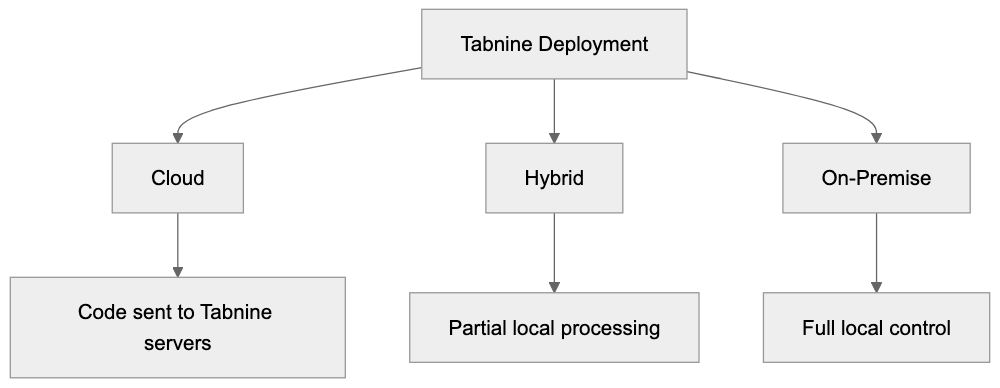
Tabnine Deployment Options:
Tabnine functions as an AI code completion assistant, operating directly within your development environment. It analyzes the context while you write code and suggests completions ranging from single words to entire functions. Tabnine uses machine learning models trained on public code repositories but does not train on your private code unless explicitly permitted. Whether you choose on-premise deployment or run it locally on your machine, your code remains within your infrastructure. Tabnine understands patterns in your codebase and learns your coding style over time, adapting its suggestions accordingly. By providing real-time completions as you type, it reduces the time spent on repetitive coding tasks. Tabnine can suggest variable names, function calls, common code patterns, and even complex multi-line code blocks.
Why Tabnine Exists and Its Core Purpose
Tabnine was created to solve two primary problems in software development, as detailed in this review. Developers often spend considerable time writing repetitive code and searching for syntax and function names. Additionally, many AI coding tools require sending code to cloud servers, posing security and privacy risks. Tabnine exists to offer AI-powered coding assistance without compromising data security. It aims to speed up development while granting enterprises full control over their code and data. Many companies cannot utilize cloud-based AI tools due to compliance requirements like GDPR, HIPAA, or internal security policies. Tabnine fills this gap by offering on-premise and private cloud deployment options. It boosts developer productivity by reducing context switching and eliminating the need for constant documentation reference, allowing developers to focus on solving complex problems.
How Businesses and Developers Use Tabnine
Software development teams use Tabnine to accelerate their coding workflow. Individual developers install it as an IDE extension and receive code suggestions immediately. The free version supports personal projects and small teams effectively. Enterprise customers deploy Tabnine on their own infrastructure to maintain control over their code. Companies in regulated industries such as finance, healthcare, and defense particularly value the on-premise deployment option. Development teams use Tabnine to onboard new developers quickly, thanks to the AI helping them learn codebase patterns efficiently. Some organizations use it to enforce coding standards by training custom models on approved code repositories. While marketing professionals don’t use Tabnine directly, software companies use it during development, integrating it into their existing development workflows seamlessly.
Privacy and Security Features
Tabnine distinguishes itself with its robust privacy features compared to most AI coding tools. It offers three deployment options: cloud, hybrid, and fully on-premise. With on-premise deployment, all code processing occurs on your servers, and nothing is sent to Tabnine’s cloud. This ensures maximum security for enterprises with strict data policies. Tabnine is SOC 2 Type 2 certified, indicating it has undergone extensive security audits. The company promises never to use customer code for training its public models, ensuring your private code stays private unless opted in for custom model training. The tool doesn’t require internet connectivity in on-premise mode, eliminating data leak risks via network transmission. It also supports air-gapped environments where systems are entirely isolated from external networks, essential for intellectual property protection. The service provides detailed audit logs, enabling security teams to monitor usage.
Tabnine Pricing and Plans
Tabnine offers several pricing tiers to accommodate various user needs. The Starter plan is free and includes basic AI code completions with limited features, suitable for individual developers and students learning to code. The Pro plan costs approximately $12 per user per month when billed annually and includes whole-line and full-function code completions, supporting all major programming languages. The Pro plan uses cloud-based processing, sending code snippets to Tabnine servers for suggestions. The Enterprise plan has custom pricing based on team size and deployment requirements. Enterprise customers gain access to on-premise deployment, custom AI model training, and priority support, with options for hybrid deployment. The Enterprise plan includes advanced admin controls, SOC 2 compliance, and SSO combining, making it ideal for teams needing maximum security.
Comparison with Alternative AI Code Assistants
Several AI code completion tools compete with Tabnine, each with different strengths. Here’s how Tabnine compares to five major alternatives.
| Feature | Tabnine | GitHub Copilot | Amazon CodeWhisperer | Codeium | Replit Ghostwriter |
|---|---|---|---|---|---|
| On-Premise Deployment | Yes | No | No | No | No |
| SOC 2 Certified | Yes | Yes | Yes | No | No |
| Free Tier Available | Yes | No | Yes | Yes | Limited |
| Custom Model Training | Yes | No | No | No | No |
| Air-Gapped Support | Yes | No | No | No | No |
| Starting Price | Free | $10/month | Free | Free | $10/month |
Tabnine Integration Architecture:

GitHub Copilot, based on OpenAI’s Codex model, is popular but operates solely in the cloud, requiring all code suggestions to be sent to Microsoft servers. This makes it unsuitable for enterprises with strict data policies. Amazon CodeWhisperer, optimized for AWS services, offers a generous free tier but lacks an on-premise option. Codeium is gaining traction among independent developers with unlimited free usage but lacks enterprise security features. Replit Ghostwriter integrates into the Replit online IDE for web-based development. Tabnine’s main differentiator is its ability to run fully on-premise while maintaining high-quality AI suggestions, making it the preferred choice for regulated industries and security-conscious organizations.
Technical Implementation and Integration
Tabnine integrates with over 30 popular IDEs and code editors. The setup process is straightforward, taking just a few minutes. Developers can install the Tabnine extension from their IDE’s marketplace. After installation, the tool provides suggestions with default settings. For individual users, no additional configuration is needed. Enterprise deployments require more setup, including installing the Tabnine engine on company servers. The on-premise version runs as a service that IDE clients connect to over the local network, allowing IT teams to configure network policies, user permissions, and model update schedules. Tabnine supports integration with existing authentication systems through SAML and LDAP, and it works with version control systems like Git without special configuration.
Performance and Accuracy Considerations
The quality of Tabnine’s suggestions depends on factors such as programming language, code complexity, and context. It performs best with popular languages like Python, JavaScript, Java, and TypeScript, having been trained on extensive public code repositories. Suggestion accuracy is generally high for common patterns and standard library usage, although it may be less accurate with proprietary frameworks or new language features. On-premise suggestion speed hinges on server specifications; a dedicated server with GPU acceleration offers the fastest response, but CPU-only systems provide acceptable performance for small to medium teams. Cloud-based deployments usually have faster speeds due to improved infrastructure, though this requires sending code context over the network.
Data Handling and Compliance
Understanding Tabnine’s data handling is vital for making informed decisions. The cloud-based Pro plan involves sending code snippets to Tabnine servers for processing, including the code you’re writing and surrounding context. Tabnine states that this data isn’t permanently stored or used for public model training, with data processed in memory and discarded afterward. For those who can’t accept any data transmission, on-premise deployment is the sole option, ensuring no code leaves your infrastructure. Tabnine supports GDPR compliance through data processing agreements and EU data centers for European customers, achieving HIPAA compliance with the Enterprise on-premise deployment.
Customization and Team Collaboration
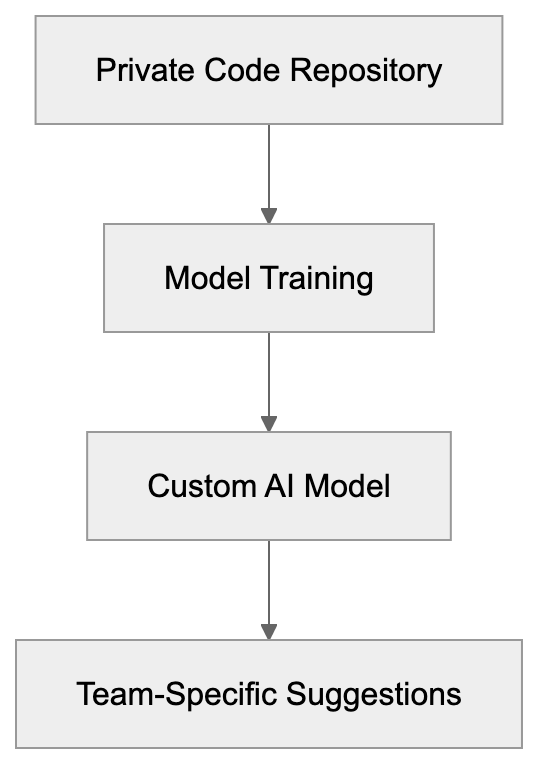
Tabnine Enterprise allows training custom AI models on private codebases, enabling the tool to learn specific coding patterns, internal libraries, and company standards. Custom model training occurs entirely on your infrastructure with on-premise deployment, using your code repositories as input to fine-tune the AI model. This results in more relevant and accurate suggestions for your team. Custom models can encode best practices and discourage anti-patterns specific to your organization. Team administrators manage which repositories are included in training and how often models are updated. This feature helps accelerate onboarding of new team members by matching coding styles from day one, maintaining code consistency across the organization.
Limitations and Considerations
While Tabnine offers strong privacy features, it has some limitations to consider. The on-premise deployment requires significant IT resources for setup and maintenance, presenting operational overhead compared to cloud-only solutions. The quality of suggestions may be lower compared to cloud-based alternatives using larger, more frequently updated models. On-premise models need manual updates, meaning you might not receive the latest AI improvements immediately. Custom model training demands substantial computational resources and expertise, potentially too complex or costly for small teams. Tabnine’s free tier has limited features compared to some competitors like Codeium. While the tool works best with mainstream programming languages, it may struggle with niche or domain-specific languages. For large enterprises, licensing costs can be significant, especially with on-premise deployment, so careful consideration of the trade-offs is essential.
Conclusion
Custom Model Training Workflow:
Tabnine stands out as a privacy-focused AI code completion tool with strong enterprise security features. The ability to deploy on-premise makes it suitable for organizations that cannot use cloud-based AI services due to compliance or security requirements. Offering SOC 2 compliance, custom model training, and air-gapped support, Tabnine is particularly valuable for regulated industries. While it provides meaningful productivity improvements by reducing time spent on repetitive tasks, it requires more setup and maintenance than cloud-only alternatives. Pricing is competitive for individual developers, but enterprise deployments can be costly. Organizations must evaluate privacy and security benefits against additional complexity and cost. For teams prioritizing data sovereignty and intellectual property protection, Tabnine balances AI productivity with enterprise-grade security controls.
Frequently Asked Questions
What programming languages does Tabnine support?
Tabnine supports over 30 programming languages, including popular ones like Python, JavaScript, Java, and TypeScript. This extensive language support allows it to cater to a wide range of development needs.
How does on-premise deployment benefit enterprises?
On-premise deployment gives enterprises full control over their code and data, ensuring compliance with security regulations without sending code to external servers. This is crucial for industries like finance and healthcare, where data privacy is paramount.
Is there a free version of Tabnine available?
Yes, Tabnine offers a free Starter plan, which includes basic AI code completions suitable for individual developers and small projects. This allows users to explore the capabilities of Tabnine before upgrading to a paid plan.
What are the requirements for using the Enterprise plan?
The Enterprise plan is tailored for larger teams and requires custom pricing based on the team's size and deployment preferences. It includes features like on-premise deployment, priority support, and advanced admin controls, making it ideal for organizations prioritizing data security.
Can Tabnine be integrated into existing development workflows?
Yes, Tabnine can be easily integrated into existing development workflows as it supports numerous IDEs and code editors. The installation process is straightforward, allowing developers to receive AI-generated code suggestions quickly.
How does Tabnine ensure data privacy?
Tabnine emphasizes data privacy by offering on-premise options where all code processes occur on local servers. The company adheres to SOC 2 compliance and guarantees that customer code isn't used for training public models unless explicitly agreed upon.
What are the limitations of Tabnine's on-premise deployment?
While on-premise deployment enhances security, it requires significant IT resources for setup and maintenance. Additionally, on-premise models may not receive real-time updates, and custom model training can demand considerable computational power and expertise.
Track Your AI Visibility
See how AI chatbots like ChatGPT, Claude, and Perplexity discover and recommend your brand.