Exploring Tencent Hunyuan: AI Innovations from China's Tech Giant
In-depth guide to Tencent Hunyuan, its WeChat integration, Tencent Cloud features, and position in the Chinese AI market compared to competitors.
What is Tencent Hunyuan
Tencent Hunyuan is a cutting-edge large language model developed by Tencent AI to compete in the fast-evolving AI market. Tencent’s AI advancements have been significant in this area. Known for its gaming division and social media platforms like WeChat, which boasts over 1.3 billion monthly active users, Tencent has a substantial presence in the Chinese AI sector. WeChat’s integration with AI has been a notable development. The Hunyuan model signifies Tencent’s entry into generative AI technology, supporting services across Tencent’s ecosystem, such as Hunyuan chatbot, content generation tools, and business solutions. Tencent’s AI model Hunyuan has been released for businesses amid competition in China. Capable of processing both Chinese and English languages, Tencent built Hunyuan using its infrastructure and data sets, embedding it into WeChat AI, and making it accessible to millions. Tencent’s AI assistant app Yuanbao connects to the WeChat ecosystem. Businesses leverage Hunyuan through Tencent Cloud for tasks like customer service automation and data analysis, facing competition from similar offerings like Alibaba AI and Baidu AI in the Chinese AI market.
Why Tencent Built Hunyuan
Tencent Hunyuan Ecosystem Overview:
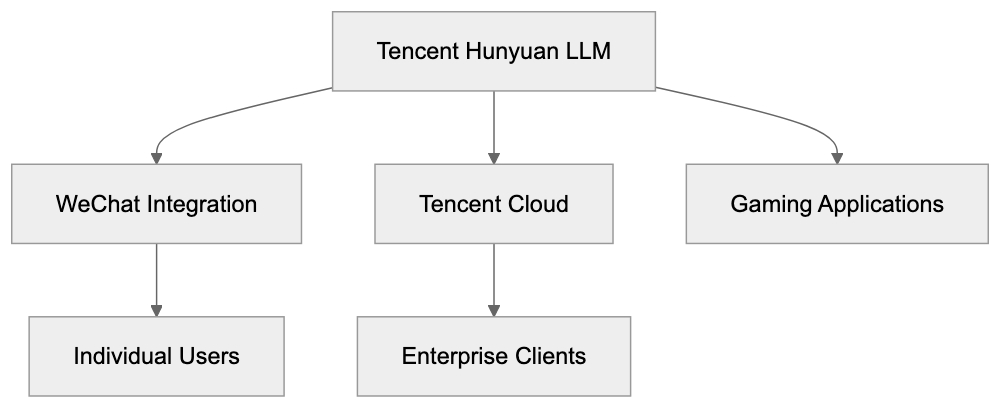
Tencent developed Hunyuan to secure a competitive edge in the AI industry, emphasizing the need for localized Chinese AI solutions. The company leveraged vast data from WeChat and other platforms to train the large language model. The goal was to create an AI solution adept at understanding Chinese linguistic nuances and cultural contexts. Additionally, Tencent aimed to provide AI services to its existing business clients via Tencent Cloud. Hunyuan is used within Tencent’s gaming entities for NPC dialogue and content creation, and on social media for content moderation and recommendation. As the enterprise AI market in China expands, Tencent positions Hunyuan as foundational technology, minimizing dependence on external providers and retaining control over user data.
How Hunyuan Integrates with WeChat
Hunyuan’s Strategic Position:
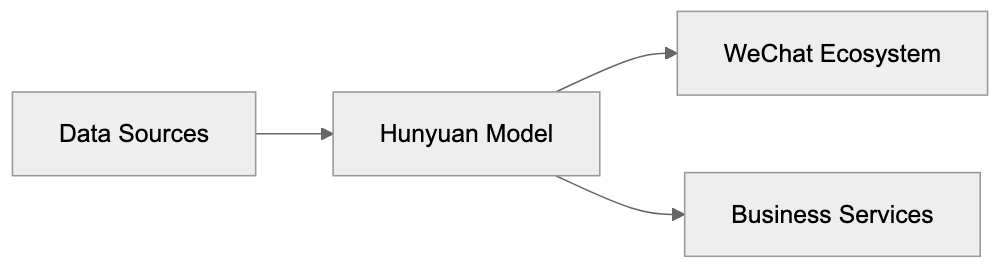
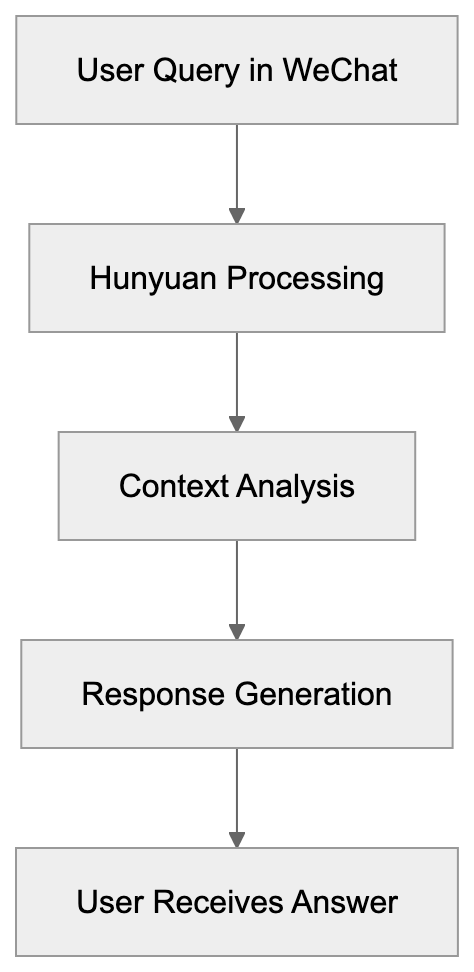
WeChat seamlessly integrates Hunyuan, allowing users to interact with the AI through mini-programs. There’s no need to download separate apps or create new accounts. Within WeChat, users can ask questions, generate text, and receive direct assistance. Businesses use Hunyuan-powered chatbots for customer service, answering inquiries, processing orders, and making product suggestions. The AI adapts based on the conversation context, switching between formal and casual tones. WeChat’s vast user base offers Tencent a real-world testing environment, using feedback to enhance Hunyuan. Developers can also access Hunyuan’s APIs via WeChat’s platform, enabling third-party applications to incorporate advanced AI features.
Tencent Cloud and Hunyuan for Businesses
WeChat AI Integration Flow:
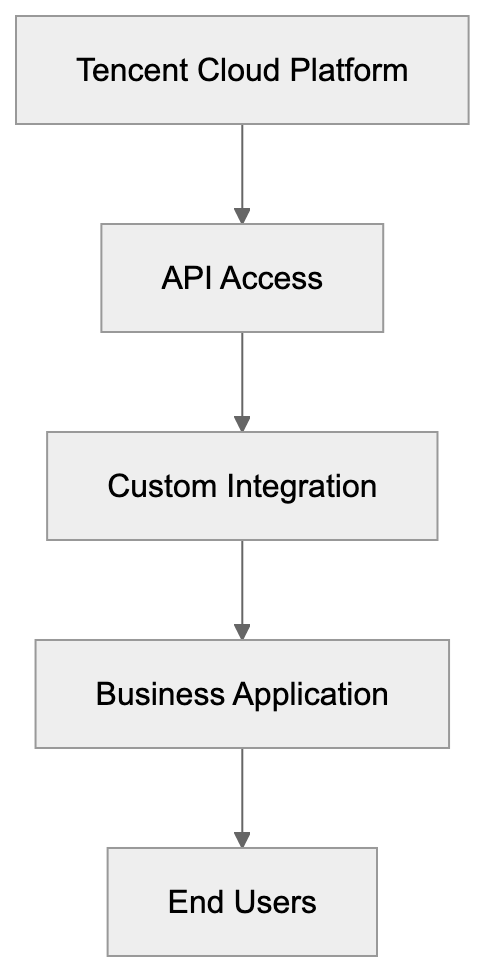
Through Tencent Cloud, enterprises can utilize Hunyuan efficiently. Available via APIs, companies can incorporate the model into their applications, with flexible pricing models, including pay-per-use and subscriptions. Businesses across various industries utilize Hunyuan for document analysis, code generation, and automating customer interactions. Fine-tuning on custom datasets allows clients to tailor the model to specific industry needs. Companies like e-commerce platforms use Hunyuan for generating product descriptions, and financial services employ it for risk analysis. Tencent offers tools for API monitoring, cost management, and performance tracking, with additional security options like data encryption and access controls. Hunyuan’s services are comparably influential in the market, amidst competition from Alibaba Cloud and Baidu Cloud.
Hunyuan Compared to Other Chinese AI Models
Enterprise Hunyuan Deployment:
 Within the competitive Chinese AI arena, Tencent’s Hunyuan stands out among several key players, each with distinct language model offerings:
| Model | Company | Primary Integration | Strengths | Target Users |
|---|---|---|---|---|
| Hunyuan | Tencent | WeChat, Tencent Cloud | Social media, gaming applications | WeChat users, gaming companies |
| Qwen | Alibaba | Alibaba Cloud, DingTalk | E-commerce, business tools | Online retailers, enterprises |
| ERNIE | Baidu | Baidu Search, Baidu Cloud | Search integration, knowledge retrieval | Search-dependent businesses |
| ChatGLM | Zhipu AI | Open source, various platforms | Research applications, customization | Developers, researchers |
| SenseChat | SenseTime | Computer vision products | Multimodal capabilities | Vision AI users |
Baidu AI’s ERNIE Bot emphasizes search integration, while Alibaba AI’s Qwen targets e-commerce enhancements. Tencent benefits from WeChat’s massive user base and gaming focus. ChatGLM is oriented towards customizable developer solutions, and SenseChat integrates with visual AI products. Each model exhibits unique strengths, with Hunyuan particularly excelling in conversational Chinese.
Technical Capabilities and Limitations
Hunyuan excels in various natural language processing (NLP) tasks: text generation, question answering, document summarization, and translation. Additionally, it can perform code generation in several programming languages and maintains conversational context coherence. Training data includes a diverse range of Chinese internet sources and Tencent proprietary datasets. While exact architecture details are undisclosed, the model performs robustly on Chinese language benchmarks and understands regional dialects well. Nonetheless, like other large language models, Hunyuan occasionally generates confident yet incorrect information and adheres to Chinese content regulations affecting some responses.
Privacy and Data Usage Considerations
User interaction with Hunyuan through platforms like WeChat involves data collection, potentially used for model enhancement. While businesses using Tencent Cloud can negotiate data handling procedures, individual WeChat users have limited control over data inclusion in training sets. Although retaining data within China, Tencent’s transparency over specifics remains limited, typical of many free online services.
Getting Started with Hunyuan
WeChat users can easily trial Hunyuan by searching for official Tencent AI mini-programs, requiring only a WeChat account. For developers, Tencent Cloud offers API access, with comprehensive documentation available in both Chinese and English. Developers can register for API keys through Tencent’s developer console, with free tiers for testing and paid plans for broader use. Proper prompt engineering enhances response quality, with community forums available for troubleshooting and integration advice.
Tencent Hunyuan embodies a major stride in Chinese AI by leveraging Tencent’s social media and gaming prowess to reach millions via WeChat AI. The model caters to diverse business applications through Tencent Cloud, rivaling Alibaba’s Qwen and Baidu’s ERNIE in the AI landscape. Although user data utilization considerations remain pertinent, Hunyuan’s seamless integration with Tencent’s platforms offers an accessible AI solution for existing users.
Frequently Asked Questions
What types of tasks can Tencent Hunyuan perform?
Tencent Hunyuan excels at natural language processing tasks such as text generation, question answering, document summarization, and translation. It is also capable of code generation across various programming languages, making it useful for a wide range of applications.
How does Hunyuan integrate with WeChat?
Hunyuan integrates seamlessly with WeChat, enabling users to interact with the AI through mini-programs. Users can ask questions and engage with the AI without the need to download separate apps, allowing for a more unified experience.
Is Hunyuan available for businesses?
Yes, Hunyuan is available for businesses via Tencent Cloud. Companies can utilize its APIs to incorporate the model into their applications for tasks such as customer service automation and data analysis, with flexible pricing models for different needs.
What are the privacy considerations when using Hunyuan?
User interactions with Hunyuan may involve data collection for improving the model, with potential limitations on individual data control for WeChat users. Businesses can negotiate data handling procedures, but transparency regarding data usage remains a challenge.
How can I start using Hunyuan as a WeChat user?
WeChat users can begin using Hunyuan by searching for official Tencent AI mini-programs, which only require a WeChat account for access. This provides a straightforward way to experience Hunyuan's capabilities in a familiar environment.
What sets Hunyuan apart from other AI models in China?
Hunyuan's primary advantage is its integration within WeChat, which has a massive user base and strong gaming applications. This allows it to perform particularly well in conversational Chinese and leverage Tencent's extensive dataset for improved contextual understanding.
Can developers access Hunyuan's capabilities for their applications?
Yes, developers can access Hunyuan through Tencent Cloud by utilizing its APIs. Comprehensive documentation is available in both Chinese and English to support developers in integrating Hunyuan into their projects.
Track Your AI Visibility
See how AI chatbots like ChatGPT, Claude, and Perplexity discover and recommend your brand.