Tongyi Qianwen: Alibaba's AI Assistant Explained
Complete guide to Tongyi Qianwen AI assistant. Learn about Qwen models, Alibaba ecosystem integration, ERNIE Bot comparison and more.
Introduction
Tongyi Qianwen launched in April 2023 as Alibaba’s AI assistant powered by large language models, responding to the growing AI chatbot market. This powerful tool helps users with text generation, question answering, code writing, and content creation. Think of it as Alibaba’s version of ChatGPT, but specifically built for the Chinese market and deeply integrated into the Alibaba ecosystem. The AI assistant operates on the Qwen model family, which Alibaba Cloud developed. Supporting multiple languages, including Chinese and English, it serves companies needing AI assistants that understand Chinese nuances and comply with local regulations. Moreover, Alibaba has released several Qwen models as open source, empowering developers to create custom AI applications, with models available under the Apache 2.0 license.
What is Tongyi Qianwen
Tongyi Qianwen translates to “truth from a thousand questions” in English, reflecting its design to handle diverse queries. It’s a conversational AI assistant accessible through web interfaces or mobile apps. Understanding natural language queries, it generates human-like responses. You can ask it to write emails, summarize documents, answer questions, or assist with coding tasks. The technology behind it is the Qwen model series—transformer-based large language models trained on massive datasets, with Qwen2.5-Max outperforming other foundation models in key benchmarks. Alibaba released several versions, including Qwen-7B, Qwen-14B, and Qwen-72B, with numbers indicating billions of parameters in each model. Larger models typically perform better but demand more computing power. The assistant works in multiple languages, processing text inputs and producing text outputs, supporting 119 languages and dialects. Some versions also handle images, analyzing visual content. Integration into Alibaba services like DingTalk and Tmall makes it easily accessible for existing users.
Tongyi Qianwen Model Architecture:
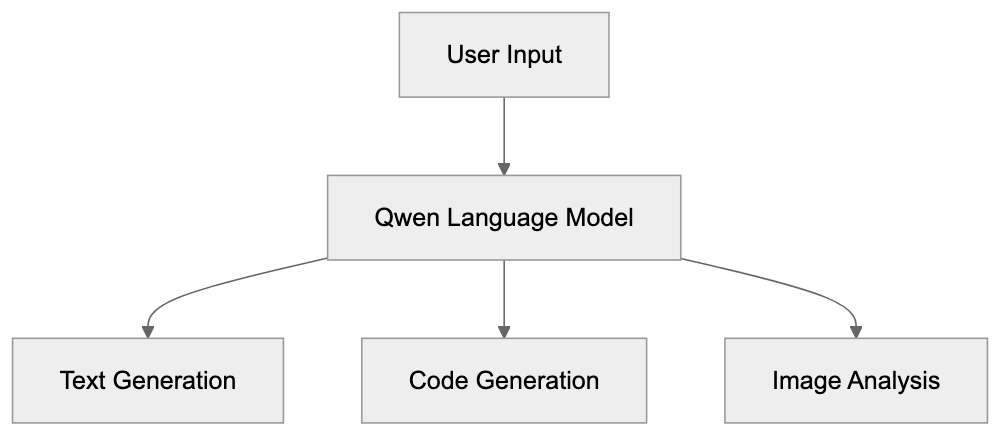
Why Tongyi Qianwen Exists
Alibaba created Tongyi Qianwen to compete in the AI assistant market. Following ChatGPT’s surge in popularity in late 2022, Chinese tech firms rushed to develop similar tools. Baidu launched ERNIE Bot, Tencent released their AI assistant, and Alibaba introduced Tongyi Qianwen. Alibaba needed a solution that performed well with the Chinese language and culture, given differences in grammatical structures and contextual meanings compared to English. Foreign AI services face restrictions in China, making local alternatives necessary. Alibaba also wanted to keep user data within their ecosystem and comply with Chinese data regulations. Combining AI with its e-commerce platforms, cloud services, and software, Alibaba enhances these products, aiding sellers on Taobao in writing product descriptions, automating customer service, and more. The open-source approach fosters a developer community and sparks new ideas on their platform.
How Businesses Use Tongyi Qianwen
Companies integrate Tongyi Qianwen in various ways. E-commerce businesses generate product descriptions and marketing copy, inputting basic product info for the AI to create engaging text. Customer service departments use it as a chatbot, automating responses to common questions and escalating complex queries to human agents. Content creators leverage Tongyi Qianwen for brainstorming and drafting, while marketing teams generate social media posts, blog outlines, and ad copy. In software development, its code generation features assist in writing functions, debugging errors, and explaining code snippets across languages like Python, Java, and JavaScript. Alibaba employs Tongyi Qianwen in its products, using it in DingTalk for note-taking during meetings, and integrating it into Tmall for personalized shopping recommendations. API usage dictates pricing, with enterprise customers deploying private instances for sensitive data.
Alibaba AI Ecosystem Integration:
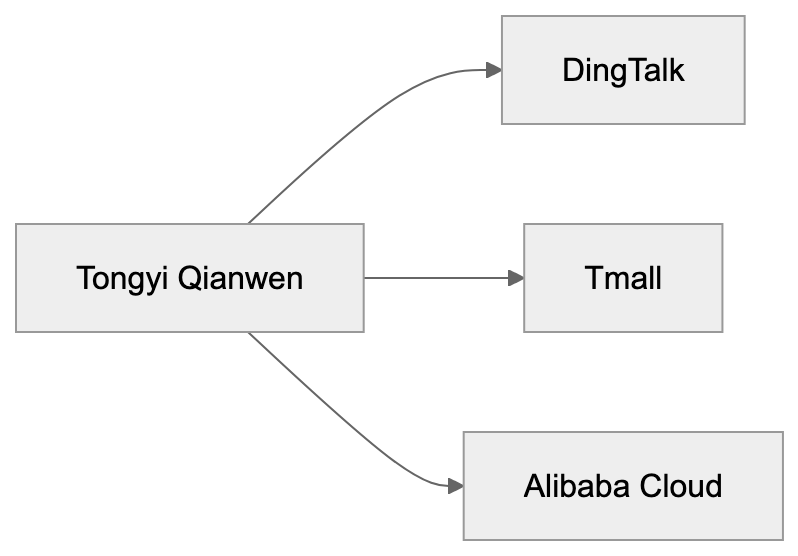
Tongyi Qianwen vs Alternative AI Assistants
Several AI assistants compete in the Chinese and global markets. Here’s a comparison of Tongyi Qianwen with major alternatives.
| Feature | Tongyi Qianwen | ERNIE Bot | ChatGPT | Claude | Gemini |
|---|---|---|---|---|---|
| Company | Alibaba | Baidu | OpenAI | Anthropic | |
| Launch Date | April 2023 | March 2023 | November 2022 | March 2023 | December 2023 |
| Chinese Language | Native support | Native support | Limited | Limited | Good |
| Open Source Models | Yes (Qwen series) | Limited | No | No | No |
| API Access | Yes | Yes | Yes | Yes | Yes |
| Ecosystem integration | Alibaba products | Baidu products | Third-party apps | Third-party apps | Google products |
| International Access | Limited | Very limited | Wide | Wide | Wide |
ERNIE Bot is Tongyi Qianwen’s closest competitor in China. Both launched around the same time, targeting similar users. ERNIE integrates with Baidu products, while Tongyi Qianwen connects to Alibaba’s e-commerce and cloud platforms. Independent benchmarks show comparable capabilities for Chinese language tasks. ChatGPT dominates globally but faces limited access in China. Its Chinese language performance improved with GPT-4 but still lags compared to models trained on Chinese data. Claude and Gemini also struggle with Chinese market accessibility. Tongyi Qianwen’s open-source approach sets it apart—Alibaba released Qwen models on platforms like GitHub and Hugging Face, promoting flexibility for companies with data privacy needs. While ERNIE Bot offers some open models, western alternatives remain mostly closed source.
Qwen Model Family Details
The Qwen model family powers Tongyi Qianwen and other applications. Alibaba released several versions for different use cases. Qwen-7B, with 7 billion parameters, works well on consumer hardware; Qwen-14B, with 14 billion parameters, offers improved performance; and Qwen-72B, the largest publicly available model with 72 billion parameters, competes with top-tier models. Alibaba also released Qwen-VL, capable of handling text and images, allowing users to upload pictures and ask questions about them. Code-specific versions like CodeQwen aid developers with programming tasks, understanding code syntax better, and generating accurate functions. All Qwen models support context windows of at least 8000 tokens, with some extended versions handling up to 32000 tokens for longer documents. The models are released under the Apache 2.0 license, allowing commercial use, modification, and distribution. Model weights can be downloaded from Hugging Face or ModelScope. Alibaba regularly releases updates and improved versions.
International Accessibility and Usage
Qwen Model Deployment Options:
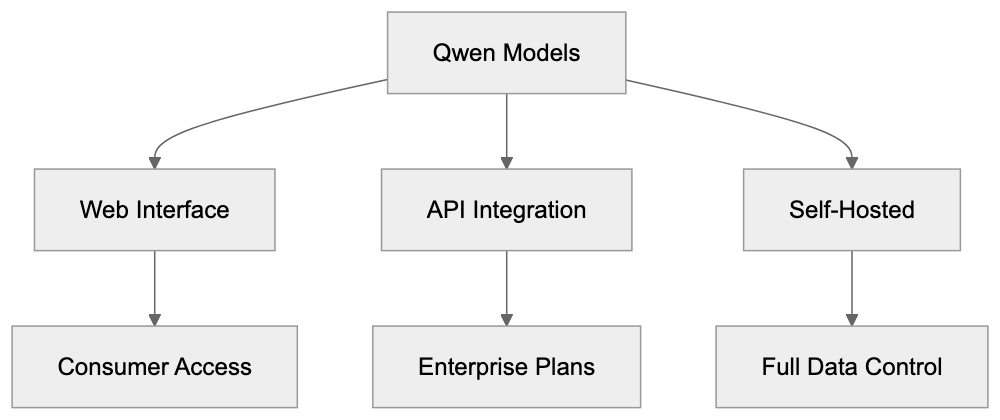
Accessing Tongyi Qianwen from outside China can be challenging, as the web interface is primarily for Chinese users and typically requires a Chinese phone number for registration. Despite focusing on the domestic market, the open source Qwen models are accessible to international developers, downloadable from GitHub or Hugging Face without restrictions. Users can run them locally or on cloud servers, making the technology accessible even if the assistant isn’t. Alibaba Cloud offers API access to Tongyi Qianwen for international customers, with standard API model pricing. Documentation is available in English, aiding non-Chinese developers. The Qwen models support English well and various levels of other languages, making them useful for multilingual applications. International companies use Qwen models as alternatives to Western AI services. Their open-source nature and permissive licensing attract developers seeking customizable solutions. Performance benchmarks show Qwen models competing well on standard English tasks, often outperforming Western models for Chinese language tasks.
Technical Specifications and Performance
Qwen models employ a decoder-only transformer architecture similar to GPT models. Trained on datasets surpassing 3 trillion tokens, they include web text, books, code repositories, and other sources. Both Chinese and English content feature prominently. The models utilize techniques like rotary position embeddings and grouped-query attention for efficiency. Alibaba published benchmarks showing strong performance across tasks. On C-Eval, a Chinese language benchmark, Qwen-72B scored above 80%, ranking among the top models. For MMLU, a multilingual benchmark, it achieved competitive scores against international alternatives. Code generation benchmarks like HumanEval reflect Qwen models writing correct code comparable to specialized coding models. The vision-language version, Qwen-VL, excels in image understanding tasks, scoring well on benchmarks like VQA and image captioning. Alibaba continually improves the models with updates, releasing versions with better performance, longer context windows, or additional capabilities. Quantized versions allow operation on less powerful hardware, trading some accuracy for faster inference and lower memory requirements.
Data Privacy and Usage Policies
When using Tongyi Qianwen through web interfaces or apps, expect Alibaba to collect your inputs and outputs. The company uses this data to enhance AI models and services, a standard practice for most AI assistants. The privacy policy states that conversations may be reviewed by human trainers, raising concerns about confidential data sharing. For business use, Alibaba offers enterprise plans with stronger privacy guarantees, including options to prevent data from entering training datasets. Enterprise customers can deploy private instances to keep data within their infrastructure. Using the open-source Qwen model offers more control. Running the model on your servers means Alibaba doesn’t see your inputs or outputs, ideal for companies with strict data privacy requirements. This approach requires technical expertise and resources. For API users, reviewing service terms, especially data retention and usage policies, is crucial, as different tiers have varying data standards. Consider data privacy implications and evaluate usage policies before deployment.
Conclusion
Tongyi Qianwen marks Alibaba’s significant entry into AI assistants, combining consumer-facing chatbots with developer tools and open-source models. It excels at Chinese language tasks and is deeply integrated with Alibaba’s ecosystem. Businesses use it for customer service, content creation, and productivity enhancement. The Qwen model family provides flexibility through various sizes and specializations, with open-source releases for customization. Compared to competitors like ERNIE Bot, it offers similar Chinese language capabilities with stronger open-source options. International services like ChatGPT, though globally widespread, face restrictions in China. For developers and businesses working with Chinese language or seeking customizable AI solutions, Tongyi Qianwen and the Qwen family present solid options. The technology advances with regular updates and new features, but consider data privacy implications and review usage policies carefully before implementation.
Frequently Asked Questions
How can businesses integrate Tongyi Qianwen into their operations?
Businesses can use Tongyi Qianwen for various purposes such as generating product descriptions, automating customer service responses, and assisting in content creation. Integration can be achieved through APIs or by adopting the assistant in existing platforms like Alibaba's DingTalk and Tmall for enhanced functionalities.
What are the key differences between Tongyi Qianwen and other AI assistants?
Tongyi Qianwen is specifically designed for Chinese users with native support for the language and deep integration into Alibaba's ecosystem. Unlike other AI assistants like ChatGPT, it is open source, allowing for customization and better compliance with local regulations. Additionally, it excels in processing Chinese language tasks more effectively than its international counterparts.
What are the available deployment options for Qwen models?
Qwen models can be deployed through Alibaba's cloud services or run locally by developers. The open-source versions are available on platforms like GitHub and Hugging Face, allowing companies to customize the AI for their specific use cases while ensuring data privacy.
Is data privacy guaranteed when using Tongyi Qianwen?
Data privacy is a significant consideration when using Tongyi Qianwen. While Alibaba collects inputs for model improvement, enterprise plans offer stronger privacy guarantees. Businesses can also opt to run the open-source models on their own servers to retain complete control over their data.
Can international users access Tongyi Qianwen?
International users can access Tongyi Qianwen indirectly through the open-source Qwen models, downloadable from GitHub and Hugging Face. However, direct access via the assistant's web interface is primarily targeted at Chinese users, requiring a local phone number for registration.
What makes the Qwen model family unique?
The Qwen model family is characterized by its flexibility, with various sizes optimized for different use cases, including specialized versions for code generation and multimodal tasks. The open-source nature allows developers to modify and optimally deploy these models according to their needs, which is a distinct advantage over many proprietary models.
How does Tongyi Qianwen support multiple languages?
Tongyi Qianwen supports 119 languages and dialects, making it suitable for multilingual applications. While it excels in Chinese, it also processes English and other languages effectively, allowing businesses operating in diverse markets to leverage its capabilities to cater to a wider audience.
Track Your AI Visibility
See how AI chatbots like ChatGPT, Claude, and Perplexity discover and recommend your brand.