Understanding YouBot: The AI Search Crawler by You.com
Learn about YouBot, You.com's AI search crawler. Discover its purpose, behavior, user-agent details, and how it indexes content for AI search.
Introduction
YouBot is the web crawler that powers You.com, an AI-powered search engine. As an AI search engine indexing tool, web crawlers like YouBot are automated programs that visit websites and collect information to build search indexes. Think of them as digital scouts that help search engines understand what content exists on the internet. YouBot specifically serves You.com, which launched in 2021 and aims to provide more personalized and AI-enhanced search results. The You.com crawler, YouBot, visits web pages, reads their content, and adds this information to You.com’s database. This allows the search engine to return relevant results when users perform searches. Unlike traditional search crawlers, YouBot also collects data that feeds into You.com’s AI systems. The company behind You.com is focused on creating a next-generation search experience that combines traditional web indexing with AI capabilities.
What is YouBot and How Does It Work
YouBot is an automated web crawler developed and operated by You.com. The You.com search bot identifies itself with a specific user-agent string when it visits websites. This string typically reads “YouBot” or includes “You.com”. Web crawlers work by starting with a list of known URLs and then following links from those pages to find new content. YouBot does the same but focuses on gathering information for an AI search engine.
YouBot Crawling Process:
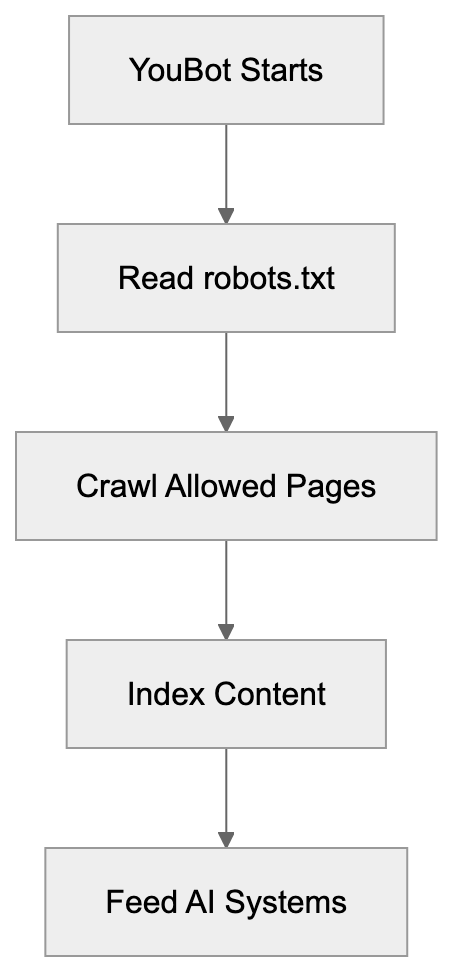
When You.com’s AI search engine indexing tool visits your website, it reads the HTML content, follows internal and external links, and may download images or other resources. The crawler respects standard protocols like robots.txt files, which tell it which parts of a site it should or should not access. YouBot runs continuously because the web is always changing, with new content being published every second. The frequency of visits to any particular site depends on how often that site updates and how important You.com considers it.
Why YouBot Exists and Its Purpose
You.com created YouBot to build and maintain its search index. Without a crawler, a search engine cannot function because it needs fresh data about what exists on the web. Traditional search engines like Google and Bing use web crawlers for the same reason, but You.com positions itself differently. The company wants to create an AI-native search experience.
This means YouBot does not just index pages for keyword matching; it collects data that helps train and improve You.com’s AI models. The crawler gathers information about page content, structure, relationships between pages, and how information is organized across the web. This data becomes training material for the AI systems that power You.com’s search features.
The purpose extends beyond simple indexing. YouBot helps You.com understand context, meaning, and relevance in ways that go deeper than traditional keyword-based search. The crawler also supports You.com’s various AI modes, like YouChat and YouWrite, which need comprehensive knowledge about web content to function properly.
How You.com Uses Data Collected by YouBot
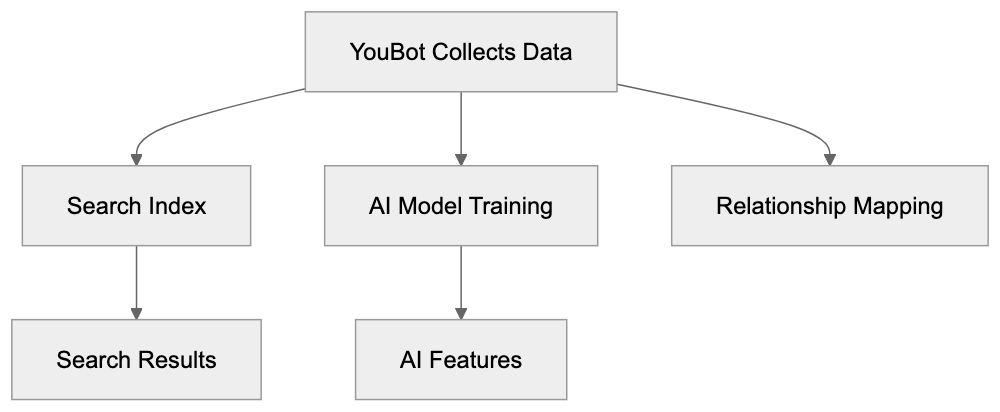
You.com uses the data collected by YouBot in multiple ways:
How You.com Uses Crawled Data:
-
Searchable Index: Builds a searchable index of web content. When someone searches on You.com, the platform queries this index to find relevant pages.
-
Training AI Models: The collected data trains AI models. You.com offers AI-powered features that need to understand language, context, and factual information. The content gathered by YouBot provides this training material.
-
Understanding Relationships: The crawler helps You.com understand the relationship between different pieces of information across the web. This allows the platform to provide more complete answers rather than just links.
You.com has stated that it respects user privacy and follows standard web practices, but like most AI companies, they likely use crawled public web data to improve their models. The company offers different search modes including a default mode, private mode, and AI chat features. All of these rely on the underlying index that YouBot creates and maintains. Website owners who want their content to appear in You.com search results need to allow YouBot access.
YouBot Behavior and Technical Details
YouBot follows standard web crawler protocols. It reads and respects robots.txt files, which are instructions that website owners provide to control crawler behavior. If you wish to block YouBot specifically, you can add rules to your robots.txt file. The user-agent string for search bot blocking is typically “YouBot,” though you should check You.com’s official documentation for the exact string.
The crawler generally behaves politely, meaning it does not overload servers with too many requests at once. Most legitimate crawlers, including YouBot, implement rate limiting to avoid causing problems for the websites they visit. The frequency of YouBot visits depends on several factors. Sites that update frequently may see more visits. Important or authoritative sites may also get crawled more often. YouBot likely follows links it finds on pages to find new content, similar to how other search crawlers operate. The crawler can handle different content types, including HTML pages, PDFs, and images. It processes JavaScript-rendered content, though the extent of this capability may vary. Website owners can use standard meta tags to control how individual pages are indexed.
Comparing YouBot to Other Search Crawlers
Several companies operate web crawlers for search and AI purposes. Here is how YouBot compares to some major alternatives:
| Crawler Name | Company | Primary Purpose | Blocking User-Agent | Launch Period |
|---|---|---|---|---|
| YouBot | You.com | AI search indexing | YouBot | 2021-2022 |
| Googlebot | Search indexing | Googlebot | 1996 | |
| Bingbot | Microsoft | Search indexing | Bingbot | 2010 |
| CCBot | Common Crawl | Open dataset creation | CCBot | 2011 |
| GPTBot | OpenAI | AI training data | GPTBot | 2023 |
| ClaudeBot | Anthropic | AI training data | ClaudeBot | 2023 |
YouBot is newer compared to traditional search crawlers like Googlebot and Bingbot, which have been operating for decades and crawl far more of the web. YouBot likely has a smaller crawl budget and covers less total content. Compared to AI-focused crawlers like GPTBot and ClaudeBot, YouBot serves a dual purpose. It needs to both build a search index and gather AI training data. GPTBot and ClaudeBot focus primarily on collecting training data for large language models. CCBot creates an open dataset that researchers and companies can use. YouBot’s data stays within You.com’s ecosystem.
Website Owner Control Options:
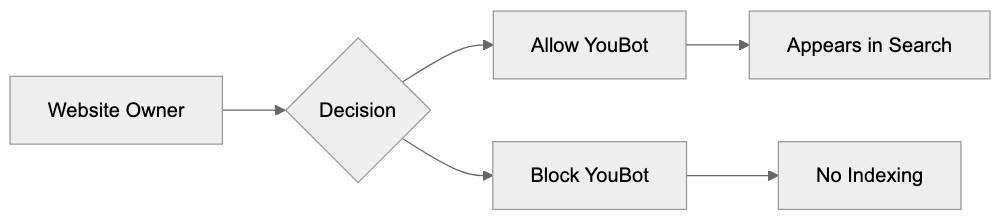 The blocking methods are similar across all these crawlers. Website owners can use robots.txt files or server configurations to prevent access. Some website owners block AI crawlers to prevent their content from being used in AI training, while others allow crawling because they want to appear in search results.
Should You Block YouBot
Whether to block YouBot depends on your goals. If you want your content to appear in You.com search results, then you should allow the crawler. Blocking it means your site will not show up when people search on You.com, but You.com currently has a much smaller market share compared to Google or Bing. Many website owners prioritize those larger search engines.
If you are concerned about AI companies using your content for training, blocking YouBot might match that goal. You.com uses crawled data to improve its AI features. Some content creators object to this practice, especially if they are not compensated. The decision often comes down to weighing visibility versus control. Allowing YouBot gives you presence on another search platform. Blocking it limits how You.com can use your content.
You can implement selective blocking. For example, you might allow YouBot to crawl some sections of your site, but not others. This is done through robots.txt rules or meta tags on specific pages. Keep in mind that blocking crawlers does not guarantee your content will not be used. Someone could still manually copy your content or access it through other means, but blocking is a clear signal of your preferences, and most legitimate crawlers respect it.
How to Block or Allow YouBot
Controlling YouBot access happens primarily through your robots.txt file. This file sits in your website’s root directory and tells crawlers which parts of your site they can access.
To block YouBot completely, add these lines to your robots.txt:
User-agent: YouBot
Disallow: /
This tells YouBot not to crawl any part of your site. To allow YouBot, but block specific directories, you would specify those paths:
User-agent: YouBot
Disallow: /private/
Disallow: /admin/
To allow YouBot full access, either do not mention it in robots.txt or explicitly allow it:
User-agent: YouBot
Allow: /
You can also control indexing at the page level using meta tags. Adding this to a page’s HTML head section instructs crawlers not to index that specific page:
<meta name="robots" content="noindex">Some web servers let you block crawlers based on user-agent strings in the server configuration. This works at a deeper level than robots.txt, but robots.txt is the standard method and what most crawlers expect. Remember, robots.txt is a public file. Anyone can view it by going to yoursite.com/robots.txt. The rules you set are suggestions that well-behaved crawlers follow. Malicious bots might ignore them. YouBot, as a legitimate search crawler, should respect your robots.txt settings. If you notice YouBot not respecting your rules, you can contact You.com support to report the issue.
You.com as an AI Search Platform
You.com launched as a search engine with AI capabilities built in from the start. The platform was founded by former Salesforce executives Richard Socher and Bryan McCann and went public in late 2021. The company positions itself as a privacy-focused alternative to traditional search engines.
You.com offers several features beyond basic web search. YouChat is an AI assistant similar to ChatGPT that can answer questions and help with tasks. YouWrite assists with content creation. YouCode helps developers find programming solutions. YouImagine generates images from text descriptions. All these features rely on the underlying index that YouBot creates.
The platform also offers customizable search experiences, allowing users to prioritize certain sources. You.com has raised significant funding to compete in the search market. The company faces competition from established players like Google and Bing, as well as newer AI-focused search engines like Perplexity. The search market is difficult to break into because it requires massive infrastructure and comprehensive web indexes. YouBot plays an important role in building that index and keeping it current.
Conclusion
YouBot is the web crawler for You.com’s AI-powered search platform. It visits websites to collect content that builds You.com’s search index and supports its AI features. The crawler operates like other search bots by following links, reading content, and respecting robots.txt protocols. Website owners can choose to allow or block YouBot depending on whether they want their content indexed by You.com. The crawler represents You.com’s effort to build a comprehensive web index that powers both traditional search and AI-improved features.
Compared to established crawlers like Googlebot, YouBot is newer and likely covers less of the web. Compared to AI-specific crawlers, it serves dual purposes of search indexing and AI training. Understanding YouBot helps website owners make informed decisions about crawler access and helps developers recognize the traffic patterns from You.com’s indexing activities. As AI search continues to grow, crawlers like YouBot will likely become more common as more companies build AI-powered search alternatives.
Frequently Asked Questions
What happens if I block YouBot using my robots.txt file?
If you block YouBot in your robots.txt file, it will not be able to crawl your site, meaning your web pages will not appear in You.com's search results. This can be beneficial if you want to prevent AI companies from using your content for training. However, blocking it also limits your site's visibility on You.com.
How often does YouBot visit websites?
YouBot visits websites based on their update frequency and importance as determined by You.com. Sites that frequently update their content may see more regular visits from YouBot. Generally, crawlers like YouBot operate continuously to keep their indexes up to date.
Can I control what content YouBot indexes from my site?
Yes, you can control what YouBot indexes using meta tags and by configuring your robots.txt file. For instance, you can specify directories to block or allow certain pages to be indexed by providing rules in these files.
Is You.com a privacy-focused search engine?
Yes, You.com was designed as a privacy-focused alternative to traditional search engines. The platform aims to offer users greater control over their search experience, including how their data is used, which is especially relevant given the use of crawled data for AI model training.
How does YouBot differ from traditional web crawlers like Googlebot?
YouBot primarily focuses on building a searchable index that incorporates AI capabilities, whereas traditional crawlers like Googlebot predominantly focus on keyword indexing. YouBot also collects data that helps train You.com’s AI models, offering a dual purpose beyond just indexing.
What should I do if YouBot ignores my robots.txt rules?
If you notice that YouBot is not adhering to your robots.txt rules, it is advisable to contact You.com's support for assistance. Generally, legitimate crawlers respect these rules, but if there’s an issue, reporting it may help to resolve it.
How does You.com utilize the data collected by YouBot?
You.com uses the data collected by YouBot to create a searchable index, train AI models, and understand the relationships between different pieces of web content. This enables the platform to deliver more accurate and contextually relevant search results and enhances its AI-powered features.
Track Your AI Visibility
See how AI chatbots like ChatGPT, Claude, and Perplexity discover and recommend your brand.