Grok AI: xAI's Real-Time Search Assistant Explained
Complete guide to Grok by xAI. Learn about real-time X integration, Grok-3 features, X Premium requirements, and how it compares to ChatGPT.
What is Grok and xAI
Grok is the flagship AI product from xAI, a company Elon Musk established in March 2023. The company’s goal is to build AI systems that understand the universe and advance scientific discovery. xAI operates as a separate entity from X, though the two companies work closely together. The combination of Grok and X gives the AI assistant direct access to the platform’s real-time data stream—a significant technical advantage over other AI assistants.
The first version of Grok launched in November 2023 for X Premium+ subscribers. Since then, xAI has released multiple iterations, each improving reasoning capabilities while maintaining its core feature of real-time information access. Unlike many AI companies that keep their development quiet, xAI has been relatively open about Grok’s capabilities and limitations. The company positions Grok as an AI that won’t shy away from controversial topics or questions that other AI systems might refuse to answer. This approach appeals to users seeking fewer restrictions on their AI exchanges.
Why Grok Exists and Its Purpose
xAI created Grok to address what Elon Musk and his team saw as limitations in existing AI assistants. Most AI chatbots like ChatGPT and Claude AI have knowledge cutoff dates, meaning they can’t access information beyond their training data. As a result, they can’t answer questions about events happening right now. Grok solves this problem by connecting directly to X’s data feed.
Grok’s purpose goes beyond just being another chatbot. xAI designed it to be a research assistant that helps users understand current events, analyze real-time discussions, and provide context for what’s happening in the world. For businesses and marketers, this means the ability to track trending topics, understand public sentiment, and gain immediate insights into conversations as they unfold.
Grok is also a testing ground for xAI’s broader AI research goals. The company uses feedback from Grok users to improve its models and develop new capabilities. By integrating Grok directly into X, xAI gains access to millions of users interacting with the AI in real-world scenarios. This data helps the company refine its technology faster than if it operated in isolation.
The tool is meant for anyone needing current information quickly. Developers can use it to understand emerging technologies. Marketing professionals can track brand mentions and sentiment. Business owners can monitor competitor activities. Content creators can find trending topics to write about. The real-time aspect makes Grok particularly valuable for time-sensitive research and decision-making.
How Companies and Users Deploy Grok
Grok Data Retrieval Flow:
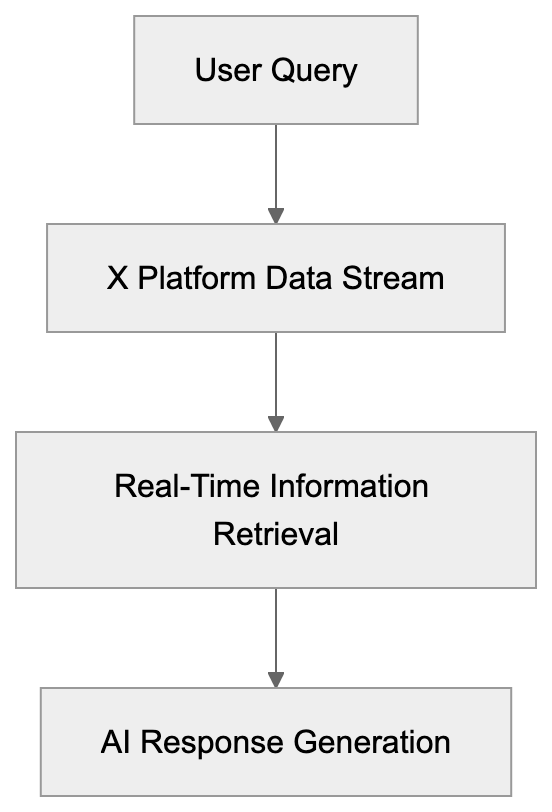
Grok is primarily accessed through the X platform. Users with X Premium or X Premium+ subscriptions can find Grok in the sidebar or through the Grok tab in the mobile app. The integration is seamless; you don’t need to leave X to use the AI. You can ask Grok questions directly in the interface and get responses that include citations to relevant posts on X.
Use Cases Include:
- Marketing Professionals: Monitor brand mentions and track campaign performance in real-time. Instead of waiting for analytics reports, they can ask Grok to summarize what people are saying about their products or services. This immediate feedback helps teams adjust their strategies quickly.
- Developers and Tech Professionals: Stay updated on breaking news in their fields. When a new framework is released or a security vulnerability is discovered, Grok pulls information from discussions on X among experts. This gives them access to crowdsourced knowledge not yet in official documentation.
- Content Marketers: Identify trending topics and understand what conversations are gaining traction. By asking Grok about specific industries or keywords, they can find what people are talking about and create timely content that addresses current interests.
- Web Developers: Track algorithm updates and industry changes. When search engines make announcements or industry leaders share ideas, Grok aggregates and provides summaries.
Grok’s Key Features and Capabilities
Grok’s main feature is real-time information access. The AI can read and analyze posts on X as they’re published. This ensures that when you ask about a current event, Grok provides up-to-the-minute information instead of saying its knowledge is outdated. The model can also cite specific posts as sources for its answers, offering transparency about where the information comes from.
The latest Grok-4 model includes advanced reasoning capabilities, performing better on complex problem-solving tasks. xAI reports significant improvements in mathematical reasoning, coding tasks, and multi-step logical problems. For developers, this means more reliable code suggestions and better debugging assistance.
Grok can understand and analyze images. You can upload a photo and ask questions about it. The AI can describe scenes, read text from images, and even explain diagrams or charts. This multimodal capability makes Grok useful for tasks involving visual information alongside text.
Grok’s personality and tone differ from other AI assistants. It’s designed to be conversational and can use humor in its responses. Grok has fewer content restrictions than competitors like ChatGPT. It will engage with topics other AI systems might decline to discuss, appealing to users seeking more direct answers without extensive safety disclaimers.
X Premium Requirements and Access
You cannot use Grok without an X Premium subscription. X Premium costs $8 per month (or $84 per year) in most regions. X Premium+ costs $16 per month (or $168 per year). Both subscription levels include Grok access, but Premium+ users get priority access during high-traffic periods and higher usage limits.
The subscription ties your exchanges with Grok to your X account, raising data collection considerations. X’s privacy policy states they collect data from your exchanges with their services, including Grok. This data may improve the AI and personalize your experience. However, there isn’t a clear opt-out option for preventing your Grok conversations from being used in AI training while still using the service.
For businesses considering Grok, the subscription cost is relatively low compared to other AI tools, but each team member needing access will require their own X Premium subscription. There’s no enterprise pricing or team management feature for Grok.
The access model means Grok usage is subject to X’s terms of service and community guidelines. If your X account is suspended or banned, you lose access to Grok as well. This dependency on the platform might be a consideration for businesses seeking guaranteed access to AI tools.
How Grok Compares to ChatGPT and Claude
Grok’s biggest advantage over ChatGPT and Claude AI is real-time information access. Unlike standard AI models with knowledge cutoffs, Grok’s direct integration with X ensures continuous access to current information without needing separate web search features.
In terms of reasoning and general capabilities, independent benchmarks suggest ChatGPT (GPT-4) and Claude 3.5 Sonnet still outperform Grok-3 on many tasks, but Grok-4 has significantly narrowed this gap. For specialized tasks involving current events or social media analysis, Grok has a clear edge. For complex reasoning, creative writing, or coding tasks, ChatGPT and Claude often produce better results.
ChatGPT and Claude offer free tiers with usage limits, whereas Grok doesn’t. ChatGPT Plus costs $20 per month; Claude Pro costs $20 per month, while X Premium with Grok access costs $8 per month. The price difference is notable, but an X account and participation in that ecosystem are required.
Content restrictions differ significantly. ChatGPT and Claude have extensive safety guidelines and will refuse many requests they deem potentially harmful or inappropriate. Grok has fewer restrictions and will engage with controversial topics more readily, which can be an advantage or disadvantage depending on your use case. For professional and business use, the stricter guidelines of ChatGPT and Claude might be preferable to avoid potential issues.
Integration capabilities also vary. ChatGPT and Claude offer API access for developers to build into their applications. In contrast, Grok currently doesn’t have a public API, limiting its use to the X platform interface. For developers who want to integrate AI into their products, ChatGPT and Claude are more flexible options.
Technical Workflow and Implementation
Grok operates by combining a large language model with real-time data retrieval from X. When you ask a question, the system analyzes your query to understand what information you need. If the question relates to current events or recent discussions, Grok searches through X’s data stream to find relevant posts and conversations.
The AI processes this information alongside its pre-trained knowledge to generate a response. For questions about breaking news or trending topics, Grok prioritizes recent posts from verified accounts and high-engagement discussions, filtering out misinformation and focusing on credible sources.
The underlying models (Grok-3 and Grok-4) are trained on a mix of public web data and conversations from X. xAI utilizes this training data to teach the model about language patterns, reasoning, and interpreting different types of queries.
For image understanding, Grok employs computer vision models that analyze uploaded images and extract information. You upload an image directly in the Grok interface and ask questions about it. The AI processes the visual information and combines it with its language understanding to provide answers.
The workflow for using Grok is straightforward. You open X, navigate to the Grok section, type your question or upload an image, and receive a response. For follow-up questions, Grok maintains conversation context, allowing for multi-turn dialogues. The system remembers what you discussed earlier and can reference previous points.
From a data perspective, your conversations with Grok are stored by X. The privacy policy indicates this data may be used to improve service, which typically includes AI training. Unlike some competitors, X doesn’t currently offer a clear option to opt out of having your Grok conversations used for training while still using the service.
Data Privacy and Usage Considerations
When you use Grok, your questions and the AI’s responses are collected by X. According to X’s privacy policy, the company uses data from your exchanges with their services to improve and personalize the platform, including conversations with Grok.
The policy doesn’t provide a specific opt-out mechanism for excluding Grok conversations from AI training data. For businesses and professionals handling sensitive information, this presents a consideration. You should avoid sharing confidential business data, personal information, or proprietary details in Grok conversations. The terms of service don’t guarantee that your inputs remain private or are excluded from training future AI models.
Compare this to ChatGPT, which allows users to turn off chat history and opt-out of having their conversations used for model training. Claude also provides options to control how your data is used. Grok’s integration with X means your usage is governed by X’s broader privacy policy, which doesn’t offer the same level of granular control.
The real-time access to X data also means Grok can see and reference public posts from any user on the platform. If you’re researching competitors or tracking brand mentions, the information Grok provides is already public, but the AI’s ability to aggregate and analyze this information quickly creates new capabilities that weren’t possible before.
For developers and technical users, there’s currently no API access to Grok, limiting its use programmatically or integration into automated workflows.
End
Grok represents a different approach to AI assistants by focusing on real-time AI information access through integration with X. The tool’s main strength is its ability to answer questions about current events using live data from the platform. This makes it valuable for tracking trends, understanding breaking news, and monitoring discussions as they happen. The latest Grok-4 model shows significant improvements in reasoning and problem-solving compared to earlier versions.
Access to Grok requires an X Premium subscription at $8 per month minimum. Your conversations with Grok are subject to X’s privacy policy and may be used for AI training without a clear opt-out option. For businesses handling sensitive information, this is an important consideration. Compared to ChatGPT and Claude AI, Grok offers lower pricing but fewer features for data privacy control and no API access.
Grok AI System Architecture:

The tool works best for users who need current information and are already active on X. Marketing professionals, content creators, and developers can benefit from Grok’s real-time capabilities for research and trend monitoring, but for tasks requiring maximum reasoning capability or strict content guidelines, alternatives like ChatGPT or Claude might be more appropriate. Grok’s unique positioning as a real-time AI assistant makes it a useful addition to an AI chatbot toolkit, particularly for users focused on social media intelligence and current events analysis.
Frequently Asked Questions
What features make Grok different from other AI assistants?
Grok's main differentiator is its real-time access to data from X, allowing it to answer questions about current events instantly. Additionally, its ability to analyze images and maintain a conversational tone with humor sets it apart from more traditional AI assistants.
How can Grok be deployed in a business setting?
Businesses can use Grok to track brand mentions, monitor trending topics, and provide real-time insights into public sentiment. It integrates easily within the X platform, enabling teams to quickly adapt their marketing strategies based on immediate feedback.
Are there privacy concerns when using Grok?
Yes, using Grok involves privacy considerations, as your conversations are collected and may be used for AI training by X. Users should avoid inputting sensitive information, as there's no clear opt-out for conversation data usage in training.
What subscription is required to access Grok?
Access to Grok requires an X Premium subscription, starting at $8 per month. For additional features like priority access during high traffic, users can subscribe to X Premium+, which costs $16 per month.
Can Grok handle complex reasoning tasks?
While Grok has improved in reasoning capabilities, it still may not perform as well as systems like ChatGPT or Claude in complex tasks. However, for questions involving current events or social media analysis, Grok has a clear advantage due to its real-time data access.
Is there an API available for Grok?
Currently, Grok does not have a public API, limiting its integration into other applications. Developers looking for more flexibility may find alternatives like ChatGPT or Claude more suitable.
What industries stand to benefit the most from Grok?
Marketing professionals, content creators, and developers are key users who can leverage Grok's real-time capabilities. Its ability to track trends and provide immediate insights makes it valuable across various sectors looking for timely information.
Track Your AI Visibility
See how AI chatbots like ChatGPT, Claude, and Perplexity discover and recommend your brand.