YandexGPT AI Engine: Features, Capabilities & Comparison
Complete guide to YandexGPT, the AI model powering Russia's leading search engine. Learn about features, Alice assistant, and how it compares to alternatives.
YandexGPT, the large AI language model developed by Yandex, fuels various Yandex services, including the popular Yandex search engine and the Alice assistant. The Alice (“Alisa”) assistant was upgraded from custom NLP (Natural Language Processing) to Yandex GPT in April 2024 to be fully powered by a large language model, enabling it to explain complex concepts and understand conversational context. This Russian AI model is designed primarily for Russian language processing, making it particularly effective for Russian-speaking users. Competing with systems like ChatGPT and Claude, YandexGPT focuses on Russian language understanding and generation, demonstrating significant potential in this area. Key features include conversational AI capabilities, text generation, and seamless integration across Yandex’s product ecosystem, with the latest version, YandexGPT 4, offering smarter reasoning and the ability to process up to four times more text.
What is YandexGPT
YandexGPT represents a family of neural network models created by Yandex for natural language processing tasks. These models are comparable to OpenAI’s GPT series, with versions varying in size and capabilities. They efficiently understand context, generate text, and handle multiple language tasks simultaneously.
YandexGPT Integration in Yandex Ecosystem:
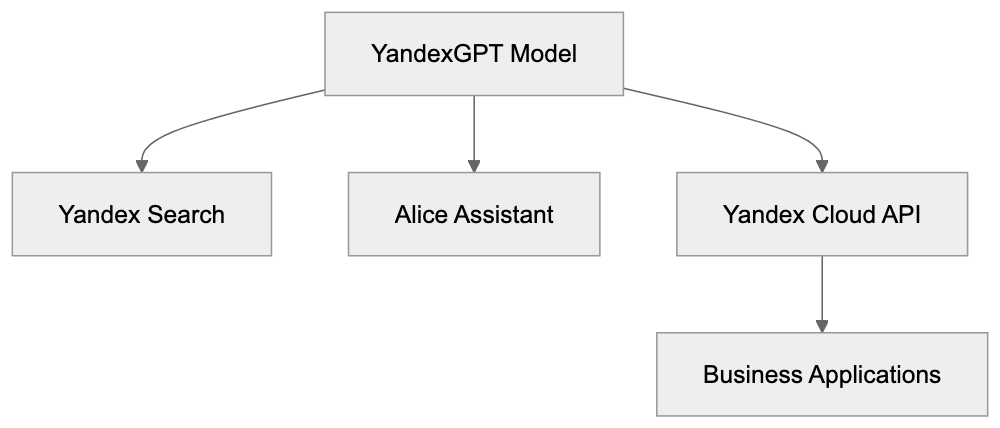
The technology behind YandexGPT utilizes transformer architecture, similar to most modern AI language models. However, it is specifically trained on Russian language data, giving it an edge with Russian text compared to models trained primarily on English. Yandex offers YandexGPT through its Yandex Cloud platform, providing API access for developers to integrate this Russian language AI model into applications.
Why YandexGPT Exists and Its Purpose
YandexGPT was created to maintain Yandex’s competitive advantage in the Russian tech market. Western AI models often struggle with Russian language nuances and cultural context. By developing a local model, Yandex effectively addresses these gaps. The primary purpose of YandexGPT is to enhance Yandex search results and deliver more relevant answers to user queries.
Furthermore, YandexGPT serves as a cornerstone for Yandex’s AI strategy, including monetization through Yandex Cloud services. Companies use the YandexGPT API to integrate conversational features into applications and automate text-related tasks.
Improving Russian language processing remains a core focus. Russian grammar and syntax are complex, and YandexGPT handles these linguistic features better than models trained primarily on English, making it ideal for Russian language applications.
How Yandex and Users Utilize YandexGPT
Yandex has integrated YandexGPT into its search engine to provide direct answers to queries, similar to how Google uses AI in its search results. This allows users to get faster answers without visiting multiple websites.
YandexGPT Core Capabilities:

The Alice assistant heavily relies on YandexGPT technology. Available on smartphones and smart speakers, Alice can converse, answer questions, and control smart home devices. YandexGPT enhances these interactions, making them more natural and context-aware.
Businesses use the YandexGPT API for customer service automation. For instance, chatbots powered by this AI model can address common questions and support requests. In e-commerce, YandexGPT aids product recommendations and automated content generation.
Developers access YandexGPT through the Yandex Cloud platform. Pricing is based on the number of tokens processed, which is typical for AI language model APIs. Different model versions are available to meet varying accuracy and speed requirements.
Content creators utilize YandexGPT for writing assistance, draft generation, and text rephrasing. News organizations explore its potential for automated article summaries, keeping human oversight essential.
Market Position and Key Facts
Yandex holds approximately 60-65% of the Russian search engine market share, making it the dominant player ahead of Google. The extensive user base provides vast data for training and improving YandexGPT.
Yandex search began integrating generative AI features in 2023, gradually enhancing query types. Users began seeing AI-generated summaries for informational searches, with continuous expansion through 2024.
Alice, launched in 2017, received significant upgrades when YandexGPT technology became available. Now, the assistant handles complex conversations and understands context better, available in Russian and supporting voice commands.
Yandex Cloud offers YandexGPT API access based on usage. It provides various model sizes to cater to different needs. Smaller models balance speed and cost, while larger models offer better accuracy for complex tasks.
YandexGPT Compared to Alternatives
Several AI language models compete in the Russian and global markets. Here is a comparison of YandexGPT with major alternatives:
| Feature | YandexGPT | ChatGPT | GigaChat | Claude | Gemini |
|---|---|---|---|---|---|
| Primary Language | Russian | English | Russian | English | English |
| Russian Language Quality | Excellent | Good | Excellent | Good | Good |
| API Access | Yes via Yandex Cloud | Yes via OpenAI | Yes via Sber | Yes via Anthropic | Yes via Google |
| Free Tier | Limited | Limited | Limited | Limited | Limited |
| Search Integration | Yandex Search | Bing (via partnership) | None native | None native | Google Search |
| Virtual Assistant | Alice | None native | GigaChat Assistant | None native | Google Assistant |
| Market Focus | Russia/CIS | Global | Russia | Global | Global |
| Availability in Russia | Unrestricted | Restricted | Unrestricted | Restricted | Restricted |
Globally, ChatGPT is perhaps the most renowned alternative. While it handles Russian text reasonably well, it lacks the cultural context understanding that YandexGPT offers. Moreover, access to ChatGPT is complicated in Russia due to restrictions.
Russian AI Market Landscape:
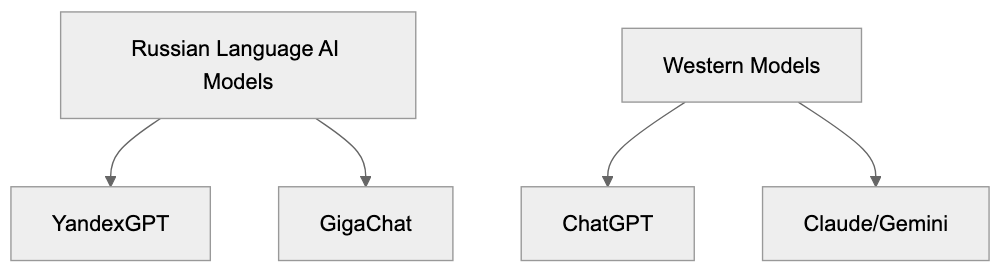 GigaChat, developed by Sberbank, is another Russian alternative focusing on Russian language improvement and operates as part of Sber’s services ecosystem. Both YandexGPT and GigaChat aim to provide domestic AI solutions independent of Western technology.
Western alternatives like Claude and Gemini, with strong capabilities, handle Russian language decently but were trained primarily on English data. Consequently, their understanding of Russian cultural nuances is less developed than YandexGPT’s.
For Russian language tasks, YandexGPT and GigaChat currently offer the best performance. Western models remain preferable for multilingual tasks or primarily English applications, depending on the use case and geographic location.
Technical Capabilities and Limitations
YandexGPT supports standard natural language processing tasks, including text generation, summarization, translation, question answering, and conversational dialogue. The model handles context from previous conversation messages, enabling more natural exchanges.
The model has context window limitations, similar to all language models, controlling the amount of text processed at once. Larger contexts allow working with longer texts but increase processing costs.
YandexGPT excels at comprehending Russian morphology and syntax, including informal internet language and slang. Limitations include the potential for generating incorrect information, necessitating fact verification from reliable sources.
Performance with non-Russian languages diminishes compared to specialized models. Multilingual applications may require multiple models for optimal results.
Real-time information access is limited by the model’s training data cutoff date, unlike search-integrated features with current information access.
Privacy and Data Considerations
Yandex collects user exchanges with YandexGPT-powered features to improve performance. Their privacy policy governs data usage. API users should understand data handling policies and options to opt out of data collection where available.
Data residency is crucial for some entities, and YandexGPT processes data within Yandex’s infrastructure, ensuring data remains within Russia. This consideration impacts compliance and privacy evaluations.
Conversations with the Alice assistant are analyzed to enhance service quality. Users can delete voice history through account settings, though processes may vary.
Comparisons with Western alternatives, where data might be processed internationally, reveal different privacy implications. Each organization should evaluate based on specific compliance and privacy needs.
End
YandexGPT is Russia’s significant entry into the large language model arena, enhancing Yandex search and Alice assistant capabilities. Its key strength is Russian language understanding and generation, offering great value to Russian-speaking users and businesses.
Competing with Western alternatives like ChatGPT and Claude, YandexGPT excels in Russian language performance due to specialized training. GigaChat provides similar features as a domestic option.
Accessible via Yandex Cloud API, YandexGPT supports customer service automation, content generation, and conversational interfaces. Developers should consider Russian language needs when choosing between YandexGPT and alternatives.
Yandex holds a 60-65% market share in Russian search, with YandexGPT integrated across multiple products. As AI technology evolves, YandexGPT remains a top choice for Russian language AI applications alongside GigaChat, while Western models suit primarily English or multilingual applications.
Frequently Asked Questions
What languages does YandexGPT support?
YandexGPT is primarily designed for Russian language processing, offering excellent comprehension and generation of Russian text. While it can handle some non-Russian languages, its performance is optimized for Russian, making it less effective for tasks in other languages.
How can businesses integrate YandexGPT?
Businesses can access YandexGPT through the Yandex Cloud platform. They can utilize the API to incorporate conversational features into their applications, automate text-related tasks, or enhance customer service through chatbots powered by YandexGPT technology.
Does YandexGPT have limitations?
Yes, YandexGPT has limitations similar to other AI models, particularly in generating potentially incorrect information. Users should verify essential facts through reliable sources, especially since performance with non-Russian languages is not as strong as with Russian.
How does YandexGPT compare to ChatGPT?
While both YandexGPT and ChatGPT offer powerful language processing capabilities, YandexGPT excels in understanding Russian language nuances and cultural context. ChatGPT is more widely known globally but may not handle Russian text with the same depth and accuracy as YandexGPT.
What is the primary use of YandexGPT?
The primary use of YandexGPT is to enhance Yandex’s search engine results and provide relevant answers to user queries. Additionally, it supports applications in automation, content creation, and conversational AI.
Is user data collected when using YandexGPT?
Yes, Yandex collects user exchanges with YandexGPT features to improve performance, as outlined in their privacy policy. Users have options to manage data collection preferences, including the ability to delete voice history associated with the Alice assistant.
What industries can benefit from YandexGPT?
Multiple industries can benefit from YandexGPT, including e-commerce for product recommendation and content generation, customer service through automated chatbots, and journalism for generating article summaries and drafting support.
Track Your AI Visibility
See how AI chatbots like ChatGPT, Claude, and Perplexity discover and recommend your brand.