Claude AI by Anthropic: Features, Models & Safety Guide
Complete guide to Claude AI - Anthropic's chatbot with 200K context window, multiple models, API access, and safety-focused design for developers.
Table of Contents
- What is Claude AI?
- Why Claude Exists and Its Purpose
- How Users and Companies Use Claude
- Claude Models and Versions
- Claude Features Breakdown
- Comparing Claude to Alternatives
- Claude API and Integration
- Enterprise and Safety Features
- Claude Pro Subscription Details
- Privacy and Data Usage
- Getting Started with Claude
- Conclusion
- What is Claude AI?
- Why Claude Exists and Its Purpose
- How Users and Companies Use Claude
- Claude Models and Versions
- Claude Features Breakdown
- Comparing Claude to Alternatives
- Claude API and Integration
- Enterprise and Safety Features
- Claude Pro Subscription Details
- Privacy and Data Usage
- Getting Started with Claude
- Conclusion
Claude AI: Revolutionizing AI Safety and Assistance
Claude is an AI chatbot and assistant developed by Anthropic. The company was founded in 2021 by former OpenAI researchers determined to build safer AI systems. Claude stands out for its constitutional AI approach, following specific rules and principles during training. This tool handles conversations, writes code, analyzes documents, and assists with various tasks, making it a versatile AI assistant.
Claude is unique for its massive 200K token context window, especially in earlier models like Claude 3.5 Sonnet, allowing you to work with lengthy documents. This service offers free access with additional paid tiers for power users and businesses. Anthropic has released multiple versions of Claude, including Claude 3 Opus, Claude 3 Sonnet, and Claude 3.5 Sonnet, each with distinct performance levels. Developers can access Claude through the Claude API, enabling companies to deploy it for enterprise use.
What is Claude AI?
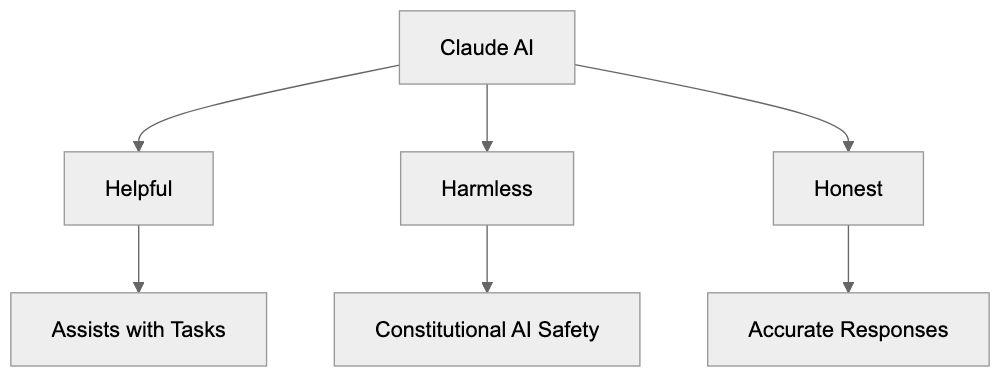
Claude’s Core Design Principles:
Claude is a conversational AI assistant built on large language models (LLM), developed by Anthropic. Users interact with it through text, either by asking questions or giving instructions. The system processes inputs to generate human-like responses. Anthropic designed Claude to be helpful, harmless, and honest, guided by these three principles. This Claude chatbot can summarize documents, write content, answer questions, help with coding tasks, and analyze data. Unlike some AI tools that feel robotic, Claude aims for natural conversations.
The interface is clean and simple; users type messages and receive responses without complicated setups. The free tier grants access to Claude with some usage limits, while paid plans offer more features and higher usage caps.
Why Claude Exists and Its Purpose
Anthropic developed Claude AI to address safety concerns in AI development. Founders believed existing AI models needed better alignment with human values, introducing constitutional AI as a method where the model learns from principles rather than just human feedback. The goal is to craft AI that’s both capable and safe for widespread use. Claude targets a need for AI assistants that won’t produce harmful content or give dangerous advice. By incorporating safety into its core design, Claude AI serves developers seeking dependable API access, businesses needing document analysis, and individuals wanting a capable AI assistant. Competing directly with OpenAI’s ChatGPT and Google’s Gemini, Claude focuses heavily on AI safety.
How Users and Companies Use Claude
Developers integrate Claude through the Claude API to enhance applications. JSON responses are easy to parse and incorporate into code. Small businesses utilize Claude AI for customer support, drafting emails, and content creation. The 200K context window is particularly beneficial, as users can input entire codebases or long documents and ask specific questions.
Claude AI Development Approach:

Marketing professionals leverage it to generate copy, analyze campaign data, and brainstorm ideas. Web developers utilize Claude for debugging, writing documentation, and explaining technical concepts. The Artifacts feature enables users to create and iterate on content like code snippets or documents in a side panel while chatting.
Enterprise customers deploy Claude AI for internal tools, research assistance, and data processing. Some companies utilize it to analyze legal documents or technical manuals, capitalizing on its large context window. The Claude API pricing model is token-based, letting users pay as they go. Claude Pro subscribers receive priority access during high traffic and can send more messages.
Claude Models and Versions
Anthropic offers several Claude models with varying capabilities. Claude 3 Opus was a powerful version handling complex tasks and subtle instructions. Claude 3 Sonnet balanced performance and speed, suitable for most everyday tasks. In 2024, Claude 3.5 Sonnet was released, improving coding abilities and response times. Earlier models have a 200K token context window, but newer models may differ in reasoning ability and cost. Opus costs more per token but delivers better results for challenging problems. Sonnet models are cheaper and faster, ideal for high-volume use cases. All models support multiple languages, though English performs best. Users can switch between models based on needs, using Opus for critical tasks and Sonnet for routine work. Anthropic updates these models regularly, adding features and improving safety guardrails.
Claude Features Breakdown
The 200K token context window is a standout feature for earlier Claude models, as reported by CNBC. This equates to approximately 150,000 words or about 500 pages of text. Users can upload entire books, codebases, or research papers and ask questions. The Artifacts feature creates a workspace alongside the chat, allowing iterative generation and editing of code, documents, or content. This keeps conversations clean while facilitating things build iteratively.
Claude supports file uploads, such as PDFs, text files, and images in some versions. The vision capabilities allow Claude to analyze images and describe them. Claude Pro costs $20 per month in the US, offering significantly more usage than the free tier. Subscribers receive priority access during peak times and early access to new features. Different pricing tiers are available on the Claude API, based on the model used. Streaming responses allow users to see the output as it’s generated. Built-in safety filters help decline harmful requests.
Comparing Claude to Alternatives
Here’s how Claude compares with other major AI assistants:
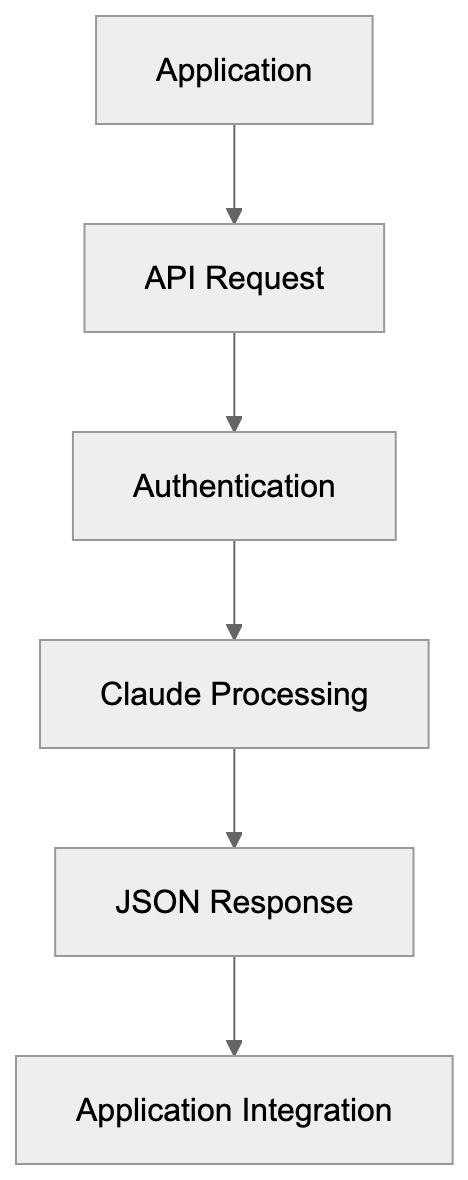
Claude API Integration Flow:
| Feature | Claude 3.5 Sonnet | ChatGPT-4 | Gemini Pro | Llama 3 | Mistral Large |
|---|---|---|---|---|---|
| Context Window | 200K tokens | 128K tokens | 32K tokens | 8K tokens | 32K tokens |
| Free Tier | Yes | Limited | Yes | Open source | Limited |
| API Access | Yes | Yes | Yes | Self-hosted | Yes |
| Vision Support | Yes | Yes | Yes | No | Limited |
| Mobile App | Yes | Yes | Yes | N/A | No |
| Monthly Pro Cost | $20 | $20 | $20 | Free | Varies |
Claude excels with its large context window, crucial for document analysis. ChatGPT boasts wider name recognition and integrations, while Gemini integrates with Google services. Llama 3 is open source, requiring technical setup for self-hosting. Mistral offers European-based AI, appealing to companies preferring European data residency. Claude’s safety focus attracts enterprises concerned about liability. The Claude API pricing is competitive, comparable to OpenAI’s. Response quality varies by task, with some users favoring Claude AI for writing, while others choose ChatGPT for coding. Testing different models for specific use cases is advisable.
Claude API and Integration
The Claude API utilizes REST endpoints that return JSON responses. Authentication is done via an API key from an Anthropic account. Rate limits vary based on your tier, with free accounts having lower limits while paid plans offer more. API documentation is comprehensive, with code examples in Python, JavaScript, and other languages.
Messages are sent in a conversation format, maintaining context across multiple turns. Streaming allows users to process responses as they arrive, rather than waiting for completion. The API supports system prompts where users define Claude’s behavior and role. Error handling is straightforward, using standard HTTP status codes. Pricing is per million tokens, with input tokens cheaper than output tokens. Opus costs more per token than Sonnet models.
Behavior can be fine-tuned through prompt engineering rather than model training. The API includes safety features that may refuse certain requests. Response times are generally fast, usually under a few seconds for typical queries. Usage is monitored through the Anthropic dashboard.
Enterprise and Safety Features
Anthropic provides enterprise plans with custom contracts and volume pricing. Enterprise customers receive dedicated support, SLAs, and security reviews. Claude’s constitutional AI training follows principles like respecting privacy and avoiding deception, reducing risks compared to models trained purely on human feedback.
Claude AI does not assist with illegal activities, generating malware, or creating misleading content. Safety filters may trigger excessively, frustrating users, but prevent misuse. Companies in regulated industries like healthcare and finance use Claude for these safeguards. Data handling policies specify that Anthropic does not train on enterprise customer data by default.
Opt-out options exist for data collection for model improvement in account settings. The company publishes research on AI safety and transparency. Enterprise deployments can occur in private clouds for sensitive data. Anthropic performs red teaming to identify vulnerabilities before release, updating safety measures as new risks arise.
Claude Pro Subscription Details
Claude Pro costs $20 per month, targeting power users. It offers roughly 5x more usage compared to the free tier before users hit rate limits. Though exact message limits are unpublished, Pro users report sending hundreds of messages daily. Priority access ensures faster response times during peak hours when free users might experience slowdowns.
Pro subscribers get early access to new features and models before general release. The subscription does not include API access, which is billed separately. Users can access Claude Pro on both web and mobile apps. The plan supports the same features as the free tier, including file uploads and Artifacts. Some users find the free tier sufficient for occasional use, while professionals need Pro for daily work. There’s no annual discount currently, as it’s a month-to-month subscription. Users can cancel at any time without penalties. The Pro tier is beneficial if you exceed free tier limits or need reliable access for work, while students and casual users often stick with the free tier.
Privacy and Data Usage
When using Claude AI without an account, conversations might be collected for training purposes. Creating an account gives users more control over data usage. In account settings, users can opt-out of having data used for model improvement.
Enterprise customers negotiate data handling in their contracts. Anthropic states it does not sell user data to third parties. The privacy policy explains what data is collected and how it’s used. Conversations are stored on Anthropic servers, but enterprise plans can negotiate data residency.
If users paste sensitive information into Claude AI, considering privacy implications is important. The free tier offers fewer privacy guarantees than paid plans. For confidential business data, using the Claude API with proper data handling agreements is advisable. Anthropic publishes transparency reports about government requests and complies with GDPR and other privacy regulations. Users can request data deletion through account settings. It is recommended to always check current privacy policies, as updates may occur.
Getting Started with Claude
Visit claude.ai to access the web interface. Claude can be used without creating an account, but features are limited. Signing up with email or Google authentication unlocks full features. The free tier provides immediate access after signup.
Start with simple questions to understand Claude’s responses. Try uploading a document to test the context window capabilities. Experiment with different prompt styles for better results. For Claude API access, visit console.anthropic.com and generate an API key. Read the documentation before making your first API call.
Install the official Python or JavaScript SDK for easier integration. Test with the free tier before committing to Pro or API spending. Join the Anthropic Discord or forums to learn from other users. Follow Anthropic’s blog for updates on new features and models. Set usage alerts if you’re on a paid plan to avoid surprise bills. Remember, Claude AI has a knowledge cutoff date and won’t be aware of recent events.
Conclusion
Claude AI by Anthropic offers a safety-focused alternative in the AI assistant space. The 200K context window distinguishes it for document analysis and complex tasks. Multiple models let users balance cost versus performance based on needs. The constitutional AI approach is appealing to enterprises concerned about AI risks.
Claude Pro offers power users higher limits, while the Claude API serves developers building applications. Competition with ChatGPT and Gemini drives continuous improvements. The Artifacts feature and vision support expand capabilities beyond simple chat. Privacy controls and enterprise options meet business requirements. Whether users need help with coding, writing, analysis, or general questions, Claude AI handles varied use cases. Its capability and safety focus make it an AI assistant worth exploring.
Frequently Asked Questions
What are the main features of Claude AI?
Claude AI offers features like a 200K token context window for handling large documents, an Artifacts tool for iterative content creation, and vision capabilities for image analysis. It supports file uploads and provides a clean interface for conversational interactions.
How does Claude AI ensure safety in its responses?
Claude AI incorporates safety measures that prevent it from generating harmful content or providing dangerous advice. Its constitutional AI approach guides its training, emphasizing helpfulness and honesty to align with human values.
Can I use Claude AI for coding tasks?
Yes, Claude AI is equipped to assist with coding tasks such as debugging, writing documentation, and generating code snippets. Its large context window allows users to input significant portions of code for more accurate assistance.
What subscription options are available for using Claude?
Claude offers a free tier with limited usage and a paid subscription called Claude Pro, which costs $20 per month. Pro subscribers enjoy greater usage limits and priority access during peak times.
How can developers integrate Claude AI into their applications?
Developers can access Claude AI through its API, which utilizes REST endpoints returning JSON responses. The API documentation provides comprehensive guides and code examples in various languages, making it easy to integrate into applications.
What should I know about privacy when using Claude AI?
Users can control their data usage by creating an account, which provides options to opt-out of using data for model improvement. For enterprise customers, data handling policies can be negotiated, ensuring privacy and compliance with regulations.
Are there any limitations to the free tier of Claude?
The free tier offers fewer features and lower usage limits compared to paid plans. Users may find it suitable for occasional use, but professionals or heavy users may require the Pro subscription for reliable access.