AI Search Engines: Perplexity vs ChatGPT vs Google AI
Table of Contents
- What Are AI Search Engines
- Why AI Search Engines Exist
- How These AI Search Engines Work
- Key Features and Capabilities
- Accuracy and Source Citations
- Speed and Response Quality
- Pricing and Access Models
- Best Use Cases for Each Platform
- Comparison Table
- Alternative AI Search Tools
- Privacy and Data Usage
- Technical Limitations
- Combining and API Options
- Making Your Choice
- What Are AI Search Engines
- Why AI Search Engines Exist
- How These AI Search Engines Work
- Key Features and Capabilities
- Accuracy and Source Citations
- Speed and Response Quality
- Pricing and Access Models
- Best Use Cases for Each Platform
- Comparison Table
- Alternative AI Search Tools
- Privacy and Data Usage
- Technical Limitations
- Combining and API Options
- Making Your Choice
What Are AI Search Engines
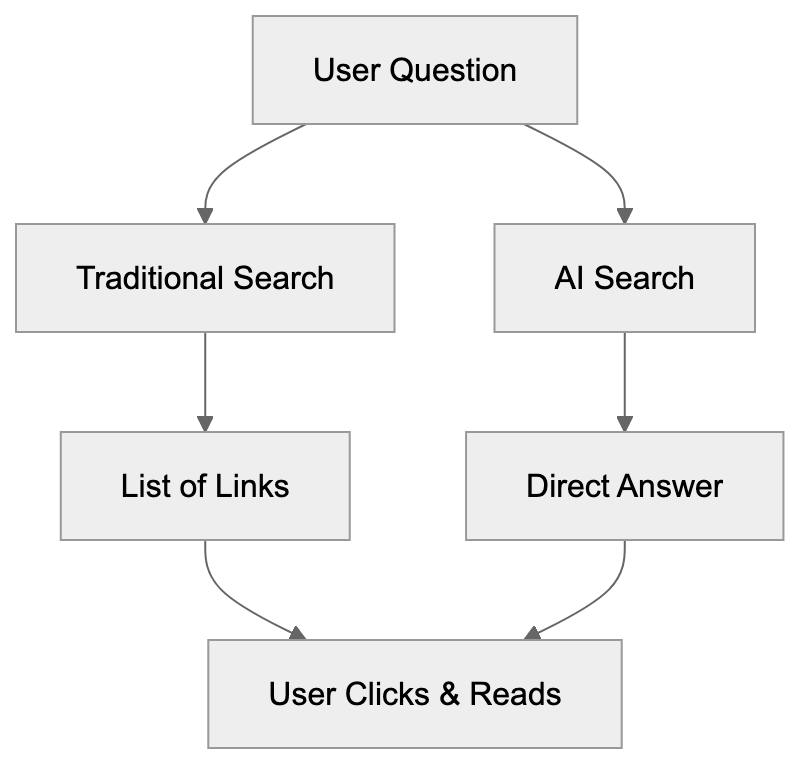
AI search engines represent a new way to find information online. Unlike traditional search engines that show a list of links, these tools provide direct answers. They use large language models to understand your questions and respond in natural language.
Perplexity AI, ChatGPT Search, and Google AI Overview are three major players in this space. Each takes a different approach to answering questions:
- Perplexity focuses on citing sources and research.
- ChatGPT Search emphasizes conversational responses.
- Google AI Overview combines traditional search with AI answers.
These AI tools matter because they save time. Instead of clicking through multiple websites, you get your answer right away. Software developers use them for quick documentation lookups. Marketing professionals use them for research. Small business owners use them to find information fast.
The main features vary between platforms. Perplexity AI provides citations with every answer. ChatGPT Search offers follow-up conversations. Google AI Overview appears directly in search results. Understanding these differences helps you pick the right tool for your needs.
Why AI Search Engines Exist
Traditional search engines were built for a different era. They index websites and rank them by relevance, requiring users to click multiple links to find answers. This process works but takes time.
Core Difference in Approach:
AI search engines solve this problem by understanding natural language. They process your question and generate a direct answer, removing the need to scan through numerous websites. The technology involves training models on massive datasets.
Companies build these tools for different reasons:
- OpenAI created ChatGPT Search to extend their chatbot capabilities.
- Google developed AI Overview to keep users on their platform.
- Perplexity was built specifically as an AI-first search engine.
The purpose is clear: make information access faster and more intuitive. Businesses benefit too. Customer support teams use these tools to answer questions quickly. Developers use them as coding assistants. The applications continue to grow as the technology improves.
How These AI Search Engines Work
Perplexity works by combining search with language models. When you ask a question, it searches the web for relevant sources and synthesizes those sources into an answer. Every response includes citations.
ChatGPT Search operates differently, using the GPT-4 architecture with real-time web access. It responds conversationally because that’s what GPT excels at, but lacks explicit source citations for verification.
AI Search Engine Architecture:

Google AI Overview appears at the top of regular Google searches. It generates AI summaries using Google’s Gemini models combined with their search index, making it convenient but less interactive.
Key Features and Capabilities
Perplexity offers several distinct features:
- Choose different AI models including GPT-4 and Claude.
- Upload files and search specific sources like academic papers.
- Citations appear inline, aiding easy fact-checking.
ChatGPT Search integrates with the main ChatGPT interface:
- Access search capabilities if you have ChatGPT Plus.
- Refine your question without starting over.
Google AI Overview features:
- Appears in regular Google searches.
- Summaries are concise and include links for more details.
Accuracy and Source Citations
Accuracy varies between platforms and depends on the question.
- Perplexity is reliable for factual queries due to its citations.
- ChatGPT Search lacks consistent citation formatting.
- Google AI Overview benefits from high-quality sources but may oversimplify complex topics.
Speed and Response Quality
Perplexity delivers responses in a few seconds with high research quality, though responses can be wordy for simple questions.
ChatGPT Search responds quickly, with quality depending on the question type.
Google AI Overview appears almost instantly, with summaries that prioritize brevity.
Pricing and Access Models
- Perplexity: Free tier and Pro for $20/month with advanced models.
- ChatGPT Search: Available to ChatGPT Plus subscribers at $20/month.
- Google AI Overview: Free with no subscription required.
Best Use Cases for Each Platform
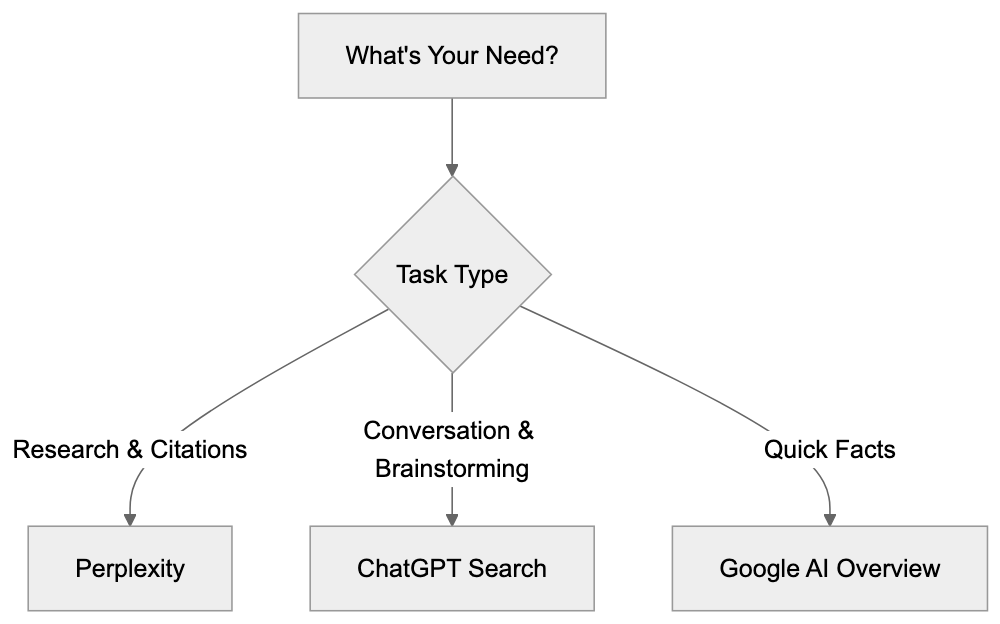
- Perplexity: Best for research and fact-finding with source citations.
- ChatGPT Search: Excels at conversational queries and brainstorming.
- Google AI Overview: Ideal for quick factual lookups without leaving search results.
Comparison Table
| Feature | Perplexity | ChatGPT Search | Google AI Overview |
|---|---|---|---|
| Base Model | Multiple options | GPT-4 | Gemini |
| Citations | Yes, inline | Limited | Source links |
| Free Tier | Yes | No | Yes |
| Paid Price | $20/month | $20/month | Free |
| Conversation | Basic | Advanced | None |
| Response Speed | Fast | Fast | Very fast |
| Mobile App | Yes | Yes | Web only |
| API Access | No | Yes | Limited |
| Source Control | Focus modes | None | None |
| Best For | Research | Dialogue | Quick answers |
Alternative AI Search Tools
Beyond the big three, other options include You.com for privacy-focused search, Bing Chat for general queries, Phind for developer questions, Metaphor for semantic searches, and Brave Search for privacy-respecting summaries.
Privacy and Data Usage
Privacy practices vary by platform, with different levels of control over data usage, search history, and query processing.
Technical Limitations
Platform Selection Guide:
 All platforms struggle with very recent information and complex logical reasoning. Perplexity might misattribute sources, ChatGPT can hallucinate information, and Google might simplify complex answers.
Combining and API Options
- Perplexity does not offer a public API.
- ChatGPT Search integrates with OpenAI’s API for custom applications.
- Google AI Overview lacks a standalone API, but Google Cloud offers similar features.
Making Your Choice
Choose Perplexity AI for research tasks. Pick ChatGPT Search for conversational queries. Opt for Google AI Overview for quick lookups. Many users combine multiple tools based on their strengths.
AI search engines have changed how we find information online. Perplexity AI, ChatGPT Search, and Google AI Overview each offer different approaches. Understanding these differences helps you pick the right tool for each situation. As AI technology advances, these platforms will continue evolving and adding new capabilities.
Frequently Asked Questions
What are the main differences between the three AI search engines?
Each AI search engine has a unique focus: Perplexity emphasizes research with citation support, ChatGPT Search excels in conversational responses, and Google AI Overview provides quick summaries integrated into regular search results. Choosing the right one depends on your specific needs like research, interaction, or speed.
How do I know which AI search engine to use for my needs?
Consider what you need the tool for: use Perplexity for research and fact-checking, ChatGPT for interactive and exploratory inquiries, and Google AI for quick answers. Understanding these use cases will guide you in selecting the most appropriate platform.
Are these AI search engines free to use?
Perplexity offers a free tier along with a Pro version at $20/month. ChatGPT Search requires a ChatGPT Plus subscription for $20/month, while Google AI Overview is free with no subscription necessary.
Can I trust the accuracy of the information provided by these AI search engines?
Accuracy can vary by platform. Perplexity is reliable for factual queries due to its citations, whereas ChatGPT Search may lack consistent citations, and Google AI Overview can oversimplify complex topics. Always cross-reference important information, especially when accuracy is critical.
What should I be aware of regarding privacy while using these platforms?
Privacy practices differ among platforms. Each has varying controls over data usage and search history, so it's essential to review their privacy policies to understand how your data is handled.
Can I integrate any of these AI search engines into my applications?
ChatGPT Search provides API integration through OpenAI's API, while Perplexity does not offer a public API. Google AI Overview also doesn't have a standalone API, but similar features can be accessed through Google Cloud.
What limitations should I consider when using these AI search engines?
All platforms face challenges with very recent information and complex logical reasoning. Be cautious of potential inaccuracies, such as misattributed sources on Perplexity, hallucinations in ChatGPT, and oversimplified responses from Google AI.
Related Articles
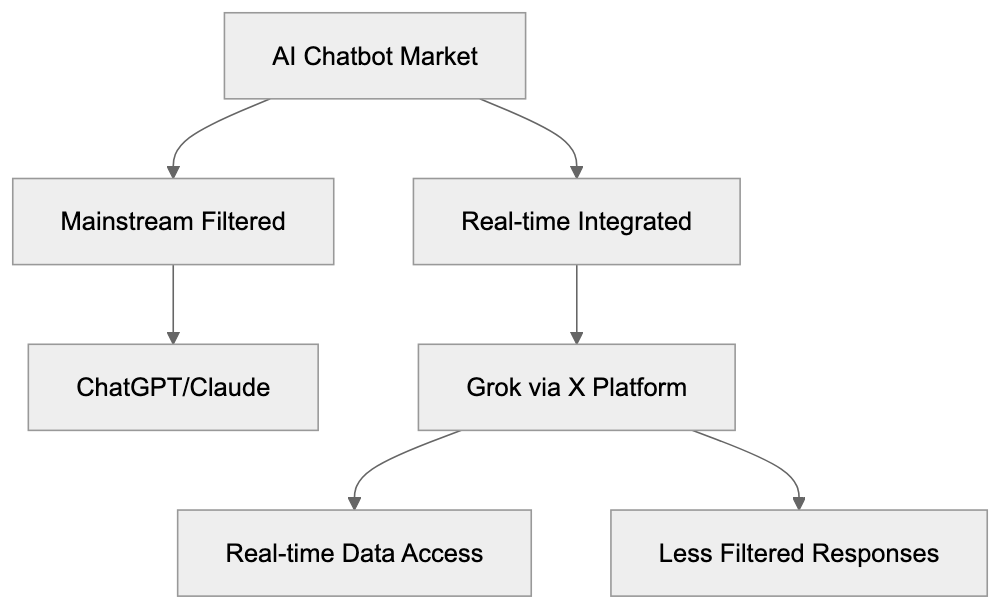
Grok AI Chatbot by xAI: Features, Models & Comparison
Complete guide to Grok by xAI. Learn about Grok-3/4 models, real-time X integration, unfiltered responses, and how it compares to other AI chatbots.
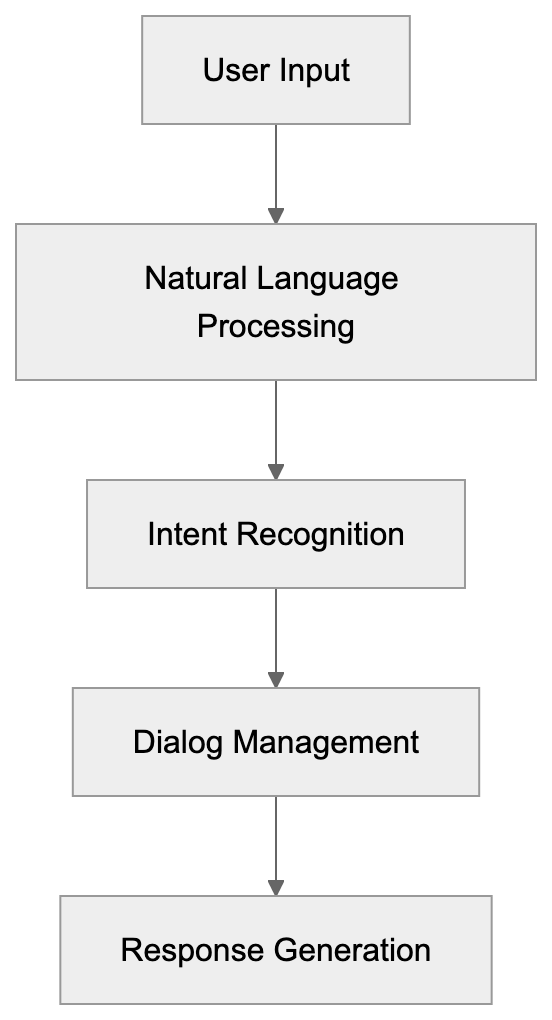
IBM watsonx Assistant: Leading Enterprise Conversational AI
Explore IBM watsonx Assistant for enterprise AI, covering customer service automation, NLP, and hybrid cloud solutions.
Pi AI: Inflection's Empathetic Personal Chatbot Explained
Learn about Pi AI from Inflection AI. An emotional chatbot focusing on empathy and conversation rather than productivity tasks.