Wikipedia & AI Visibility: What Businesses Need to Know
How Wikipedia shapes AI knowledge and why most businesses won't qualify for a page. Learn notability rules and AI training facts.
Table of Contents
- Why Wikipedia Matters for AI Systems
- What Makes Wikipedia So Important for AI Training
- Wikipedia Notability Requirements Explained Simply
- Why You Should Never Write Your Own Wikipedia Article
- How Wikipedia Information Shapes AI Knowledge About Your Business
- Comparing Wikipedia to Other Knowledge Platforms
- Alternative Strategies for AI Visibility Without Wikipedia
- Understanding the Long-term Implications
- Practical Steps to Take Today
- Conclusion
- Why Wikipedia Matters for AI Systems
- What Makes Wikipedia So Important for AI Training
- Wikipedia Notability Requirements Explained Simply
- Why You Should Never Write Your Own Wikipedia Article
- How Wikipedia Information Shapes AI Knowledge About Your Business
- Comparing Wikipedia to Other Knowledge Platforms
- Alternative Strategies for AI Visibility Without Wikipedia
- Understanding the Long-term Implications
- Practical Steps to Take Today
- Conclusion
Why Wikipedia Matters for AI Systems
Wikipedia has become the backbone of AI knowledge. Every major language model you interact with has trained on Wikipedia content. The platform contains over 6.9 million English articles that are fed into AI systems during training. In 2024, Wikimedia partnered with Kaggle to release datasets improved specifically for AI training purposes. This means whatever is written about your business on Wikipedia directly influences what AI chatbots say about you.
However, here’s a reality check most small businesses need to hear: you probably won’t get a Wikipedia page, and that’s completely normal. The platform has strict notability requirements that exclude most companies and individuals. This guide explains how Wikipedia influences AI systems, what the notability criteria actually mean, and why writing your own article is a terrible idea.
What Makes Wikipedia So Important for AI Training
Wikipedia is a primary knowledge source for large language models. The platform offers clean, structured data that AI systems can easily process. Articles follow consistent formatting with citations and clear hierarchies, making Wikipedia ideal for training compared to messy, unstructured web content. OpenAI’s GPT models, Google’s LaMDA, and Bard, Anthropic’s Claude, and Meta’s LLaMA models have all trained on Wikipedia data.
Wikipedia’s Role in AI Knowledge:
The 2024 Wikimedia-Kaggle partnership has made this relationship even stronger by releasing curated datasets designed specifically for machine learning applications. These datasets include structured information from millions of articles and aim to improve how AI systems understand and generate factual content. So when you ask ChatGPT or another AI assistant about a company or person, it checks the knowledge it learned from Wikipedia during AI training.
Wikipedia’s influence extends beyond just text generation. Knowledge graphs used by search engines pull heavily from Wikipedia data. Google’s Knowledge Panel often sources information directly from Wikipedia articles. Voice assistants like Alexa and Siri reference Wikipedia for factual queries. The platform has become the de facto source of truth for automated systems across the internet, significantly boosting Wikipedia visibility.
Wikipedia Notability Requirements Explained Simply
Here’s where most businesses hit a wall. Wikipedia has strict notability guidelines that determine what deserves an article. The core requirement is significant coverage in multiple independent reliable secondary sources. Let’s break down what each part of that phrase actually means.
- Significant coverage: Substantial discussion, not just a passing mention. A single sentence in an article doesn’t count.
- Multiple: Requires several sources, not just one or two.
- Independent: Sources can’t be connected to the subject.
- Reliable: Must be established publications with editorial oversight.
- Secondary: Sources must be about the subject, not created by the subject.
What doesn’t count? Press releases, company blogs, social media posts, paid advertorials, user-generated content sites, and directory listings don’t count. Most local news coverage doesn’t count unless it’s in-depth reporting.
Wikipedia Notability Requirements:

What does count? Articles in major newspapers like the New York Times or Wall Street Journal, coverage in established industry publications, academic papers, peer-reviewed research, published books from reputable publishers, and in-depth investigative journalism from credible outlets.
For businesses, Wikipedia requires proof of impact beyond normal commercial activity. Being successful in your local market or having millions in revenue isn’t automatically enough. You need newsworthy achievements that independent sources cover extensively.
Why You Should Never Write Your Own Wikipedia Article
Wikipedia has clear conflict of interest policies strongly discouraging people from writing about themselves or their own businesses. The community views self-written articles with extreme skepticism and they often get deleted quickly. Here’s why this policy exists and why you should respect it.
-
Lack of neutrality: Self-written articles naturally present the best light, emphasizing achievements and downplaying controversies. Wikipedia requires a neutral point of view, which is nearly impossible to achieve when writing about yourself.
-
Detection of self-promotion: Experienced editors review new articles constantly. They check edit histories and look for conflicts of interest. When they find promotional content, they tag it for deletion. Paid editing without disclosure violates Wikipedia’s terms of use, resulting in permanent bans.
Even if you hire someone to write an article about your business, it’s still problematic. Wikipedia’s paid contribution disclosure policy requires editors to reveal if they’re compensated. Undisclosed paid editing is considered deceptive. Many PR firms and reputation management companies have been banned from Wikipedia for violating these rules.
The proper approach if you believe you’re notable is to compile your sources and request that an independent editor review them. You can use Wikipedia’s Articles for Creation process, where experienced volunteers evaluate potential topics. However, be prepared for rejection. Most submissions don’t meet notability standards.
How Wikipedia Information Shapes AI Knowledge About Your Business
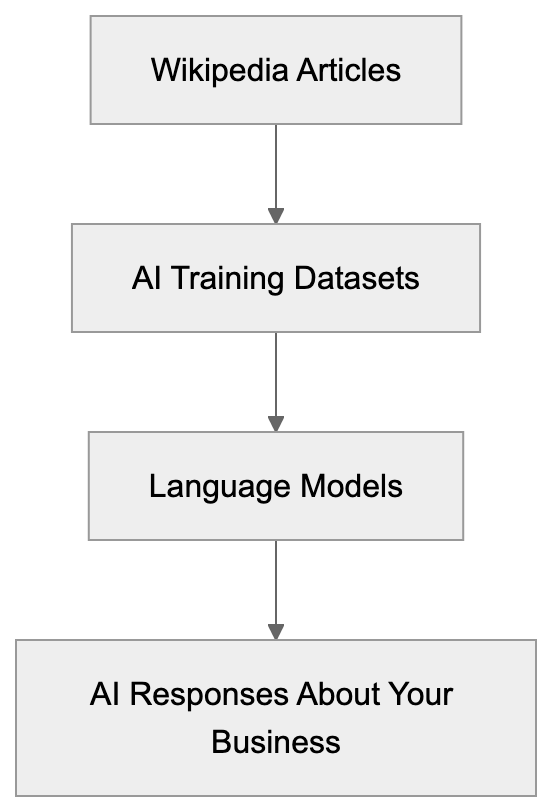
Once information appears on Wikipedia, it gets absorbed into AI training datasets. This creates a permanent imprint on how AI systems understand your business. If Wikipedia says your company was founded in 2015, AI models will repeat that date. If Wikipedia mentions a controversy, AI assistants will know about it. If Wikipedia describes your main product incorrectly, that error propagates to AI systems.
This creates both opportunities and risks. Accurate positive Wikipedia coverage means AI systems will provide accurate positive information about you. However, inaccurate or negative Wikipedia content means AI will spread those inaccuracies or negatives. You have limited control over this process.
If incorrect information appears on your Wikipedia page, you can request corrections following proper procedures. Post on the article’s talk page explaining the error and providing reliable sources for the correct information. Don’t edit the article directly if you have a conflict of interest. Wait for independent editors to review your request and make changes if warranted.
Some companies find their Wikipedia articles contain outdated information. Maybe your business pivoted or changed focus years ago, but the Wikipedia article still describes your old model. Getting this updated requires finding recent reliable sources that discuss your current business model. Without those sources, the old information stays.
Remember, AI models get trained on snapshots of Wikipedia from specific time periods. Even if you correct information today, AI systems trained on older data will still have the outdated version. This lag effect means errors can persist in AI knowledge for extended periods.
Comparing Wikipedia to Other Knowledge Platforms
Wikipedia isn’t the only platform influencing AI knowledge, but it’s by far the most significant. Here’s how it compares to alternatives.
Wikipedia Information Flow to AI Systems:

| Platform | AI Training Use | Editability | Notability Requirements | Business Focus |
|---|---|---|---|---|
| Wikipedia | Very High | Community edited | Very strict | Minimal |
| Wikidata | Very High | Community edited | Follows Wikipedia | Structured data |
| Crunchbase | Medium | Company submitted | Low | High |
| Medium | Self-edited | None | High | |
| DBpedia | High | Auto-generated from Wikipedia | Same as Wikipedia | Minimal |
Wikidata deserves special mention as a structured knowledge base maintained by the Wikimedia Foundation. AI systems use Wikidata extensively for factual information. Wikidata entries usually require a corresponding Wikipedia article, so the notability bar remains high.
Crunchbase allows companies to create and manage their profiles, making it easier for businesses to establish a Wikipedia presence, but the information carries less authority. AI systems may reference Crunchbase but weight Wikipedia more heavily for factual claims.
LinkedIn company pages are self-managed. Any business can create one, regardless of size or notability. AI systems scrape LinkedIn but treat it as less authoritative than Wikipedia. The self-reported nature of LinkedIn content makes it less reliable for training.
DBpedia extracts structured data from Wikipedia articles. It is a knowledge graph that AI systems query. If you’re on Wikipedia, you’re automatically in DBpedia. If you’re not on Wikipedia, you won’t be in DBpedia either.
Alternative Strategies for AI Visibility Without Wikipedia
Most businesses won’t qualify for Wikipedia, and that’s fine. You can still influence AI knowledge about your business through other channels. These approaches won’t have Wikipedia’s authority, but they’re realistic options.
- Earn legitimate press coverage: When reputable publications write about your business, AI systems will eventually encounter that content during training or retrieval. Quality journalism in established outlets carries weight even without a Wikipedia article.
- Contribute expert commentary: Engage with industry publications and publish original research or data that others cite. These activities create credible content about your business across the web.
- Maintain accurate structured data: Use schema markup to help AI systems understand key facts about your business, including founding date, location, products, and services.
- Build presence on industry-specific platforms: If you’re a tech startup, Crunchbase matters. If you’re in retail, industry trade publications matter. If you’re in professional services, LinkedIn matters. Different AI systems weigh different sources based on query context.
- Monitor AI systems’ descriptions: Test queries about your company across multiple AI assistants. Note any errors or outdated information and work to create authoritative content that corrects these issues. Eventually, improved information should propagate.
Consider that many AI systems now use retrieval-augmented generation. This means they search the web in real-time to supplement their training knowledge. Having a strong authoritative web presence helps, even if you’re not in the original training data. Clear, accurate information on your official channels gives AI systems better sources to cite.
Understanding the Long-term Implications
Wikipedia’s role in AI training will likely grow, not shrink. The Wikimedia-Kaggle partnership signals increased combining between the encyclopedia and AI development. More AI companies will use Wikipedia data, and more tools will be built to better use Wikipedia’s structured knowledge.
For businesses, this means the Wikipedia notability bar becomes increasingly important. Companies that clear this bar get permanent representation in AI knowledge. Companies that don’t remain dependent on less authoritative sources. This creates a knowledge divide where notable entities get consistent accurate AI representation, while others get inconsistent coverage.
The situation also raises questions about knowledge equity. Wikipedia’s notability standards favor certain types of organizations over others. Large corporations get coverage more easily than small businesses, and Western companies get more attention than businesses in other regions. English language sources dominate the notability evaluation.
As AI systems become more central to information discovery, these biases in Wikipedia get increased. If an AI assistant consistently provides detailed information about large companies but struggles with small businesses, that gap influences user behavior and market forces.
Some organizations are working to address these issues. The Wikimedia Foundation has programs to improve coverage of underrepresented topics, but fundamental notability requirements remain unchanged. The bar for inclusion stays high regardless of AI’s growing influence.
Practical Steps to Take Today
Even if you don’t qualify for Wikipedia presence, you should understand how the platform might affect your business. Start by searching for your company name on Wikipedia. If no article exists, that’s expected for most businesses. If an article does exist, read it carefully for accuracy.
Check if your industry or market has Wikipedia coverage. Are competitors mentioned? Are there articles about your industry segment? Understanding Wikipedia’s coverage of your space helps you gauge realistic expectations.
If you believe your business might qualify for Wikipedia, compile your evidence first. Gather links to substantial independent coverage in reliable sources. Be honest about whether these sources meet Wikipedia’s standards. A dozen press releases don’t equal one feature article in a major publication.
Never attempt to create a Wikipedia article about your own business. The risk of violating conflict of interest policies outweighs any potential benefit. If you genuinely meet notability standards, independent editors will eventually create an article. If you don’t meet standards, trying to force one will backfire.
Instead, focus on earning the type of coverage that would make you notable. Do newsworthy things, contribute to your industry, build relationships with journalists, and create products or services that warrant independent analysis. These activities have value beyond Wikipedia and might eventually lead to the coverage that establishes notability.
For most small businesses, the better strategy is accepting you won’t have Wikipedia visibility and improving other channels. Maintain excellent website content, earn quality backlinks, build authority in your niche, and provide accurate information everywhere your business appears online. These fundamentals matter for Wikipedia SEO even without Wikipedia.
Conclusion
Wikipedia AI plays an outsized role in shaping AI knowledge. With over 6.9 million English articles and direct partnerships for AI training datasets, the platform directly influences what AI systems know and say. However, strict notability requirements mean most businesses won’t qualify for coverage. Significant coverage in multiple independent reliable secondary sources is a high bar. Self-promotion and paid editing violate Wikipedia policies and usually backfire. For the small percentage of businesses that do meet notability standards, accurate Wikipedia information directly shapes AI understanding. For everyone else, focus on legitimate press coverage, structured data, and authoritative presence across relevant platforms. Wikipedia visibility isn’t achievable for most, but AI visibility through other channels remains possible with the right approach.
Frequently Asked Questions
How does Wikipedia impact AI systems?
Wikipedia serves as a crucial training source for AI models, as it provides a vast amount of structured, reliable information that these systems can process easily. The data from Wikipedia is integrated into various AI models, which influences how they generate responses or provide information about individuals and companies.
What are the notability requirements for a Wikipedia article?
To qualify for a Wikipedia article, a subject must have significant coverage in multiple independent, reliable secondary sources. This means that mere mentions in media or low-quality sources are insufficient; substantial, in-depth reporting from established publications is necessary.
What should I do if my business has outdated information on Wikipedia?
If you find inaccurate information about your business on Wikipedia, you can request corrections by posting on the article’s talk page. Be sure to provide reliable sources for the correct data and avoid directly editing the article if you have a conflict of interest.
Can I create a Wikipedia article about my own business?
No, writing your own Wikipedia article is strongly discouraged due to conflict of interest policies. Self-written articles are often deleted because they lack neutrality. It is better to collaborate with independent editors or submit a request through the Articles for Creation process if you believe your business meets notability criteria.
How can businesses improve their visibility in AI systems without a Wikipedia article?
Businesses can enhance their AI visibility by obtaining coverage in reputable publications, contributing expert commentary, maintaining accurate structured data, and establishing a presence on relevant industry platforms. Active engagement in generating credible content can ensure that AI systems reference accurate information about your business.
What steps can I take to assess whether my business qualifies for Wikipedia?
Start by searching for your business on Wikipedia to see if an article exists. If not, compile evidence of significant independent coverage from reliable sources that align with Wikipedia’s notability standards. Evaluate whether your coverage is substantive enough to warrant a page.
Why is Wikipedia considered more authoritative than other platforms like LinkedIn or Crunchbase for AI training?
Wikipedia is viewed as more authoritative because it relies on community editing and strict notability requirements, while platforms like LinkedIn allow anyone to self-publish content. As a result, information on Wikipedia is generally seen as more credible and is more heavily weighted by AI systems when generating knowledge.