AI Search Optimization: Guide to Answer Engines
Table of Contents
- AI Search Optimization: The Search Page Is Not What It Used to Be
- How AI Answer Engines Process Your Content for Answer Engine Optimization
- Entity Clarity for AI Search Optimization: Tell the Machine Exactly Who You Are
- Citation-Worthiness: What Makes AI Engines Pick Your Page
- Structured Data for AI Systems That Actually Matters
- Comparison Pages and Content Formats That Get Cited
- Controlling AI Agents Crawling and Content Access
- Measuring Visibility When Clicks Disappear
- Quick Action Checklist
- Wrapping Up
- AI Search Optimization: The Search Page Is Not What It Used to Be
- How AI Answer Engines Process Your Content for Answer Engine Optimization
- Entity Clarity for AI Search Optimization: Tell the Machine Exactly Who You Are
- Citation-Worthiness: What Makes AI Engines Pick Your Page
- Structured Data for AI Systems That Actually Matters
- Comparison Pages and Content Formats That Get Cited
- Controlling AI Agents Crawling and Content Access
- Measuring Visibility When Clicks Disappear
- Quick Action Checklist
- Wrapping Up
AI Search Optimization: The Search Page Is Not What It Used to Be
AI search improvement now decides whether your content gets seen, cited, or skipped. Google’s AI Overviews now sit above organic results for roughly 47% of queries in the US. ChatGPT search processes over 37.5 million queries per day as of early 2025. Perplexity answers millions more with cited sources. Gemini is baked into Android and Google Workspace.
The old rank-click-traffic loop is breaking. AI search improvement is now about making your content readable, citable, and trustworthy to machines that summarize answers before users ever see your link. This guide covers how answer engines read your site, how generative engine improvement works, and what to measure when clicks matter less.
TL;DR: If you run a SaaS product, a small business site, or handle technical SEO for clients, focus on entity clarity, structured data for AI, citation-worthiness, and clean answers that AI systems can extract.
How AI Answer Engines Process Your Content for Answer Engine Optimization
When an AI answer engine encounters your page, It’s not the same as Googlebot indexing.
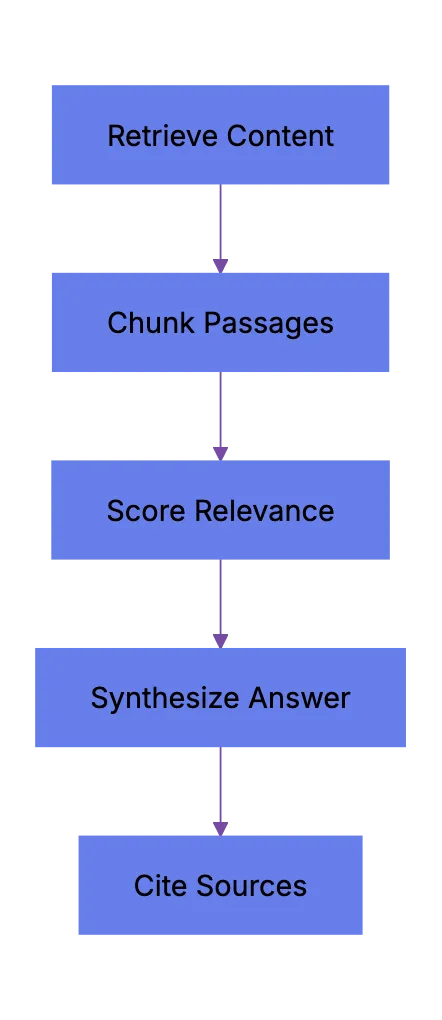
AI Answer Engine Processing Flow:
Traditional search crawlers parse HTML, follow links, and index keywords. AI answer engines retrieve content, They retrieve content, chunk it into passages, score those passages for relevance, then synthesize an answer. Your page might contribute one sentence to a response. Or zero.
Major systems work like this:
| Engine | Crawler/Agent | How It Uses Your Content | Citation Style |
|---|---|---|---|
| Google AI Overviews | Googlebot | Pulls from indexed pages, Knowledge Graph | Links to source pages inline |
| ChatGPT Search | OAI-SearchBot | Retrieves via Bing index + direct browsing | Numbered citations with URLs |
| Perplexity | PerplexityBot | Crawls directly + use search APIs | Inline numbered citations |
| Gemini | Google-Extended | Uses Google index + grounding with Search | Sometimes links, sometimes not |
| Claude | No live search (as of mid-2025) | Training data only | No live citations |
The keys difference from traditional SEO: these systems care about passage-level quality, not page-level quality. A single clear paragraph that directly answers a question can get cited. A 5,000-word page with buried answers probably won’t.
Entity Clarity for AI Search Optimization: Tell the Machine Exactly Who You Are
Most sites fail here first. AI answer engines need to understand what entity your page is about. Not just keywords: entities.
An entity is a distinct thing. A company, a product, a person, a concept. Google’s Knowledge Graph has over 8 billion entities. When an AI overview assembles an answer about “best project management tools,” it pulls from entities it recognizes and trusts.
To make your entity clear:
-
Use consistent naming everywhere. Your product name should be identical on your homepage, your About page, your schema markup, and your social profiles. No variations.
-
Add Organization and Product schema markup. This JSON-LD structured data tells machines exactly what your entity is.
-
Claim and complete your Google Business Profile, Wikipedia entry (if notable enough), Wikidata entry, and Crunchbase profile. These are the sources AI systems cross-reference.
-
Include a clear one-sentence definition of what your product or company does on every keys page. Write it like a dictionary entry. Machines love that.
Good entity clarity looks like this:
- Homepage H1: “Acme is a project management platform for remote teams”
- Schema tpye:
SoftwareApplicationwithapplicationCategory,operatingSystem,offers - About page: First paragraph restates the definition with founding year and headquarters
Entity Clarity Stack:
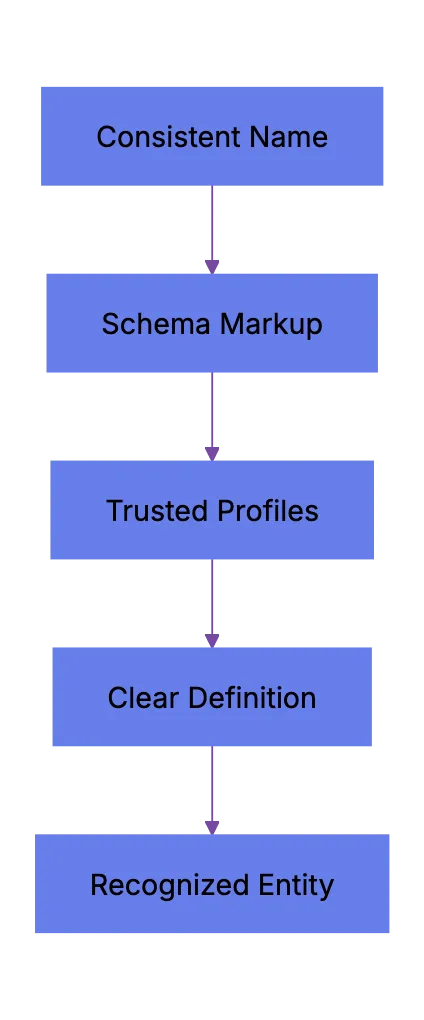
If an AI engine can’t figure out what you are in the first 200 words, you’re probably not getting cited.
Citation-Worthiness: What Makes AI Engines Pick Your Page
Answer engine improvement comes down to citation-worthiness: whether your content is worth citing. AI wants authoritative, specific, current content.
Princeton’s GEO study and AI Overview patterns suggest these factors increase citation likelihood:
- Specificity: Pages with actual numbers, dates, and named sources get cited more. “Revenue grew 34% in Q2 2025” beats “revenue grew significantly.”
- Freshness: Content updated within the last 90 days gets preferred in AI Overviews for time-sensitive queries. Perplexity explicitly shows publication dates.
- Direct answers: If someone asks “what is answer engine improvement,” the page that starts with a clean definition in the first paragraph wins. Not the page that takes 400 words to get there.
- Author authority: Pages with clear author bylines, author schema, and linked author profiles on the same domain score better. Google’s EEAT framework feeds directly into AI Overview source selection.
- Unique data or perspective: If your page says the same thing as 50 others, there’s no reason to cite yours. Original research, proprietary data, or expert commentary makes you the source others can’t replace.
Citation Selection Factors:
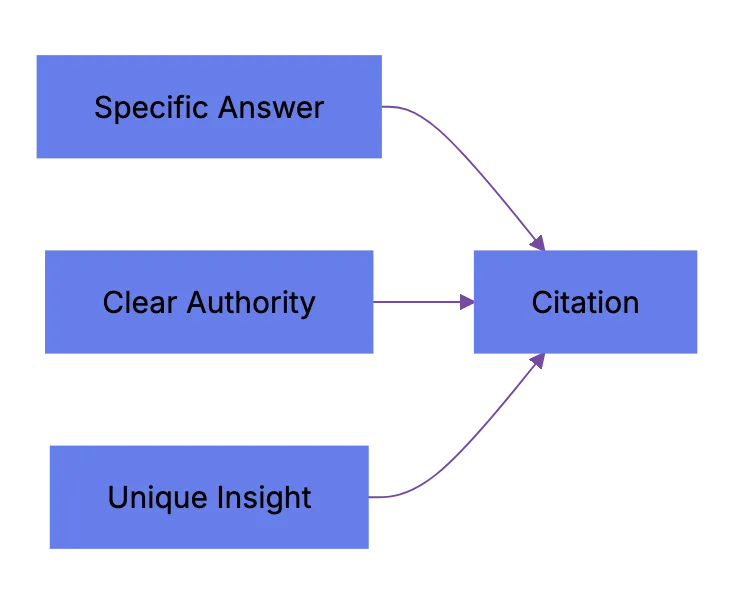
AI needs to justify its answer. Your content is the receipt. Make it easy to grab.
Structured Data for AI Systems That Actually Matters
Structured data now does more than power rich snippets. It helps AI systems parse your content accurately.
These schema types matter most for generative engine improvement and structured data for AI:
| Schema Type | When to Use | Why It Helps AI |
|---|---|---|
FAQPage |
Q&A content | Maps questions to answers directly |
HowTo |
Step-by-step guides | Structures procedural content |
Article + author |
Blog posts, guides | Establishes authorship and dates |
Product |
SaaS product pages | Price, features, ratings in one place |
Organization |
About/homepage | Entity recognition |
SpeakableSpecification |
Keys content blocks | Tells voice assistants which text to read |
Review / AggregateRating |
Product pages | Provides social proof data points |
Commonly overlooked details:
dateModifiedmatters. Update it when you actually update content. AI systems use this to assess freshness.sameAslinks on your Organization schema should point to your official social profiles and Wikipedia/Wikidata entries. This helps AI cross-reference your entity.- Don’t spam schema. Adding FAQ schema to pages that aren’t actually FAQs will hurt you. Google has been penalizing misuse since late 2023.
The SpeakableSpecification schema is underused. It marks sections as suitable for text-to-speech and AI voice responses. If you want your content read aloud by Google Assistant or similar, add it.
Comparison Pages and Content Formats That Get Cited
Comparison pages are gold for AI Overviews SEO, Perplexity SEO, and ChatGPT search improvement. When someone asks “Notion vs Asana” or “best CRM for small business,” AI systems need structured comparison data and tables.
What works:
- Create dedicated comparison pages with clear H2s naming both products.
- Include a comparison table with specific features, pricing, and ratings. Not vague stuff. Actual plan prices and feature availability.
- Add a clear verdict or recommendation paragraph. AI systems often cite the end.
- Update these pages quarterly. Pricing changes, features ship, and stale comparison pages get dropped from citations.
Beyond comparisons, these formats perform well in AI search results and answer engine improvement:
- Definition pages: “What is [term]” with a clean first-paragraph answer
- Statistics roundups: Pages collecting verified stats with sources
- How-to guides: Step-numbered procedures with clear outcomes
- Pros and cons lists: Structured evaluations with specifics
The common thread is structure. AI engines parse structured content better than flowing prose. That means your keys information should be scannable and extractable without sounding like a robo.
Write for two audiences at once: humans who read and machines that extract. The best content works for both.
Controlling AI Agents Crawling and Content Access
Not every business wants AI engines training on or citing their content, so AI crawling policies matter.
Main mechanisms:
- robots.txt: You can block specific AI crawlers.
User-agent: [GPTBot](https://platform.openai.com/docs/gptbot)blocks OpenAI’s training crawler.User-agent: OAI-SearchBotblocks ChatGPT Search specifically. - Google-Extended: Blocking this in robots.txt prevents your content from being used by Gemini and AI Overviews training, ,but it does NOT remove you from AI Overviews sourced from regular Google Search.
- X-Robots-Tag: You can add
noaiornoimageaiheaders, though enforcement varies by engine.
Blocking AI crawlers also costs citation opportunities. If you block GPTBot, ChatGPT Search can’t cite you. If you block PerplexityBot, Perplexity can’t featrue you.
| Crawler | Company | Purpose | What Blocking Does |
|---|---|---|---|
GPTBot |
OpenAI | Training data | Blocks training, NOT ChatGPT Search |
OAI-SearchBot |
OpenAI | ChatGPT Search | Blocks search citations |
PerplexityBot |
Perplexity | Search + indexing | Blocks all Perplexity citations |
Google-Extended |
Gemini training | Blocks training, NOT AI Overviews | |
ClaudeBot |
Anthropic | Training data | Blocks Claude training |
Bytespider |
ByteDance | Training data | Blocks TikTok/ByteDance AI training |
Most SaaS companies and businesses should probably NOT block these crawlers because visibility matters. ,but if you have premium content behind a paywall, blocking training crawlers while allowing search crawlers makes sense.
Measuring Visibility When Clicks Disappear
Traditional SEO metrics like click-through rate and organic sessions no longer show the full picture. Your brand might appear in an AI Overview that satisfies the user completely. Zero clicks, ,but real visibility.
What to track:
- Google Search Console: Check the “Search appearance” filter for AI Overviews. Google started showing this data in 2024. You can see impressions where your page was cited in an AI Overview.
- Brand search volume: If AI engines mention your brand in answers, branded searches should increase over time. Track this monthly.
- Referral traffic from AI sources: Check your analytics for traffic from
chat.openai.com,perplexity.ai, and similar domains. This is small ,but growing. - Third-party AI visibility tools: Tools like Otterly, Peec AI, and dwep (now seo.ai) track how often your brand appears in AI-generated answers across multiple engines.
| Metric | Tool | What It Tells You |
|---|---|---|
| AI Overview citations | Google Search Console | How often you appear in Google AI answers |
| AI engine referral traffic | GA4 / analytics | Direct visits from AI chat interfaces |
| Brand mention in AI answers | Otterly, Peec AI | Cross-engine brand visibility |
| Branded search trend | GSC, SEMrush | Indirect demand from AI exposure |
| Content freshness score | Screaming Frog + custom | How current your cited pages are |
AI Visibility Measurement Loop:
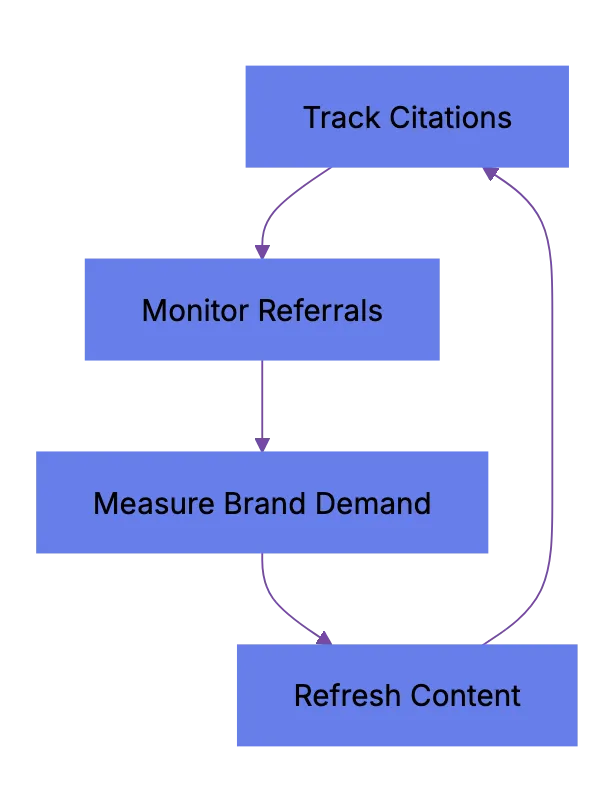
Measurement is still messy. No single dashboard shows total AI search visibility across all engines. That will probably change by late 2026. For now, combine these signals and track trends.
Quick Action Checklist
To start AI search improvement today:
| Priority | Action | Time to put in place |
|---|---|---|
| High | Add Organization + Product schema to keys pages | 1-2 hours |
| High | Rewrite first paragraphs to directly answer target queries | 2-4 hours |
| High | Update dateModified on all recently edited pages |
30 minutes |
| Medium | Create comparison tables for your top 5 competitor queries | 1-2 days |
| Medium | Set up AI referral traffic tracking in GA4 | 1 hour |
| Medium | Add author schema with linked author pages | 2-3 hours |
| Low | Audit robots.txt for AI crawler policies | 30 minutes |
| Low | Add SpeakableSpecification to keys content blocks |
1-2 hours |
Start with the high priority items. They have the biggest impact for the effort.
Wrapping Up
AI search improvement in 2026 means making content machine-readable, citation-worthy, and entity-clear. Google AI Overviews, ChatGPT Search, Perplexity, and Gemini process content differently ,but prefer the same things: structured data, specific answers, fresh content, and clear authority signals.
The click isn’t dead, ,but it’s no longer guaranteed. Answer engine improvement means your content must work when summarized, extracted, or paraphrased by AI. Be the source machines trust and cite.
Frequently Asked Questions
What is AI search improvement?
AI search improvement is the practice of making content easier for AI answer engines to understand, summarize, and cite. It focuses less on ranking alone and more on clear entities, structured data, direct answers, and trustworthy source signals.
How is AI search improvement different from traditional SEO?
Traditional SEO often focuses on rankings, clicks, and page-level signals. AI search improvement also considers whether individual passages can be extracted and used in generated answers. A clear paragraph, table, or definition may matter more than a long page with buried information.
What should I update first on my website?
Start with your highest-value pages, such as your homepage, product pages, comparison pages, and top informational articles. Add clear entity descriptions, Organization or Product schema, direct first-paragraph answers, and accurate dateModified fields. These changes are practical and usually have a strong impact relative to effort.
Should I block AI crawlers in robots.txt?
Most businesses that depend on visibility should be cautious about blocking AI crawlers because it can reduce citation opportunities. Blocking may make sense for premium, private, or paywalled content. A practical approach is to distinguish between training crawlers and search crawlers so you can protect content while still allowing discoverability where appropriate.
Do FAQ sections help with AI search visibility?
FAQ sections can help when they answer real user questions clearly and concisely. They make keys information easier for AI systems to parse, especially when paired with appropriate structured data. ,but, FAQ content should be genuinely useful and not added only to manipulate search results.
How can I tell if AI search is sending value if clicks are lower?
Track a mix of signals instead of relying only on organic sessions. Useful indicators include AI Overview impressions in Google Search Console, referral traffic from AI platforms, branded search growth, and third-party AI visibility reports. The goal is to measure visibility, citations, and demand creation, not just visits.
How often should AI-improved content be refreshed?
Time-sensitive pages, such as comparisons, pricing guides, statistics pages, and market updates, should be reviewed at least quarterly. Evergreen pages can be updated less often, ,but they should still show accurate dates, sources, and examples. Freshness matters most when users expect current information.
History
- May 19, 2026 — Published by AICW Content Team
- May 19, 2026 — Reviewed by Eugene Mi
- May 19, 2026 — Last updated by AICW Content Team.