JSON-LD Schema Markup for AI Visibility Guide
Learn how to make content machine-readable for AI systems using JSON-LD schema markup. Includes code examples, validation tools, and implementation tips.
Table of Contents
- What is JSON-LD Schema Markup
- Why JSON-LD Schema Exists
- How Businesses Use Schema Markup
- Important Implementation Details
- Priority Schema Types for AI Visibility
- JSON-LD Code Examples
- Validation Tools for Schema Markup
- How Structured Data Helps AI Systems
- Comparison of Schema Markup Tools
- Common Schema Markup Mistakes
- Schema Markup and AI Training Data
- Future of Structured Data and AI
- Putting in Place Schema Across Your Site
- Conclusion
- What is JSON-LD Schema Markup
- Why JSON-LD Schema Exists
- How Businesses Use Schema Markup
- Important Implementation Details
- Priority Schema Types for AI Visibility
- JSON-LD Code Examples
- Validation Tools for Schema Markup
- How Structured Data Helps AI Systems
- Comparison of Schema Markup Tools
- Common Schema Markup Mistakes
- Schema Markup and AI Training Data
- Future of Structured Data and AI
- Putting in Place Schema Across Your Site
- Conclusion
What is JSON-LD Schema Markup
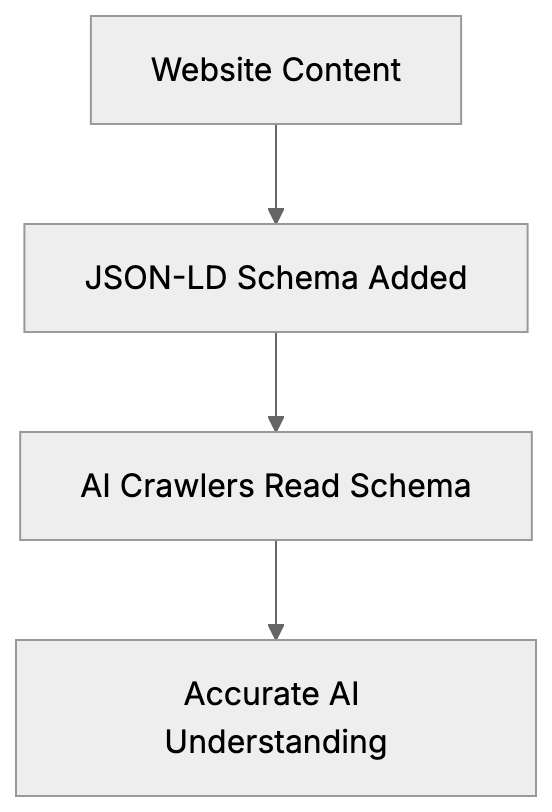
JSON-LD schema markup is a method to make your website content machine-readable. Think of it as a translation layer between your human-friendly content and what AI systems and search engines can understand. Incorporating JSON-LD into your pages allows you to inform AI crawlers exactly what your content is about, bypassing the need for interpretation.
This markup utilizes a standardized vocabulary from schema.org AI. This vocabulary defines elements like articles, products, events, people, and organizations. AI systems and search engines rely on this structured data AI to better understand your content and represent it accurately in their systems.
Why is this more critical now than ever? AI chatbots and search engines are constantly crawling the web to understand what businesses do, what articles cover, and how content helps users. Without structured data, AI systems have to guess based solely on your text. With JSON-LD schema, you provide clear signals about your content’s meaning and purpose.
Why JSON-LD Schema Exists
How JSON-LD Schema Works:
The web was built for humans to read with headings, paragraphs, images, and links. However, machines don’t see pages the way we do; they see HTML tags and text strings without context.
Schema markup AI was developed to address this challenge. It provides machines with a standardized way to comprehend content. Instead of machines deciphering whether a block of text is a product description or a blog post, they can simply read the schema.
JSON-LD uses JavaScript Object Notation for Linked Data, making it more straightforward than older formats like Microdata or RDFa. You can just drop a script tag into your page without altering your HTML structure, keeping it clean and less prone to breakage.
Search engines like Google encouraged structured data to improve search results, aiming to showcase rich snippets with ratings, prices, and event dates. Now, AI systems employ the same data to extract precise information for chatbot responses and AI-generated summaries. The purpose has expanded beyond search, encompassing the broader AI ecosystem.
How Businesses Use Schema Markup
Businesses incorporate JSON-LD schema to enable AI systems to understand their content and represent it accurately. For instance, a company might add Organization schema to define its name, logo, social profiles, and contact information, assisting AI chatbots in answering business-related questions correctly.
Content publishers use Article and NewsArticle schema on blog posts, informing AI systems about the headline, author, publish date, and article body. When an AI chatbot references your article, it can correctly cite the author and date.
E-commerce sites heavily rely on Product schema to mark up product names, prices, availability, ratings, and reviews, assisting AI shopping assistants in helping users compare products and make purchase decisions.
Educational platforms use Course schema to mark up their learning content. Marking up at least three courses allows Google to display them in a carousel format. AI systems can also recommend courses based on structured information about topics, instructors, and difficulty levels.
Service businesses use LocalBusiness schema to mark up their location, hours, service areas, and contact details, enabling AI assistants to answer questions like “What time does this business open?” or “Where is this company located?”
Important Implementation Details
Developers often overlook a crucial detail: AI crawlers cannot execute JavaScript in most cases. If your JSON-LD schema is added via client-side JavaScript, AI bots might not see it at all. The schema must be server-side rendered and present in the initial HTML response.
Thus, if you’re using a JavaScript framework like React or Vue, ensure the schema is rendered on the server or included in your static HTML. Client-side insertion after page load won’t work for many AI crawlers.
Schema Implementation Process:

The schema should be placed in a script tag with type application/ld+json, ideally in the head or body of your HTML. Most developers put it in the head section for consistency.
Validation is crucial; broken JSON or incorrect schema properties will cause AI systems to ignore your markup. Always validate before deploying to production.
Priority Schema Types for AI Visibility
Not all schema types hold equal significance. Here’s what matters most for AI visibility schema today.
Organization Schema defines your business identity, including your official name, logo, URL, social media profiles, and contact information, essential for AI systems to comprehend your brand.
Article and NewsArticle Schema mark up your blog content with headline, author, datePublished, dateModified, and articleBody, enabling AI systems to quote your content accurately and understand publication timelines.
HowTo Schema suits step-by-step guides perfectly, allowing you to mark up each step with text, images, and supply lists. AI assistants love using HowTo schema for procedural questions.
FAQPage Schema marks up question-and-answer pairs. If your site has FAQ sections, this schema helps AI systems extract exact Q&A pairs for responses.
Course Schema is essential for educational content. At least three courses must be marked up to qualify for Google’s course carousel, including name, description, provider, and courseMode.
JSON-LD Code Examples
Here’s a basic Organization schema example:
{
 "@context": "https://schema.org",
 "@type": "Organization",
 "name": "Example Company",
 "url": "https://example.com",
 "logo": "https://example.com/logo.png",
 "sameAs": [
 "https://twitter.com/example",
 "https://linkedin.com/company/example"
 ]
}
Here’s an Article schema example:
{
 "@context": "https://schema.org",
 "@type": "Article",
 "headline": "Guide to Schema Markup",
 "author": {
 "@type": "Person",
 "name": "John Smith"
 },
 "datePublished": "2024-01-15",
 "dateModified": "2024-01-20",
 "publisher": {
 "@type": "Organization",
 "name": "Example Company",
 "logo": {
 "@type": "ImageObject",
 "url": "https://example.com/logo.png"
 }
 }
}
Here’s a HowTo schema example:
{
 "@context": "https://schema.org",
 "@type": "HowTo",
 "name": "How to Bake Bread",
 "step": [
 {
 "@type": "HowToStep",
 "name": "Mix ingredients",
 "text": "Combine flour, water, yeast, and salt in a bowl"
 },
 {
 "@type": "HowToStep",
 "name": "Knead dough",
 "text": "Knead for 10 minutes until smooth"
 }
 ]
}
FAQPage schema looks like this:
{
 "@context": "https://schema.org",
 "@type": "FAQPage",
 "mainEntity": [
 {
 "@type": "Question",
 "name": "What is schema markup?",
 "acceptedAnswer": {
 "@type": "Answer",
 "text": "Schema markup is structured data that helps search engines understand your content."
 }
 }
 ]
}
Validation Tools for Schema Markup
Validating your JSON-LD before it goes live is crucial. Two main tools address this task.
Google Rich Results Test verifies if your schema qualifies for rich results AI in Google Search. Access it at Google Rich Results Tool and enter your URL or paste your code. It highlights warnings and errors specific to Google’s requirements.
Schema.org Validator at Schema.org Validator checks against official schema.org specifications. It’s stricter than Google’s tool and catches more technical errors. Use both tools to ensure your markup is solid.
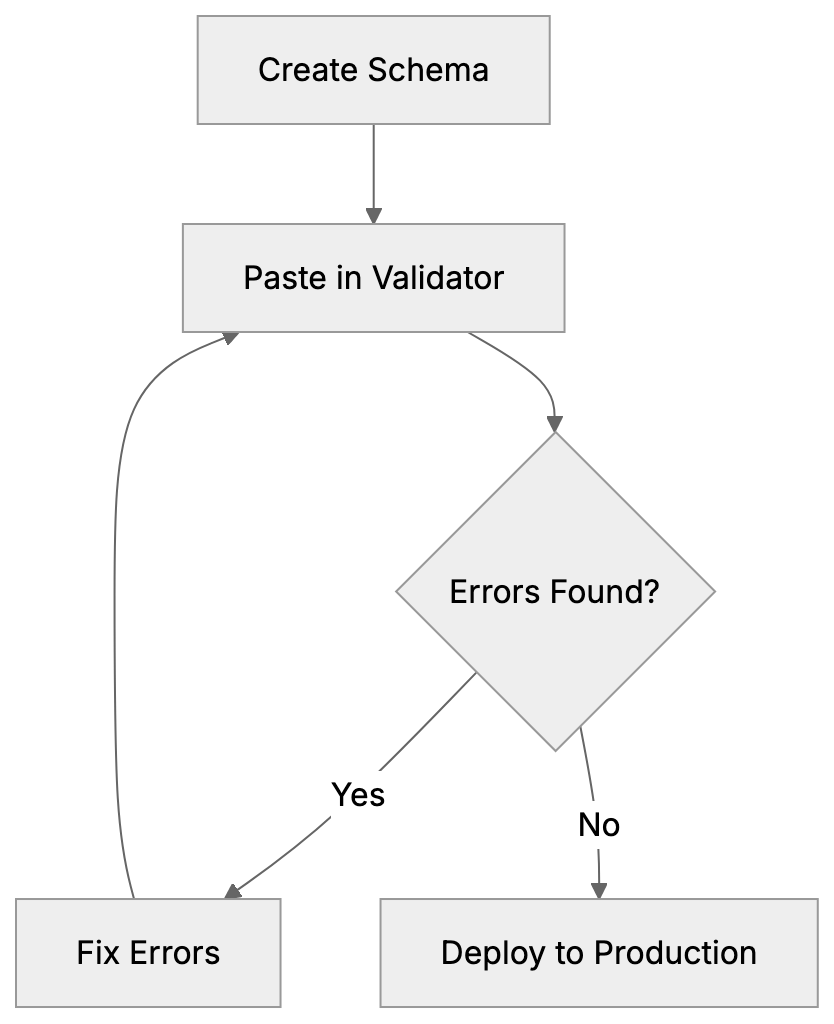
The validation process is straightforward: paste your JSON-LD code or enter your page URL. The tool parses the schema and reports any syntax errors, missing required properties, or incorrect value types. Correct all errors before deploying.
Some errors are critical and will cause AI systems to ignore your schema entirely. Others are warnings about recommended properties. Focus on fixing errors first, then address warnings to increase effectiveness.
How Structured Data Helps AI Systems
Schema Markup Validation Workflow:
When AI systems crawl your site, they’re searching for signals about your content’s meaning. Without schema markup, they rely on natural language processing to derive meaning from your text, an approach that is functional but not flawless.
With JSON-LD schema, AI systems receive explicit information. They instantly know that this page is an article published on a specific date by a certain author, or that it describes a product with definite price and features. Interpretation becomes unnecessary.
This leads to more accurate AI responses. When ChatGPT or another AI assistant references your content, it can accurately cite the correct author, date, and source. When an AI shopping assistant discusses your product, it quotes the correct price and availability.
Structured data also assists AI systems in categorizing and indexing your content accurately. It helps them understand relationships between entities, like an individual working for an organization or an article being part of a series.
The semantic markup creates a network of connected data for AI systems to navigate, which is vital as AI progresses beyond simple keyword matching to understanding context and relationships.
Comparison of Schema Markup Tools
Several tools assist in generating and managing schema markup. Here’s a brief comparison:
| Tool | Type | Price | Best For | Server-Side |
|---|---|---|---|---|
| Schema.org | Reference | Free | Learning official specs | N/A |
| Structured Data Markup Helper | Generator | Free | Quick schema creation | No |
| Schema Markup Generator by Merkle | Generator | Free | Technical SEO work | No |
| Yoast SEO | WordPress Plugin | Free/Paid | WordPress sites | Yes |
| Rank Math | WordPress Plugin | Free/Paid | WordPress automation | Yes |
| Schema App | SaaS Platform | Paid | Enterprise deployment | Yes |
| JSON-LD Schema Generator | Online Tool | Free | Manual code generation | No |
Starting with the free Google Schema Markup Helper is sensible for most developers. It guides you through creating basic schema types and generates the JSON-LD code.
WordPress users should consider using Yoast SEO or Rank Math. These plugins automatically generate schema for posts, pages, and custom post types, handling server-side rendering correctly.
Enterprise sites with complex schema requirements might benefit from Schema App, offering a visual editor and deployment tools but at a subscription cost.
The key consideration is whether the tool produces server-side rendered schema. Client-side tools that inject schema via JavaScript are ineffective for AI crawlers.
Common Schema Markup Mistakes
Many sites implement schema markup but make mistakes that undermine its effectiveness. Here are common issues:
Client-side rendering is the biggest issue. Adding schema via JavaScript after page load means AI crawlers might miss it altogether. Always render schema server-side in the initial HTML.
Invalid JSON syntax disrupts the entire schema block. A missing comma, extra bracket, or unescaped quote can cause parsers to reject everything. Always validate before deploying.
Missing required properties result in incomplete schema. Each schema type has mandatory fields. Article requires a headline and datePublished, Product needs a name and offers. Consult schema.org AI for requirements.
Incorrect property values occur when using the wrong data type. Dates should be in ISO 8601 format like 2024-01-15. URLs should be absolute, not relative. Numbers should be numeric, not strings.
Duplicate schema blocks from multiple plugins or manual additions create confusion. AI systems might not know which one to trust. Audit your pages for clean, single schema blocks.
Marking up invisible content violates guidelines. Don’t add schema for content users can’t see on the page. This is deceptive and can lead to penalties.
Schema Markup and AI Training Data
AI models train on web data, including schema markup. When AI systems learn about the structure of articles, products, or businesses, they learn partly from schema markup patterns.
This means proper schema helps not just AI systems understand your specific content but also contributes to training better AI models that grasp structured information.
As more sites adopt schema markup, AI systems improve in recognizing and utilizing structured data. This creates a positive feedback loop where better markup leads to better AI understanding.
For content creators, this means schema markup is an investment in long-term AI visibility. Sites with clean, complete schema will likely rank better in AI-generated responses and recommendations.
Future of Structured Data and AI
The importance of schema markup will only increase as AI systems become more prevalent. AI assistants, chatbots, and search engines all rely on structured data to provide accurate responses.
New schema types are being crafted specifically for AI use cases, leading to more detailed schemas for elements like AI training datasets, model information, and AI-generated content labels.
The transition from keyword-based search to AI-generated answers makes schema even more crucial. When an AI forms an answer instead of listing links, it needs structured data to cite sources accurately and extract correct information.
Voice assistants and smart devices also depend on schema markup. When someone queries Alexa about your business hours or Siri about your product price, the answer derives from structured data.
Putting in Place Schema Across Your Site
Begin with your most crucial pages. Add Organization schema to your homepage. Implement Article schema for blog posts and Product schema for product pages if your site is e-commerce.
Create templates to automatically incorporate schema into new content. Most CMS platforms and frameworks support schema templates, ensuring consistency and reducing manual effort.
Monitor your schema in Google Search Console. The Enhancements section displays which schema types Google found and any errors or warnings. Address issues as they arise.
Update schema when content changes. If you update an article, modify the dateModified field. If product prices change, update the offers section. Outdated schema is worse than none.
Test new schema implementations before going live. Use staging environments and validation tools to catch issues early.
Conclusion
JSON-LD schema markup is essential for making your content comprehensible to AI systems. It offers structured data that AI crawlers can read and interpret accurately. Prioritize implementing key schema types such as Organization for business identity, Article for blog content, HowTo for guides, FAQPage for Q&A sections, and Course for educational material.
Remember, AI crawlers cannot execute JavaScript, so your schema must be server-side rendered in the initial HTML. Use validation tools like Google Rich Results Test and validator.schema.org to ensure your setup is correct. Avoid common mistakes such as client-side rendering, invalid JSON, and missing required properties.
As AI systems become more integral to how people find and consume information, proper schema markup becomes essential for visibility. Sites with clean, complete structured data will have a distinct advantage in AI-generated responses and recommendations. Start implementing schema on your most critical pages today and expand from there.
Frequently Asked Questions
What are the benefits of using JSON-LD schema markup?
Using JSON-LD schema markup enhances the machine readability of your content, allowing search engines and AI systems to understand and accurately represent it. This can lead to improved visibility in search results and more informative AI responses that cite your content correctly.
How can I validate my JSON-LD schema?
You can validate your JSON-LD schema using tools like the Google Rich Results Test or the Schema.org Validator. These tools check for syntax errors and ensure compliance with required properties, helping to identify issues before implementation.
What types of businesses should use schema markup?
All types of businesses can benefit from schema markup, especially those with online content or products. E-commerce sites, service providers, and content publishers, in particular, can enhance their visibility and improve interactions with AI systems.
Can schema markup improve my SEO?
Yes, schema markup can improve your SEO by making your content more understandable to search engines, potentially leading to higher rankings. While it doesn’t guarantee higher rankings, the structured data can contribute to better visibility and enhanced rich snippets in search results.
What common mistakes should I avoid when implementing schema markup?
Common mistakes include client-side rendering of schema, which AI crawlers often miss, and syntax errors in JSON that can invalidate the entire markup. Additionally, ensure you mark up visible content only and avoid duplicating schema blocks.
Where should I place my JSON-LD schema markup?
JSON-LD schema should be placed within a tag of type ‘application/ld+json’, preferably in the head or body section of your HTML. Many developers choose the head for organizational consistency.
Will using JSON-LD schema require ongoing maintenance?
Yes, you should regularly update your schema as content changes, including modifications to articles, products, or services. Regular validation and monitoring for errors in tools like Google Search Console are essential to maintain effectiveness.